
Editorial update, 12 October 2026: The title and opening have been revised following David Hockney’s death on 11 June 2026, recorded in LACMA’s memorial. The original publication date is retained.
David Hockney’s legacy is difficult to reduce to a ranking. A more useful question is what his work changed about the way we look. He returned to portraits, pools and landscapes over decades, testing how colour, scale and viewpoint alter a familiar subject. The results do not all look alike. They do share a willingness to start again.
What makes a case for Hockney?
Longevity alone is insufficient. The stronger case lies in the connections between media that are often described separately: painting, printmaking, photography and digital drawing. A photographic joiner assembles more than one moment into a single image. A landscape made on a tablet can record changes of light across a day or season. A lithograph of a friend asks what a few marks can reveal about a person. Each uses a different tool to challenge the idea that a fixed viewpoint is the whole story.
That range also makes simple rankings unhelpful. A viewer might value Hockney’s experiments with space; another might turn to Gerhard Richter’s relationship with photography or to an artist whose practice addresses different social questions. These are not scores on a common scale. We can, however, point to particular Hockney works and explain what their decisions make possible.
The California pool: an image built from absence
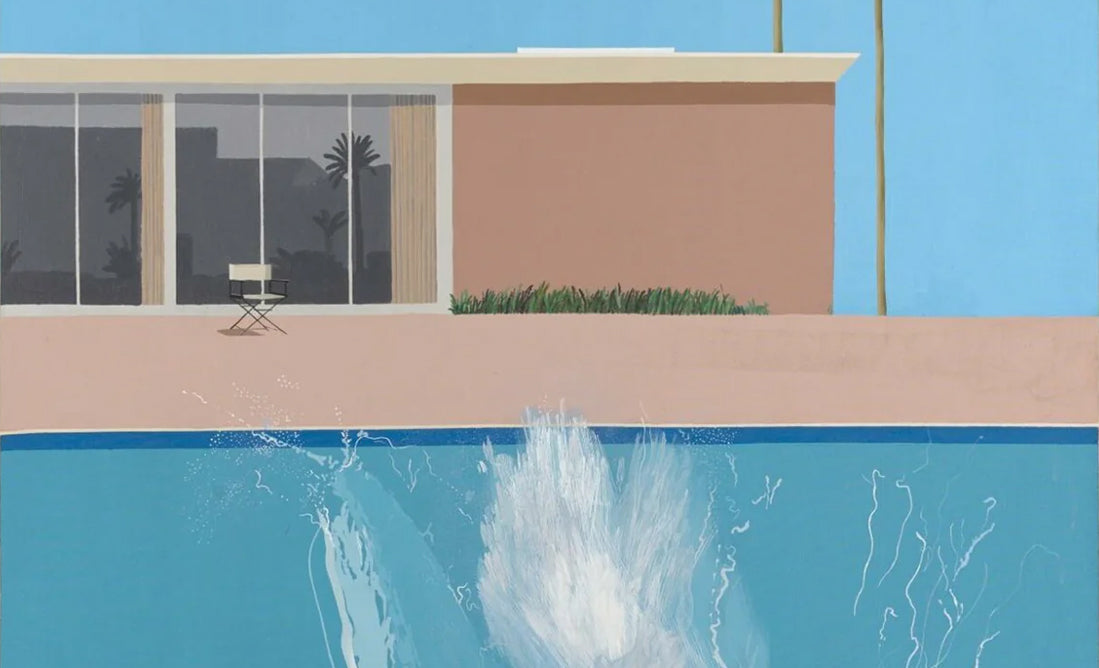
A Bigger Splash of 1967 is famous for a swimmer who is not there. We see the disturbance in the water, but no diving body. Hard architectural lines and the flat pool surface hold an instant that would vanish in seconds. The image balances a calm setting against the evidence that something has just happened. Its precision is more interesting than a general claim that the painting celebrates California.
The pool paintings also show how Hockney could use a recognisable subject to make painting itself the question. How can a still image represent moving water? What happens when sunlight, reflection and a geometric building occupy the same plane? The answers vary from one composition to another. Tate’s account of A Bigger Splash identifies the 1967 work and the implied diver; those details matter more than repeating the image’s fame.
Portraits and the space between people
Hockney’s portraits give relationships a physical shape. Mr and Mrs Clark and Percy, painted in 1970–71, places Celia Birtwell and Ossie Clark in a room where position, gaze and the space between them do much of the work. The viewer is invited to notice not only who is depicted, but how the arrangement holds two people together and apart.
Printed portraits create a different encounter. In Celia Adjusting Her Eyelash, the title directs our attention to a small action. In An Image of Gregory, a familiar sitter becomes a reason to look again at how a likeness is constructed. Compare the treatment of line and surrounding space before assuming that portraits of the same person will feel alike. The exact edition and medium belong to the individual catalogue entry.

More than one way to see a place
The Yorkshire landscapes are often set against the California paintings as though they were a return to nature after years of artifice. That misses the construction in both. A road can pull the eye around a bend. A repeated tree can set a rhythm. Colour can mark a season without recording every botanical fact. Hockney’s landscape is a worked-out experience of looking, not an unmediated view.
He used both painting and digital drawing in this period. The Royal Academy’s 2012 exhibition A Bigger Picture brought large-scale East Yorkshire landscapes together with iPad drawings. It was a 2012 exhibition, and the media shown should not be collapsed into a claim that the paintings were made on an iPad. The gallery’s The Arrival of Spring in Woldgate, East Yorkshire in 2011 offers a specific object through which to consider the subject; its catalogue details should be read on their own terms.

New tools, persistent questions
The iPhone and iPad did not replace Hockney’s earlier interests. They gave him a portable surface on which to draw and revise. A screen can be used quickly, but speed does not tell us whether an image is attentive. Look at how a branch, a road or a change in weather is organised within the frame. The question remains how a viewer can be made to spend time with a scene.
Printmaking presents another set of choices. A printed image has a particular process, support, scale and publication history. The same subject can appear as an original edition, a book illustration or an exhibition poster, and those forms should not be described as equivalents. Our collecting guide sets out the distinctions; the printmaking essay follows the changes in method.
A related example in the catalogue, The Skater, shows why format deserves attention. The Sarajevo Winter Olympics poster has its own purpose and publication history. It should not be presented as if it were a painting or treated as an edition simply because it carries a Hockney image. The composition can still be rewarding to look at, while the distinction between poster and original print remains clear. That is the kind of specificity a collector should expect in a description.
How to make your own judgement
Choose two works separated by time or medium and ask the same questions of each. Where does the image place you? Which marks or colour relationships carry your eye through it? Does the work describe a single instant or encourage a longer sequence of looking? The comparison is more revealing than a list of awards, sales or superlatives.
For a collector, that inquiry also has to meet the physical object. Check the full title, date, medium, dimensions, publisher where relevant, signature arrangement and condition. A reproduction on a screen can conceal scale and paper texture. An edition may come with documentation that matters to its identification. These details do not diminish the visual encounter; they make it possible to describe precisely what is being considered.
Hockney’s influence is substantial, but “most important” remains a matter of criteria and judgement. We find the strongest argument in his repeated refusal to let one method settle the problem of seeing. Start with a particular work rather than the ranking. Explore our David Hockney collection, or ask us for the details of an edition that holds your attention.

Leave a comment
This site is protected by hCaptcha and the hCaptcha Privacy Policy and Terms of Service apply.