
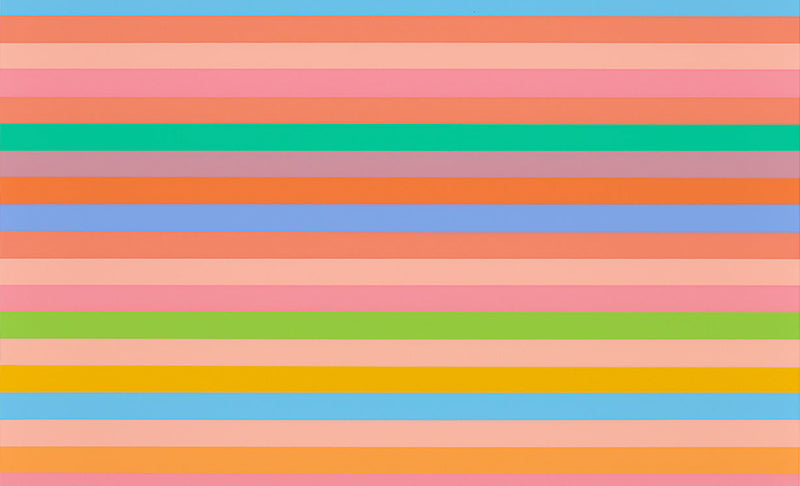
Bridget Riley: Learning to See, presented at Turner Contemporary in Margate from 22 November 2025 to 4 May 2026, offered a concentrated account of an artist who has spent more than six decades examining how vision behaves. Now that the exhibition has closed, it remains useful not as an announcement but as a lens through which to consider Riley’s continuing importance.
Learning to see
Riley’s work is often described through the label Op Art, yet that term can make the pictures sound like demonstrations of optical tricks. Their real subject is more demanding: the instability and pleasure of perception itself. Lines appear to bend, fields pulse and colours change through adjacency. Nothing physically moves, but the eye cannot hold the image still.
The exhibition’s title captured the discipline behind that experience. Seeing, for Riley, is not passive reception. It is an activity shaped by contrast, rhythm, duration and memory. Her compositions are meticulously organised, but their effects cannot be reduced to a diagram; they take place in the viewer.

From black and white to colour
Riley’s black-and-white works of the 1960s established how repeated units could generate movement without representing a moving object. Curves, checks and changing intervals disturb the apparent stability of the surface. The pictures can feel exact and bodily at once: visual information becomes physical sensation.
Colour later expanded that enquiry. Stripes and interacting hues create transitions that no individual colour contains on its own. A narrow band can alter the temperature and apparent weight of its neighbours. The image is therefore not a collection of coloured parts but an event produced between them.

Why Margate mattered
Turner Contemporary’s coastal setting offered an apt context for Riley’s sensitivity to light and natural rhythm. Her abstractions do not imitate the sea or sky, but observation of the visible world informs their changing structures. The gallery’s light and proximity to the coast encouraged a reading of abstraction grounded in experience rather than detached geometry.
Riley in print
Printmaking gives Riley a particularly precise arena for testing sequence, alignment and colour. Editions are not minor echoes of paintings; they are carefully structured works whose scale and paper create distinct viewing conditions. When collecting, check the exact title, date, process, sheet size, edition, signature, printer and publisher. Colour balance, margins and paper condition are crucial because small changes can alter the optical relationship.
After the exhibition
Learning to See demonstrated that Riley’s work has not become predictable through familiarity. Its apparent clarity continues to expose how difficult it is to describe what the eye actually experiences. The exhibition may have ended, but its invitation remains: slow down, compare, move and allow seeing to become an active process.
Studies, decisions and development
An exhibition that places studies beside finished work helps correct the assumption that Riley’s precision arrives fully formed. Preparatory material reveals comparison, revision and the testing of alternatives. A line may be moved, an interval adjusted or a colour relationship rebalanced before the final structure is determined. The apparent impersonality of the finished surface is therefore the result of sustained judgement rather than an automated formula.
What the exhibition clarified
The lasting value of the Turner Contemporary presentation was its emphasis on development. Riley’s practice is not a repeated signature effect but an evolving investigation in which earlier discoveries become the basis for new questions. Black and white, stripe, curve and coloured disc are not separate brands; they are stages in a continuous attempt to understand how sensation can be organised without illustrating an external story.
Explore available works by Bridget Riley and read our guide to Bridget Riley’s prints.
What remains useful after a show closes
An exhibition can leave a method of looking as well as a memory of particular works. In Riley's case, that method involves comparison: noticing how one arrangement prepares the eye for another and how an earlier decision can be reconsidered through a later composition. A closed exhibition still offers a valuable frame for reading the work without being presented as an event visitors can currently attend.
When returning to the catalogue or related material, distinguish documented features of the exhibition from your own response. A photograph can show how works were placed together, but it cannot fully reproduce their scale or the changing light of a room. The record is a starting point for further attention rather than a substitute for every aspect of the original encounter.
Comparison need not become a story of improvement
Moving from black and white to colour does not mean an artist has abandoned a primitive stage for a more advanced one. Different structures ask different questions. A monochrome work can make interval and contrast particularly insistent; a colour composition can introduce relationships that no isolated hue contains. Both can remain active within a long practice.
This helps a viewer resist choosing a favourite period before looking closely. Ask what a particular composition makes possible and what it deliberately leaves aside. The answer may be more informative than a general preference for the familiar black-and-white works or the later coloured arrangements.
Bring the exhibition's questions to a single print
You do not need a room of paintings to practise comparative looking. Begin with one edition, follow a line or band through its sequence, then step back and allow the field to register as a whole. Return on another occasion and notice whether the same feature attracts attention. The stable object provides a basis for observing changes in perception.
When browsing the Bridget Riley collection, keep the actual dimensions and medium beside the image. A website grid tends to equalise size, while prints may establish quite different viewing distances. The Riley print essay develops this relationship between physical precision and visual experience.
The continuing value of Learning to See lies in that invitation to be exact about an experience that never becomes entirely fixed. A carefully organised image can remain open because the viewer's attention is always active within it.
Return to the same print after viewing a contrasting work. The eye may notice a rhythm or interval that was less apparent before the comparison.

Leave a comment
This site is protected by hCaptcha and the hCaptcha Privacy Policy and Terms of Service apply.