
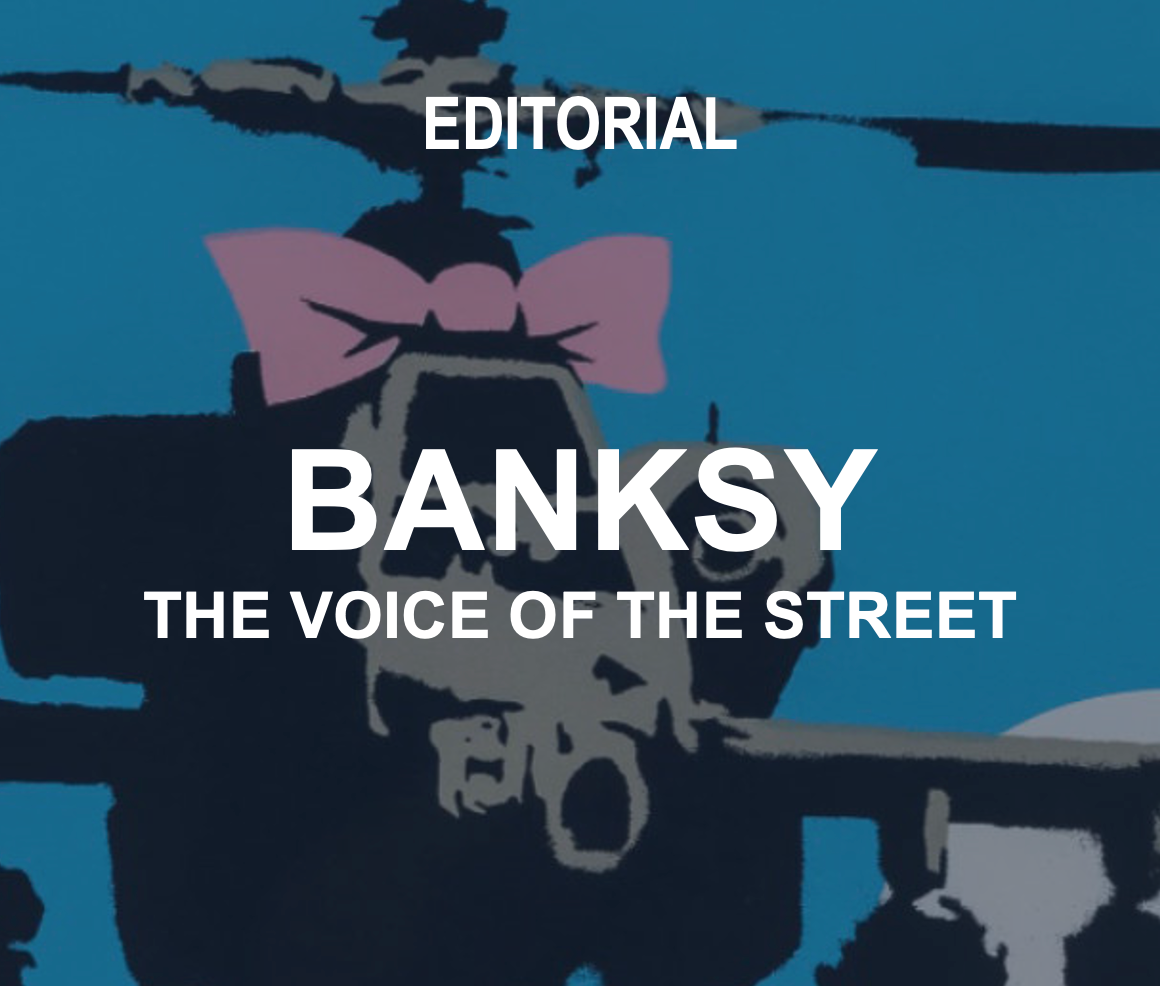
Banksy is one of the most influential and enigmatic artists of the 21st century, known as much for his anonymity as for his provocative artwork. Emerging from the underground graffiti scene in the United Kingdom during the 1990s, Banksy has transformed street art from an act of vandalism into a globally recognized cultural force. His stenciled images, often appearing overnight on walls, bridges, and buildings, blend dark humour with sharp political and social commentary.

In context
A defining feature of Banksy’s work is accessibility. By placing art in public spaces rather than galleries, he bypasses traditional art institutions and speaks directly to everyday people. His imagery is usually simple and immediately recognizable: rats, police officers, soldiers, children, and iconic symbols reimagined in unexpected ways. Through these figures, Banksy addresses themes such as war, consumerism, capitalism, authority, migration, and environmental destruction. The clarity of his visuals allows his messages to resonate across cultures and languages.

Anonymity plays a crucial role in Banksy’s identity. Despite decades of speculation, his true name has never been officially confirmed. This secrecy serves multiple purposes: it protects him from legal consequences, maintains focus on the message rather than the artist, and enhances the mystique that surrounds his work. In an age dominated by personal branding and celebrity culture, Banksy’s refusal to step into the spotlight is itself a form of rebellion.
Banksy is also known for challenging the art market. While his works have sold for millions at auction, he frequently mocks the commercialization of art. One of his most famous stunts occurred in 2018 when his painting Girl with Balloon partially self-destructed moments after being sold at Sotheby’s. The act was widely interpreted as a critique of how art is commodified, even though the shredded piece paradoxically increased in value. This contradiction highlights Banksy’s complex relationship with fame and money.

Beyond individual works, Banksy has undertaken large-scale projects that blur the line between art and activism. In 2005, he painted images on the West Bank barrier, drawing global attention to the conflict. In 2015, he created Dismaland, a dystopian parody of a theme park that critiqued consumer culture, corporate control, and political apathy. These projects demonstrate his ability to use spectacle to spark public discussion.
Ultimately, Banksy’s impact lies not just in his art, but in the conversations it generates. By combining wit, outrage, and simplicity, he encourages viewers to question power structures and societal norms. Whether seen as an artist, activist, or provocateur, Banksy has reshaped contemporary art by proving that a spray-painted image on a wall can challenge the world to think differently.
EXPLORE ALL OUR CURRENT WORKS BY BANKSY
A public audience is not a single audience
A street image can be encountered by residents, workers, visitors, property owners and people who see it only through photographs. Those groups may respond differently. What feels like a welcome intervention to one viewer may feel like an intrusion to another. Public visibility creates debate partly because the work enters a space already used and understood in competing ways.
This makes location more than a backdrop. The scale of a wall, a nearby sign or the route people take past it can change the force of an image. When a photograph crops those surroundings away, it may preserve the central motif while losing part of the encounter. Looking for a wider view can therefore be as useful as examining the stencil itself.
Humour creates a sudden reversal
Banksy's visual jokes often begin with a familiar situation and alter one element. A prop, gesture or unexpected participant can overturn the viewer's first assumption. The image communicates quickly because much of the scene is already recognisable; the changed detail supplies the disturbance. The humour is a form of compression, allowing a short encounter to raise a larger question.
The reversal does not always resolve into one stable message. A work can mock authority while remaining ambiguous about what should replace it. It can make a market contradiction visible while continuing to circulate within that market. A careful reading describes the contradiction instead of assuming that the artist's participation cancels every critical possibility or that criticism removes every commercial interest.
The photograph creates another public life
Once an image circulates online, it can reach viewers who will never visit its site. Captions, headlines and surrounding commentary then influence interpretation. The artwork becomes part of a sequence of reposts and responses, and its location may recede from view. This wider circulation is central to its cultural reach, but it should not be confused with direct experience of the wall or object.
The stencil essay explains the visual economy that helps these images travel. The rat essay follows a recurring character whose meaning changes with its action and setting. Together they offer more specific ways of looking than treating every work as a general statement of rebellion.
Buying an edition is a different encounter
An editioned work enters a private collection with a defined support, publication and condition history. Its relationship to public imagery can remain important without making it an extracted piece of street art. Browse the Banksy collection through those exact descriptions, and use the authentication guide linked below when considering a particular example.
The strongest understanding holds both encounters in view: the image's public force and the physical object's specific identity. Neither should be used to substitute for the other.
Related reading
- Banksy Authentication and Pest Control Explained
- Signed or Unsigned Banksy Prints: What Collectors Need to Know
- Girl with a Balloon: Why Banksy’s Image Endures
Location creates meaning
Banksy’s imagery is economical, but the surrounding wall, neighbourhood and political moment frequently determine its force. Removal or reproduction preserves the design while changing the encounter. A responsible account therefore separates the public work from photographs, authorised prints and later products, rather than treating the image as a single object that travels unchanged.
A precise collecting framework
For an edition, verify title, date, medium, dimensions, colourway, edition, signature status and Pest Control authentication. Review condition independently of authenticity, including fading, handling, creases and restoration. Famous images attract ambiguous descriptions, so insist on clear front and reverse photographs, provenance and an invoice that states exactly what is being sold.


Leave a comment
This site is protected by hCaptcha and the hCaptcha Privacy Policy and Terms of Service apply.