
Few contemporary artists inspire as much debate, fascination, and headline-grabbing attention as Damien Hirst. Since emerging in the late 1980s as a leading figure of the Young British Artists (YBAs), Hirst has built a career on challenging viewers’ perceptions of life, death, beauty, and value. Whether preserved animals in tanks of formaldehyde or intricate arrangements of pharmaceutical packaging, his works invite questions that linger long after the initial shock fades.

In context
Hirst first caught the public eye with The Physical Impossibility of Death in the Mind of Someone Living (1991), a tiger shark suspended in a glass vitrine of formaldehyde. The piece became an icon of the 1990s art world, embodying themes that would define his career—mortality, spectacle, and the blurred line between science and art. It also showcased his talent for transforming simple, even macabre ideas into cultural flashpoints.
Another recognizable body of work is Hirst’s Spot Paintings, created over decades with the help of studio assistants. Although deceptively simple—rows of uniformly colored dots—these paintings probe ideas about repetition, authorship, and the role of the artist’s hand in a mass-producing art market. Their clinical precision echoes Hirst’s enduring interest in pharmaceutical aesthetics, a fascination also seen in his Medicine Cabinets series.

One of Hirst’s most audacious pieces is For the Love of God (2007), a platinum cast of a human skull encrusted with 8,601 diamonds. Beyond its dazzling surface lies a meditation on death and the value we place on material wealth. The work’s rumored £50 million price tag became part of its mythology, raising questions about whether Hirst’s real medium is gemstones or the art market itself.
Controversy has often followed Hirst—sometimes eclipsing his artistic achievements. Critics argue that his work prioritizes shock value over substance, while supporters praise his willingness to address uncomfortable truths. Accusations of using assistants too heavily, recycling ideas, or exploiting sensationalism have done little to slow his momentum. Instead, they’ve contributed to his persona as an artist unafraid of public scrutiny.

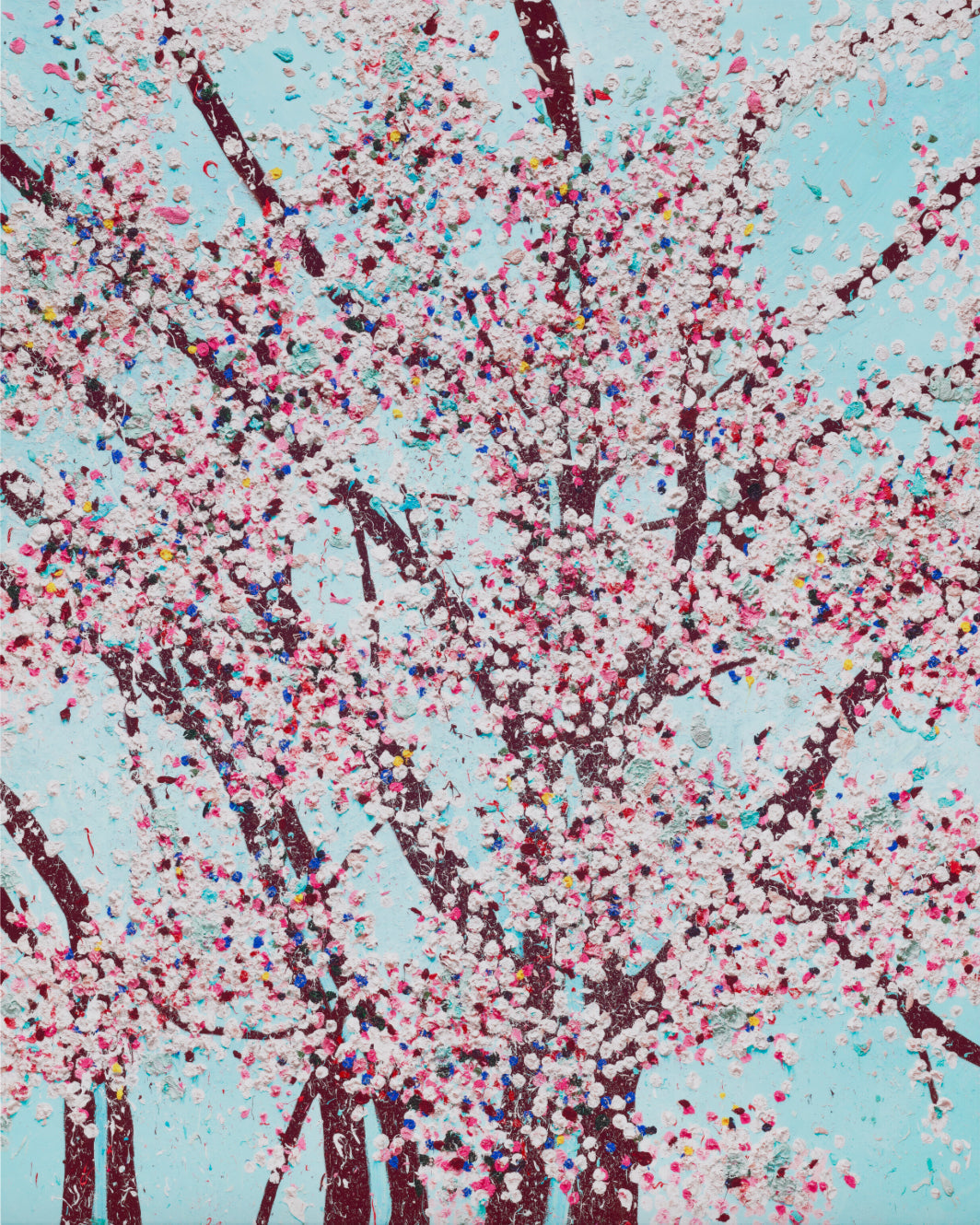
Beautiful, Once Stiflingly Active, Soul-Piercing Vapour Painting (2023)
Beyond gallery walls, Hirst has also expanded into large-scale projects like Treasures from the Wreck of the Unbelievable (2017), an ambitious exhibition presented as the recovered artifacts of a fictional ancient shipwreck. Combining myth, meticulous craftsmanship, and theatrical presentation, the show blurred boundaries between archaeology, storytelling, and contemporary art.
 Currency (H11). 2022
Today, Damien Hirst stands as one of the most commercially successful artists of his generation. His work continues to challenge conventions not only of visual art but of authorship, authenticity, and value. Love him or hate him, Hirst’s ability to provoke conversation is undeniable—and in the ever-shifting world of contemporary art, that might be his greatest masterpiece of all.
The display structure is part of the subject
A vitrine, cabinet or repeated grid can make an object appear classified and controlled. Such structures carry associations with museums, laboratories, shops and collections. Hirst uses those associations to shape the viewer's expectations before the contents are fully considered. The form of presentation can promise knowledge or security while the subject introduces uncertainty.
This gives a more specific route into the work than shock alone. Ask what the container or arrangement encourages you to believe. Does it make a disturbing object seem orderly? Does repetition make a fragile thing appear replaceable? Does a polished surface invite admiration while leaving the underlying question unresolved? These relationships can sustain attention after the initial spectacle has passed.
Delegation does not remove the question of authorship
When an artist defines a system that others help execute, authorship involves decisions about selection, rules, approval and presentation as well as physical making. The resulting work can prompt disagreement about how those contributions should be understood. That disagreement becomes more useful when the actual production process is described clearly instead of reduced to a claim that an assistant made it or that the idea alone settles everything.
Editioned works make the collaborative structure particularly visible. Printers, fabricators and publishers may contribute specialised knowledge while the artist determines and approves the project. A complete catalogue description helps the viewer understand those roles. It also prevents the same image appearing in different formats from being treated as one undifferentiated object.
Beauty and unease can coexist
Repeated colour and symmetrical arrangements can be immediately pleasurable. In Hirst's work, that pleasure may sit beside associations with fragility, preservation or mortality. The viewer is not required to choose one response and discard the other. The tension between attraction and discomfort is often more revealing than an argument about whether the work is simply beautiful or provocative.
Compare the Spot Paintings essay with the catalogue descriptions of other Hirst series. Notice which elements remain stable and which change: the role of a grid, the use of a repeated motif, the scale of the support or the physical finish. Those observations connect individual works without assuming that they all pose exactly the same question.
Headlines are not a collecting method
A celebrated sale or controversial exhibition belongs to the history of a particular work or event. It should not become a forecast for every edition bearing the artist's name. Browse the available works through their actual medium, dimensions, publication and condition. The most useful purchase discussion begins with those facts and with a clear reason for wanting the particular object, rather than with the scale of the artist's publicity.
Related reading
Systems behind the spectacle
Hirst’s best-known images can appear sensational, but much of the work is organised through systems: repetition, pharmaceutical grids, serial spots, vitrines and the controlled transformation of organic material. Production and delegation are not incidental; they test how authorship operates when an artist defines a structure that others help realise.
Collecting across formats
Hirst’s paintings, prints, sculptures and multiples occupy very different market categories. Identify the precise medium, date, dimensions, edition, signature, publisher and fabricator. Spot and butterfly motifs have been issued in numerous formats, so a familiar image should not stand in for object-level research. Condition, provenance and any installation or handling requirements should be recorded.

Leave a comment
This site is protected by hCaptcha and the hCaptcha Privacy Policy and Terms of Service apply.