
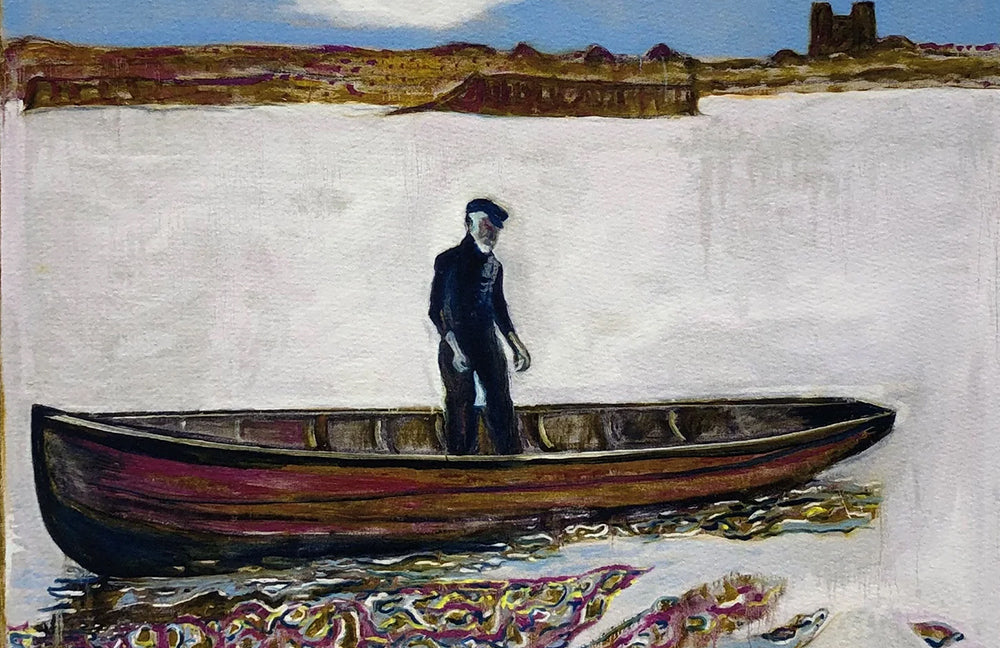
Few artists embody the spirit of unfiltered creativity quite like Billy Childish. Born Steven John Hamper in 1959 in Chatham, Kent, Childish has spent more than four decades painting, writing, and making music with the kind of raw energy that defies categorisation. His work—spanning over 2,000 paintings, 100 albums, and dozens of books—is a testament to independence, emotional honesty, and the power of persistence.

In context
Heaven's Journey (2018)
Archival print on heavy matt stock
30.5 x 36.3 cm
Edition of 200
Signed and numbered by the artist
The Making of an Outsider
Childish’s early years were shaped by hardship and rebellion. Leaving school at sixteen due to undiagnosed dyslexia, he began working as a stonemason at the Chatham Dockyard, all the while filling sketchbooks with drawings that would later earn him a place at Saint Martin’s School of Art. His time there was short-lived; he was expelled in 1982 for his unwillingness to conform—a theme that would define his entire career.
A Painter of Raw Emotion
At first glance, Childish’s paintings may appear untamed- thick brushstrokes, muted tones, figures rendered with expressive simplicity. But beneath that surface lies a profound humanity. His subjects- self-portraits, landscapes, and historical scenes- are imbued with sincerity and emotional charge. Drawing inspiration from artists such as Edvard Munch and Van Gogh, his paintings are not about technical perfection but emotional truth. The result is work that feels alive, personal, and defiantly unpolished.
His recent exhibitions have reaffirmed his place as one of Britain’s most compelling painters. Whether depicting the Kentish marshes or intimate moments of reflection, Childish captures the tension between solitude and resilience. Each canvas feels like a confession rendered in colour.

Moonrise on River (2012)
Giclée Print on Paper
39 x 30.5 cm
Edition of 50
Signed and numbered
The Prolific Poet and Musician
Beyond painting, Childish is a celebrated poet and musician. He has written over 40 poetry collections and several novels, often reflecting on working-class identity, childhood trauma, and love. His words are spare but visceral, revealing an artist who refuses to shy away from the difficult or the deeply personal.
In music, he has been equally unstoppable. Through bands such as Thee Milkshakes, Thee Headcoats, and The Buff Medways, Childish helped shape Britain’s underground garage rock scene. His lo-fi recordings, made with minimal resources and maximum conviction, influenced generations of indie musicians and continue to resonate with audiences seeking authenticity over artifice.

Serenity (2014)
Giclee print
30.5 x 42.5 cm
Edition of 50
Signed, dated and numbered
A Rebellion Turned Movement
In 1999, Childish co-founded the Stuckist art movement with fellow artist Charles Thomson, advocating for figurative painting and emotional engagement in an era dominated by conceptual art. While he later distanced himself from the movement, its principles echo through his practice: a belief that art should be direct, human, and made from the heart.
The Enduring Legacy
Billy Childish’s body of work—whether a portrait painted in oil, a line of verse, or a scratchy guitar riff—forms a singular vision of creative honesty. He stands apart from trends and institutions, guided instead by instinct and integrity. His output is not a career strategy but a way of living: an ongoing act of resistance against the notion that art must be polished to have value.
In celebrating Billy Childish, we celebrate the untamed, the imperfect, and the profoundly human—the very qualities that make art endure.
Directness is a constructed quality
A painting that feels immediate may still depend on carefully chosen proportions, colour and emphasis. In Childish's work, an apparently rough edge or simplified figure should not be treated as the absence of judgement. The question is what the mark does: whether it establishes weight, directs the eye or gives a landscape a particular rhythm. Emotional force and formal decision-making can operate together.
This is a useful way to move beyond the language of instinct and sincerity. Those words can describe a response, but they do not explain how the image produces it. Follow the relation between a figure and its setting, or between a dark passage and an open area. The work becomes more particular when the viewer can connect a feeling to visible relationships.
Several media, different kinds of encounter
Painting, writing and music have different durations and material forms. A line of text unfolds through reading; a recording develops through time; a painted or printed image can be revisited from any point. An artist working across these forms may sustain recurring concerns without simply translating one message unchanged from medium to medium.
For a collector, that distinction prevents biography from overwhelming the object. Knowledge of Childish's wider practice can deepen interest in an edition, but the print still needs to hold attention through its own scale, colour and composition. It should not be valued only as a token of a prolific creative life.
Printed editions have their own specifications
The works illustrated in this article are described through different publication details, including their paper, dimensions and edition information. Read those details individually rather than assuming that every print shares the same production or signing method. A digital edition after a painting can be a legitimate collecting object while remaining distinct from the painted source.
The pigment and giclée guide explains the production vocabulary. Browse the Billy Childish collection with the complete physical description in view, and ask for condition photographs that show the margins and reverse where relevant.
A convincing choice should connect the artist's wider concerns with a particular image you want to revisit. The apparent directness may be the first attraction; close attention to how it is achieved gives that attraction a more durable basis.
Compare the image from across the room and at reading distance. A broad area of colour may establish the mood first, while a small contour or change in texture becomes more important nearby. The relationship between those two encounters can explain why a modestly sized edition remains engaging over time.


Leave a comment
This site is protected by hCaptcha and the hCaptcha Privacy Policy and Terms of Service apply.