
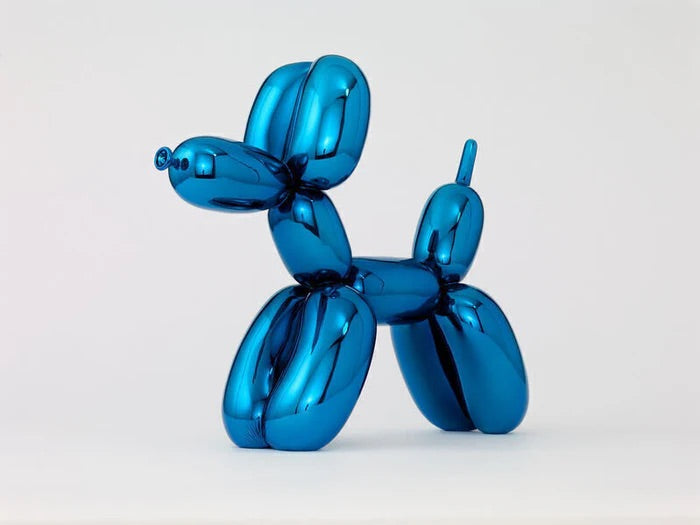
Few contemporary artists have generated as much fascination, debate, and recognition as Jeff Koons. From mirrored stainless-steel balloon animals to pristine porcelain figurines, Koons has built a career that sits deliberately at the intersection of fine art, popular culture, and consumer desire. His work is instantly recognisable, unapologetically polished, and often polarising-yet undeniably influential.

In context
Jeff Koons, Balloon Dog (blue)
Born in Pennsylvania in 1955, Koons emerged in the late 1970s and early 1980s at a moment when artists were rethinking authorship, originality, and the role of mass culture in art. Drawing inspiration from Marcel Duchamp’s readymades and Andy Warhol’s embrace of commercial imagery, Koons elevated everyday objects (vacuum cleaners, inflatable toys, kitsch ornaments) into monumental works of art. Rather than critiquing consumerism from a distance, Koons fully embraced its language, presenting objects with immaculate surfaces and industrial precision.

Jeff Koons, Ballon swan (yellow)
Central to Koons’ practice is the idea of acceptance. He has often spoken about removing judgment from art, allowing viewers to confront their own tastes, desires, and preconceptions. A porcelain sculpture of a cartoonish figure or a reflective balloon dog is not meant to be ironic or sarcastic; instead, it invites viewers to experience pleasure without embarrassment. In this sense, Koons challenges long-held distinctions between “high” and “low” culture, arguing that emotional response matters more than cultural hierarchy.

Koons’ studio practice is famously elaborate. Like a Renaissance workshop scaled to contemporary proportions, his studios employ teams of highly skilled artisans who execute works to near-perfect standards. While critics have questioned authorship and authenticity, this industrial approach is integral to Koons’ concept: perfection itself becomes the subject. Every surface is designed to erase evidence of the human hand, reflecting the viewer back at themselves-literally and metaphorically.

Jeff Koons, Balloon Animals - Collector's Set
The market response to Koons’ work has been extraordinary. His sculptures and paintings regularly command record prices at auction, placing him among the most commercially successful living artists. Yet market value alone does not explain his significance. Koons’ influence can be seen across contemporary art, design, fashion, and even architecture, where glossy finishes, playful forms, and oversized scale have become part of the visual vocabulary of the 21st century.

At the same time, Koons remains a lightning rod for debate. Critics argue that his work prioritises spectacle over substance, while supporters see in it a sophisticated reflection of modern life-one that mirrors our relationship with consumption, celebrity, and desire. This tension is precisely what keeps Koons relevant. His art does not offer easy answers; instead, it holds up a flawless mirror and asks viewers to decide what they see.
In an era defined by images, branding, and instant recognition, Jeff Koons stands as both product and producer of contemporary culture-an artist who understands that meaning today is often inseparable from surface, scale, and visibility.
BROWSE ALL WORKS BY JEFF KOONS
A reflected viewer becomes part of the surface
Where a Koons work is reflective, it does not present a completely closed image. The room, lighting and viewer can appear within its finish. Moving changes those reflections and therefore changes the encounter. The object retains its recognisable form while the surrounding world continually modifies its visible surface.
This makes installation more than a matter of finding enough space. A crowded setting can produce a different experience from an open one, and the viewer's height can change what is reflected. The polished finish may look impersonal, yet it can make the observer unusually aware of their own presence in front of the artwork.
Material can contradict the apparent subject
An object that resembles something light, temporary or disposable can be made in a durable material through an elaborate fabrication process. The viewer recognises the familiar form while discovering that its physical identity has changed. That contradiction can make an ordinary-looking subject feel strange without requiring a complicated narrative.
The effect depends on the actual object. A porcelain edition, a metal sculpture and an artist-designed decorative item should not be assigned the same material or production history because they share balloon imagery. Read the complete description before importing associations from a more famous work into the example being offered.
Acceptance does not remove the viewer's judgement
Koons's interest in pleasure and familiar imagery can invite viewers to reconsider embarrassment about taste. At the same time, a viewer may remain critical of scale, fabrication or the relationship between art and luxury. Those responses do not have to be settled before looking. The work can be approached as an encounter with desire whose implications remain open.
Ask which feature attracts you first and which makes you hesitate. Is it the colour, the finish, the memory of an ordinary object or the awareness of its transformation? Describing that mixture can be more revealing than choosing immediately between admiration and dismissal.
Collect the specified edition
Browse the Jeff Koons collection through its individual medium, dimensions, publication and markings. Check reflective or painted surfaces from several angles, and confirm which packaging or documentation accompanies the work. The guide to sculptural multiples offers useful comparison questions, while keeping each artist's objects and edition histories distinct. Familiarity with an image should sharpen these enquiries rather than replace them.
Related reading
- Andy Warhol’s Factory: The Birthplace of Pop Art
- Yayoi Kusama’s Sculptural Pumpkins and Artist Multiples
- How to Read a Limited-Edition Print Description
Finish and fabrication
Koons’s immaculate surfaces are part of the argument. They remove visible struggle and return the viewer’s reflection, making desire, consumption and self-image inseparable. Complex fabrication and studio production challenge the expectation that authenticity must be visible as the artist’s hand; authorship operates through conception, specification and control.
Editions and objects
Koons has produced sculpture, prints and artist-designed multiples at very different scales and price points. Check medium, dimensions, edition, signature or markings, publisher and fabricator. Reflective and coated surfaces require careful inspection for scratches, clouding, chips and repairs. Original packaging can assist safe transport but should not substitute for provenance or a condition report.

Leave a comment
This site is protected by hCaptcha and the hCaptcha Privacy Policy and Terms of Service apply.