Few artists have shaped contemporary British art as powerfully, or as unapologetically, as Tracey Emin. Emerging in the 1990s as part of the Young British Artists generation, Emin is best known for work that transforms deeply personal experience into art of startling emotional clarity. Her practice spans drawing, painting, sculpture, neon, film, and installation, unified by a raw, confessional intensity that challenges traditional ideas of authorship, vulnerability, and value.

In context
At the core of Emin’s work is the self-not as a stable identity, but as a site of memory, trauma, desire, and resilience. Her art draws openly on her own life: relationships, sexuality, loss, shame, and longing are not abstract themes but lived realities. This directness has often provoked controversy, yet it is precisely this refusal to soften or aestheticise experience that gives her work its lasting power. Emin does not seek distance; instead, she invites the viewer into a space of uncomfortable intimacy.

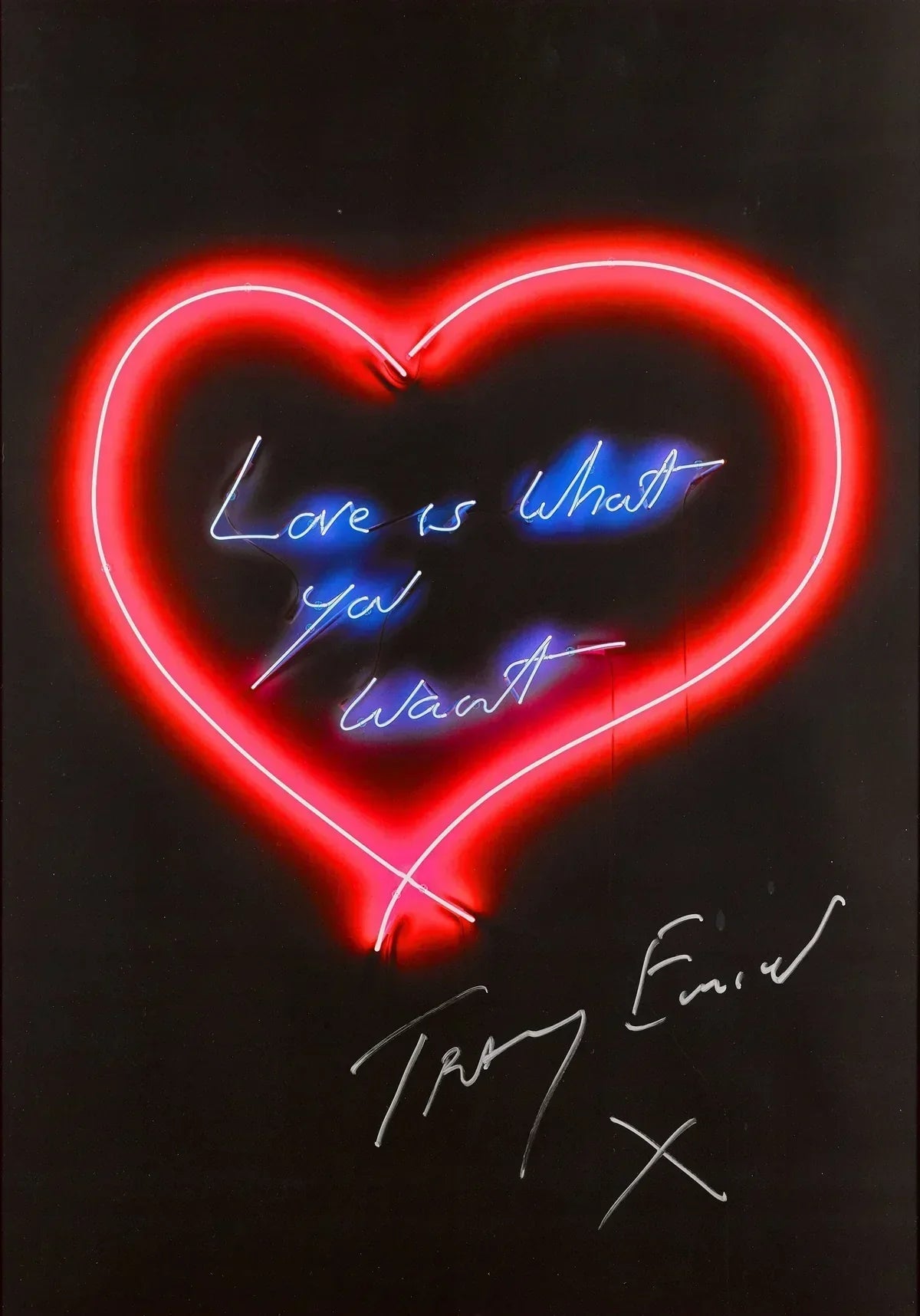
Text plays a central role in her practice, particularly in her iconic neon works. Written in her own handwriting, these glowing declarations hover between vulnerability and defiance, love and despair. They function simultaneously as personal confessions and universal statements, allowing viewers to project their own emotions onto the artist’s words. The fragility of the script contrasts with the permanence of neon, underscoring the tension between fleeting feeling and lasting impact.

In recent years, Emin’s painting and drawing have taken on renewed significance. Her figurative works-often rendered with loose, expressive line-capture the body in states of exposure and emotional flux. These works resist polish, embracing imperfection as a form of truth. Marks are left visible, corrections unapologetic, reinforcing the sense that the act of making is inseparable from the emotions driving it.

Tracey Emin’s influence lies not only in her aesthetic, but in her insistence that honesty itself can be a radical artistic gesture. By foregrounding subjectivity and emotional risk, she has expanded the possibilities of contemporary art, making space for vulnerability as a form of strength. Her work continues to resonate because it reminds us that art can be messy, painful, and deeply human-and that these qualities are not weaknesses, but sources of profound connection.
BROWSE ALL WORKS BY TRACEY EMIN
Look at the line before naming the emotion
A loose contour can seem immediate, but its effect depends on where it begins, changes pressure and stops. A broken line may leave the viewer to complete a body; a repeated mark may make a form feel uncertain rather than simply describe its outline. These are visible relationships that can be examined before assigning a narrative of pain, desire or recovery.
Try following the route of one mark across a work on paper. Notice where the eye pauses and where a gap becomes important. The image may feel emotionally direct because its elements are concentrated, not because it supplies a complete account of the experience from which it arose. Formal attention allows that distinction to remain clear.
Empty paper can hold an absent body
In a sparse image, the unmarked area is not simply leftover space. It can make a figure feel exposed, isolate a gesture or give a short phrase unusual weight. The ratio between mark and surrounding paper affects the encounter. A broad field may create distance, while a tighter arrangement can bring the viewer close to the image's pressure.
This is why margins and framing deserve attention. A mount that conceals part of the intended field can alter the balance even if the central figure remains visible. Ask for a complete sheet photograph and measurements that distinguish paper from image and frame. The physical support contributes to the work's meaning as well as its condition.
Different print processes preserve different qualities
A monoprint, lithograph and other editioned print can carry expressive marks through different production methods. The appearance of a hand-drawn line does not establish which process was used or whether the object is unique. Read the exact medium and publication details rather than relying on the general impression of spontaneity.
The printmaking guide explains why process terms matter, while the signature guide separates edition identity from the method of signing. These practical distinctions make the encounter more precise without reducing the artwork to paperwork.
Honesty does not require total disclosure
A work can be rooted in personal experience while remaining selective, revised and open to interpretation. The viewer should not assume that emotional directness grants complete access to the artist's private life. The image's omissions may be as deliberate and significant as what it states plainly.
The essay on exposure and public address develops this question through language and scale. Here, the emphasis is on the physical marks: how a body or phrase becomes present through line, interval and support. Together, these readings offer a fuller route into the available Emin works than biography or public controversy alone.
Return to the actual image after reading the context. The most persuasive interpretation should still be able to point to something visible: a contour, an interruption, a word or a field of paper that continues to hold attention.
Related reading
Confession and construction
Emin’s directness is carefully made. A phrase is selected, rewritten and given a material form; a body is reduced to the line that can carry its tension. This construction matters because the work is not raw experience transferred unchanged into art. It is a public language built from fragments, omissions and revisions, allowing the viewer to recognise emotional truth without assuming complete access to the artist’s private life.
Looking beyond biography
Biography provides necessary context, but formal attention prevents the work from becoming spectacle. Consider scale, handwriting, negative space and the relation between vulnerability and control. In editions, verify process, dimensions, edition, signature, printer and publisher, and inspect colour, paper and surface. Similar phrases may occur in different objects, so the exact publication must be identified.

Leave a comment
This site is protected by hCaptcha and the hCaptcha Privacy Policy and Terms of Service apply.