
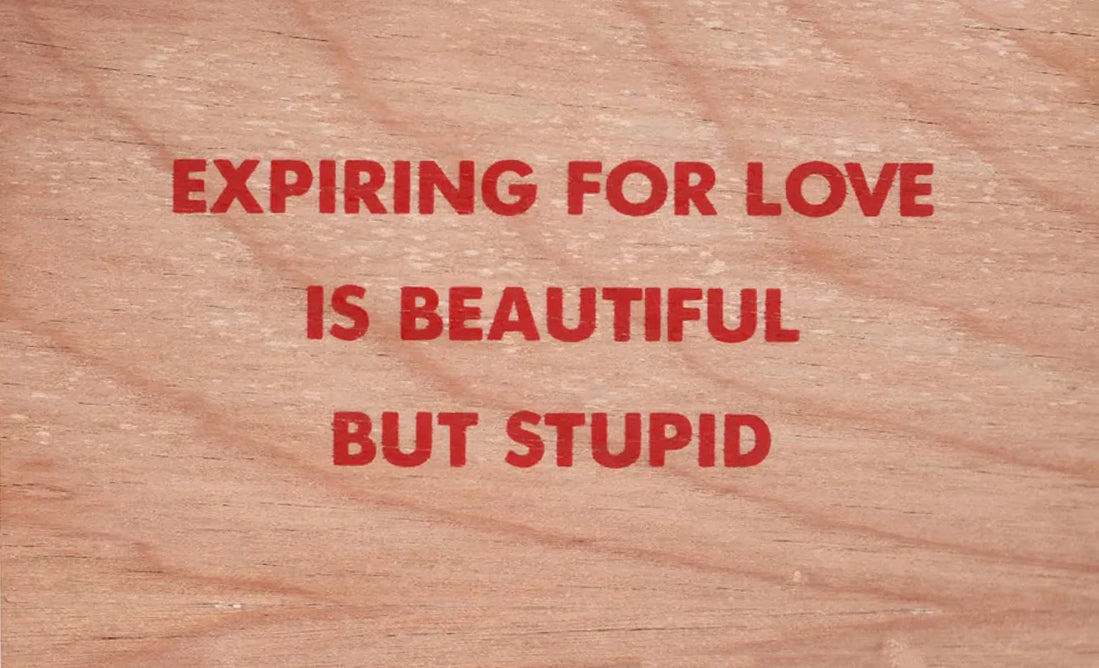
Jenny Holzer, a leading voice in conceptual and feminist art, has spent decades shaping public consciousness through language. Her renowned Truisms series, concise, provocative aphorisms that blur the line between truth and contradiction, has appeared across billboards, LED signs, and city walls. Yet one of the most striking iterations of the series lies not in neon light or concrete, but in the warm, tactile surface of cherrywood screen prints. This body of work offers a powerful intersection of material, message, and medium, transforming her signature text-based practice into an intimate yet forceful visual experience.
 Jenny Holzer by Maciek Kobielski for Harper's Bazaar
In context
The Origins of Truisms
Originally developed in the late 1970s, Holzer's Truisms are a collection of over 300 one-liners that reflect on power, identity, politics, and social norms. Phrases such as “ABUSE OF POWER COMES AS NO SURPRISE” confront viewers with stark, sometimes uncomfortable truths—or half-truths. Drawing inspiration from slogans, propaganda, and moral proverbs, Holzer distills complex cultural narratives into sharp, digestible fragments. The ambiguity of each statement forces the viewer into a space of reflection, interrogation, or even disagreement.
Text Meets Material: Cherrywood as Canvas
Holzer’s decision to screen print her Truisms onto cherrywood panels introduces a new dimension to her practice. Cherrywood, with its rich tones and fine grain, brings a warmth and permanence to the otherwise transient nature of language. Unlike her LED installations or projections that flash momentarily in the public eye, these prints are grounded—deliberate, still, and quietly confrontational. The pairing of machine-printed phrases with a natural, organic surface reflects a tension central to Holzer’s work: the mechanization of language versus the humanity it affects.
 In a Dream You Saw a Way to Survive and You Were Full of Joy, 2018
Visual Simplicity, Conceptual Depth
The aesthetic of the cherrywood Truisms is clean, direct, and devoid of ornamentation. The typography—stark and sans-serif—commands attention without distraction. By removing all decorative flourishes, Holzer allows the words to speak for themselves. Yet within that simplicity lies immense power. Each phrase, stamped into the surface of the wood, feels both timeless and deeply contemporary. The wood grain becomes a metaphorical ground for cultural commentary—each print a kind of secular tablet or artifact of collective conscience.
Language as Weapon and Mirror
At the heart of Holzer’s Truisms is a belief in the potency of language to shape, manipulate, and reflect society. By presenting contradictory ideas side by side—“FREEDOM IS A LUXURY NOT A NECESSITY” against “PEOPLE WHO DON'T WORK WITH THEIR HANDS ARE PARASITES”—Holzer refuses to offer easy answers. Instead, she encourages a critical engagement with the words we live by. On cherrywood, these statements gain an almost archival quality, reminding us that ideologies—like the wood itself—are deeply embedded, layered, and lasting.

A Feminist and Political Gesture
Holzer’s work has long been situated at the crossroads of feminist critique and institutional commentary. The Truisms on cherrywood are no exception. By inscribing politically charged language into a traditionally masculine, material medium—wood panels associated with permanence, labor, and craftsmanship—Holzer reclaims space for voices and narratives often excluded from art history’s canon. The result is a radical form of inscription: a testament to both protest and poetry.
Conclusion
Jenny Holzer’s Truisms screen printed on cherrywood stand as quietly powerful monuments to the weight of words. Melding conceptual rigour with material presence, these works distill decades of social critique into compact visual forms. They ask us not only to read, but to question—to carry their provocations into our daily lives. In a world saturated with information and overwhelmed by messaging, Holzer’s cherrywood Truisms remain deeply human: resolute, thoughtful, and profoundly urgent.

A sentence can sound authoritative without being true
Holzer's short statements often resemble maxims, instructions or public declarations. Their compressed form makes them easy to remember, but the apparent confidence of the wording does not guarantee agreement. Reading several together can reveal competing assumptions. The viewer is asked to examine the authority of language rather than simply adopt every sentence as the artist's own settled belief.
Try reading a statement once as advice and again as something imposed by an institution. The words remain the same, but the imagined speaker changes their force. This instability is central to the work's public life. A phrase can circulate quickly while its context and implied authority remain open to dispute.
Truisms is not the name for every Holzer text
Holzer developed several distinct text series. Familiar phrases should therefore be identified through their specific source rather than grouped automatically under the best-known title. The artist's broader language practice provides context for the cherrywood works, but individual editions still need their exact titles, dates and publication information. Recognition of a sentence is not a substitute for that identification.
This distinction helps a collector read both the text and the object more carefully. A phrase may be reused in another format or publication, with a different scale and viewing situation. Its words can remain stable while the experience of encountering them changes.
A material gives language a pace
Text on a fixed wooden panel can be revisited without waiting for a sequence to return. The grain, edges and dimensions give the statement a physical boundary. In an electronic display or projection, light and duration may organise the encounter differently. Neither format is simply a neutral carrier; each sets conditions for how quickly and repeatedly the language is read.
When considering a set, confirm the number of components and how their order or arrangement is documented. A single panel and a complete group may create different relationships between statements. Condition should address the support and printed surface of each component rather than treating the set as one undifferentiated item.
Explore the Jenny Holzer collection and compare the Wool and Gonzalez-Torres collaboration. Both make language visible as a material arrangement, while asking different questions about authority, circulation and ownership.


Leave a comment
This site is protected by hCaptcha and the hCaptcha Privacy Policy and Terms of Service apply.