
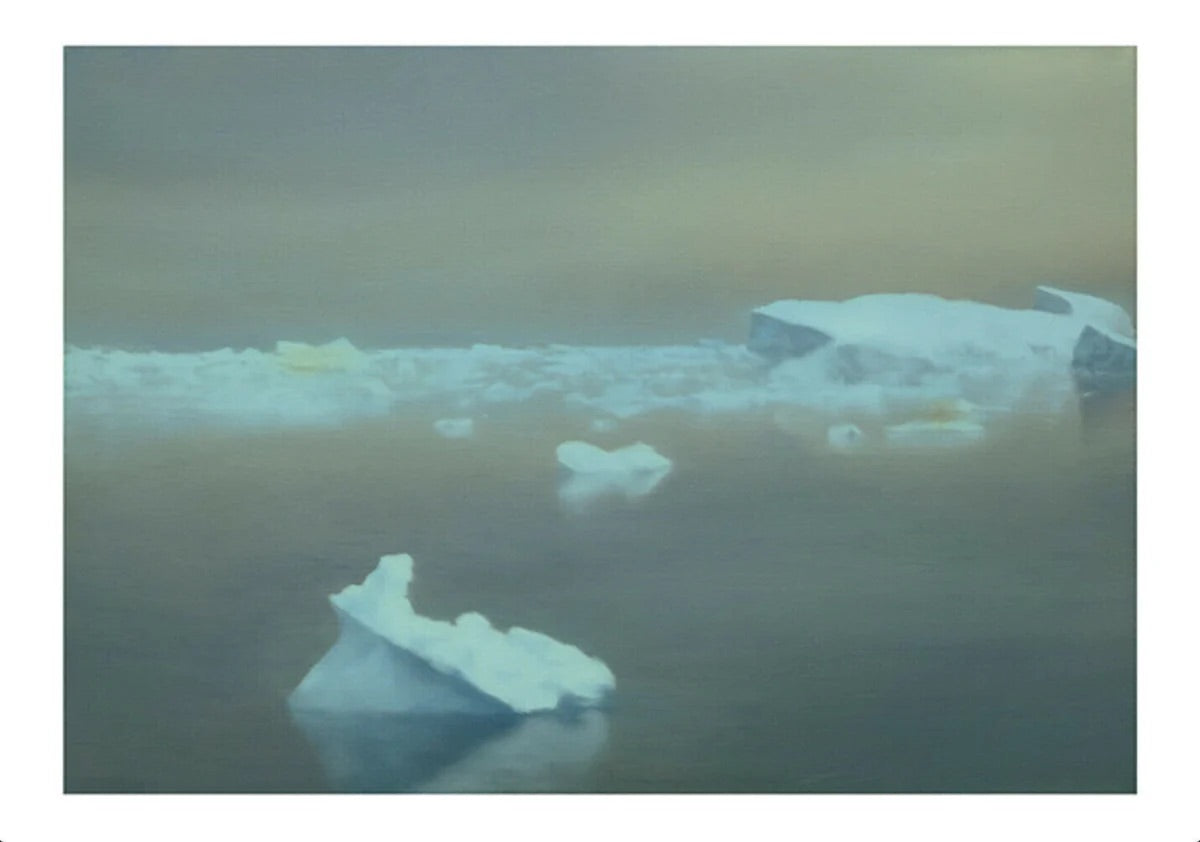
Gerhard Richter’s landscapes occupy a fascinating place in contemporary art: they look, at first glance, like familiar windows onto nature—misty coastlines, heavy skies, distant mountains—yet they quietly unravel the idea that a landscape can ever be purely “seen.” In Richter’s hands, the genre becomes less a depiction of place and more a meditation on perception, memory, and the way images shape what we believe is real.
In context
Richter began working from photographs early in his career, and that photographic starting point matters for his landscapes. Rather than painting en plein air in the Romantic tradition, he often used snapshots, postcards, or his own camera studies as source material. The result is a strange double distance: we’re already one step removed from nature by the photograph, and then Richter adds another step through paint. This is where his signature blur becomes crucial. In many of his landscape paintings, details soften and edges dissolve, as if the image is slipping between focus and forgetfulness. The blur doesn’t merely create atmosphere; it stages an encounter between the clarity we want from a picture and the uncertainty that lives inside looking.
What makes Richter’s landscapes so compelling in a gallery setting is their emotional range. Some works evoke the calm of traditional pastoral scenes-quiet fields, reflective water, the hush of late afternoon. Others lean into drama: looming clouds, dark tree lines, winter horizons that feel both expansive and foreboding. Yet even at their most beautiful, Richter’s landscapes resist sentimental resolution. They aren’t invitations to escape so much as reminders that the “natural” view is filtered-by the camera, by culture, and by our own desire for meaning.
Technically, Richter treats landscape as a testing ground. He can paint with remarkable restraint-thin layers, controlled tonal shifts, a near-monochrome discipline-or with richer chroma that vibrates against grays and whites. Sometimes the paint surface is deceptively smooth, amplifying the photograph-like effect; sometimes it carries subtle traces of the hand, a whisper of brushwork that contradicts the image’s apparent neutrality. That tension between mechanical distance and human touch is central to Richter’s project: the painting looks like it could be objective, but it never lets you forget it is made.

Richter’s landscapes also speak to art history without reenacting it. Viewers often sense echoes of Caspar David Friedrich’s German Romanticism-the solitary mood, the metaphysical skies-yet Richter reframes that tradition through modern media. Where Friedrich offered a spiritual horizon, Richter offers an image-world in which nature is encountered through reproduction. His landscapes feel “true” not because they replicate a scene perfectly, but because they mirror how we actually experience the world now: mediated, partial, and haunted by other pictures.
For collectors, Richter’s landscape works offer a distinctive balance. They are immediately legible-one can live with them, return to them, feel their weather and silence- while still carrying the intellectual charge that defines his practice. They bridge the recognizable and the elusive, the timeless appeal of landscape and the contemporary question of what an image can claim to be.

Ultimately, Richter’s landscapes do something quietly radical. They give us the pleasure of looking, then complicate it. Standing before one, you may feel the pull of a distant shoreline or the weight of a gray sky-and then you notice the soft drift of focus, the photographic hush, the sense that the scene is both there and not there. Richter turns landscape into a threshold: between nature and picture, presence and memory, certainty and doubt. In that threshold, his paintings find their lasting power.
Compare the structure before naming the mood
Landscape descriptions often begin with atmosphere: tranquil, dramatic, desolate or beautiful. With Richter, it is useful to postpone those words and first describe the arrangement. Where is the horizon? How much of the image belongs to the sky? Is the foreground available to the viewer, or does the scene begin at a distance? Those choices shape the emotional response rather than merely illustrating it.
The gallery’s Iceberg and Himalaya listings offer starting points for a comparison of mass, distance and scale. Read each object’s specifications separately, then consider how the image establishes space. A title can identify a kind of place, but the composition determines how that place becomes available to the eye.
Try comparing the images at the same displayed size, then return to their actual dimensions. The first exercise helps isolate compositional differences; the second restores the physical scale of the publications. A screen makes very different objects look equivalent, so both stages are needed when moving from visual interest to a possible acquisition.
The photograph is a starting point rather than a guarantee
A photograph can make a view seem factual, yet its framing, exposure and moment of capture are already choices. Translating that photograph into another medium introduces further decisions. Richter’s landscapes invite attention to those layers of selection. Their apparent distance from expressive painting can become one of the ways in which expression enters.
Instead of asking whether a landscape is an accurate copy of nature, ask what the image allows you to know. Can you establish the weather, time or viewpoint with confidence, or are you filling in those details from familiar conventions? The answer may change as you spend longer with the work. An image can remain persuasive while withholding the information that would make it fully explicable.
This approach also prevents biography from becoming a shortcut. A landscape may suggest memory or estrangement without illustrating a documented personal event. Such responses are interpretations to test through looking, not facts to attach automatically to every mountain, coastline or field.
Choosing between related landscape publications
For collectors, the relationship between image and object deserves particular care. A painting’s date, a photographic source and the publication date of a print may differ. Confirm which date the listing records and which medium describes the offered sheet. A landscape reproduced in an exhibition poster has a different publication history from a separately catalogued edition.
With a quieter image such as Evening Calm, pay attention to the transitions that may disappear in a compressed photograph. Request a complete-sheet view and details of the paper and image where needed. The attraction of a distant, atmospheric scene should not prevent close attention to margins, surface condition or mounting.
A useful shortlist combines an accurate catalogue record with a clear account of why you return to the image. That reason may be the balance of light, the organisation of space or the way the scene seems both familiar and inaccessible. The work need not resolve into a single message to become a sustained part of a collection.



Leave a comment
This site is protected by hCaptcha and the hCaptcha Privacy Policy and Terms of Service apply.