
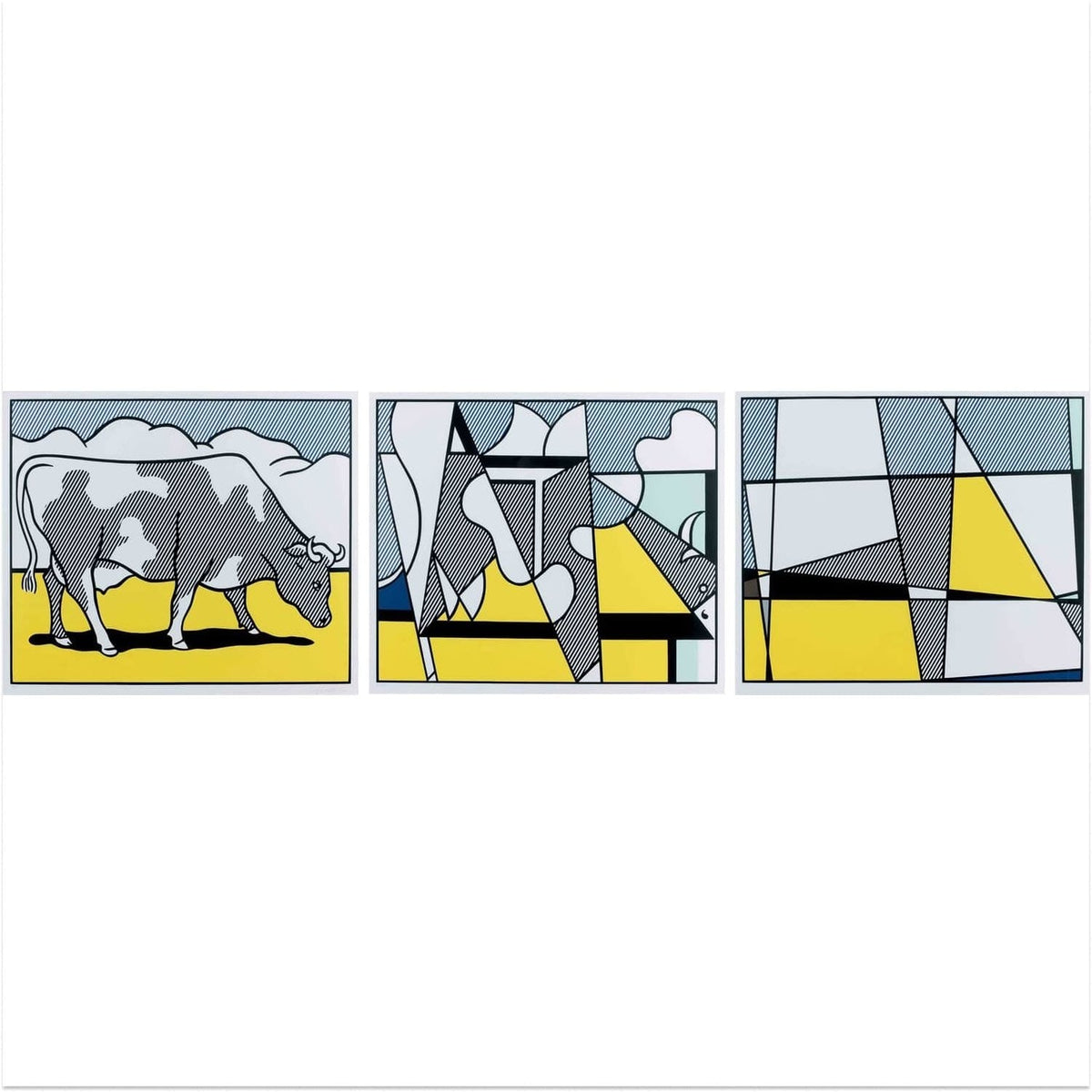
A close look at Roy Lichtenstein’s Cow Going Abstract sequence and how six images turn a familiar subject into a lesson about representation.

A picture that changes while we watch
Roy Lichtenstein’s Cow Going Abstract is not simply an image of a cow followed by a set of increasingly simplified variations. It is a sequence about the way pictures organise vision. Across six stages, the animal moves from a recognisable black-and-white figure towards a composition of hard-edged shapes. The subject does not vanish all at once: contours are displaced, tonal contrasts become autonomous, and details that initially described a body begin to behave like marks in their own right.
Why the sequence matters
The work makes abstraction legible as a process rather than a fixed style. Looking from one panel to the next, we can test how little information is needed before recognition breaks down. A curve may first read as the cow’s back, then as a compositional device; a patch of black may describe a marking on hide, then become a weight within the picture. Lichtenstein turns the viewer into an active participant, continually deciding whether to see an animal or an arrangement of forms.
A dialogue with modern art
The subject carries a deliberately art-historical charge. The cow recalls a tradition of rural and pastoral imagery, while the progression towards abstraction evokes the twentieth-century belief that modern painting could distil appearances into structure. Lichtenstein approaches that history with characteristic clarity and wit. Instead of presenting abstraction as a heroic leap, he gives us an almost instructional progression whose neatness is itself slightly comic.
Mechanical clarity, human decisions
The crisp surfaces associated with Lichtenstein can appear impersonal, but every stage depends on selection: which contour to retain, where to interrupt a form, how to balance black, white and colour. Reproduction techniques sharpen those decisions. Flat areas and emphatic outlines remove the atmospheric effects of painting and make each alteration easy to compare. The apparent coolness of the work is therefore not an absence of judgement; it is judgement made visible.
Living with the image
As a work on paper, Cow Going Abstract rewards both immediate recognition and prolonged comparison. From a distance the sequence reads rhythmically, almost like frames in an animation. At closer range, small shifts between stages become the subject. Condition is especially important in a work relying on clean paper, strong contrast and precise colour. Buyers should examine the sheet, margins, surface and any fading, as well as publication information and provenance.
A useful place to start
For collectors, the work offers an unusually concise introduction to several strands of Lichtenstein’s practice: appropriation, serial thinking, the tension between representation and abstraction, and the translation of painted ideas into editioned form. It is playful without being slight. Its humour comes from the cow’s stubborn recognisability, even as the image is methodically taken apart.
Recognition after abstraction
Even the final stages remain haunted by the cow. Once the starting image is known, the viewer cannot fully unsee it; abstract shapes keep attracting anatomical readings. This persistence is the sequence’s sharpest lesson. Representation is not simply removed as forms are simplified. Memory continues to organise perception, showing that abstraction and recognition can operate simultaneously rather than replacing one another.

Leave a comment
This site is protected by hCaptcha and the hCaptcha Privacy Policy and Terms of Service apply.