
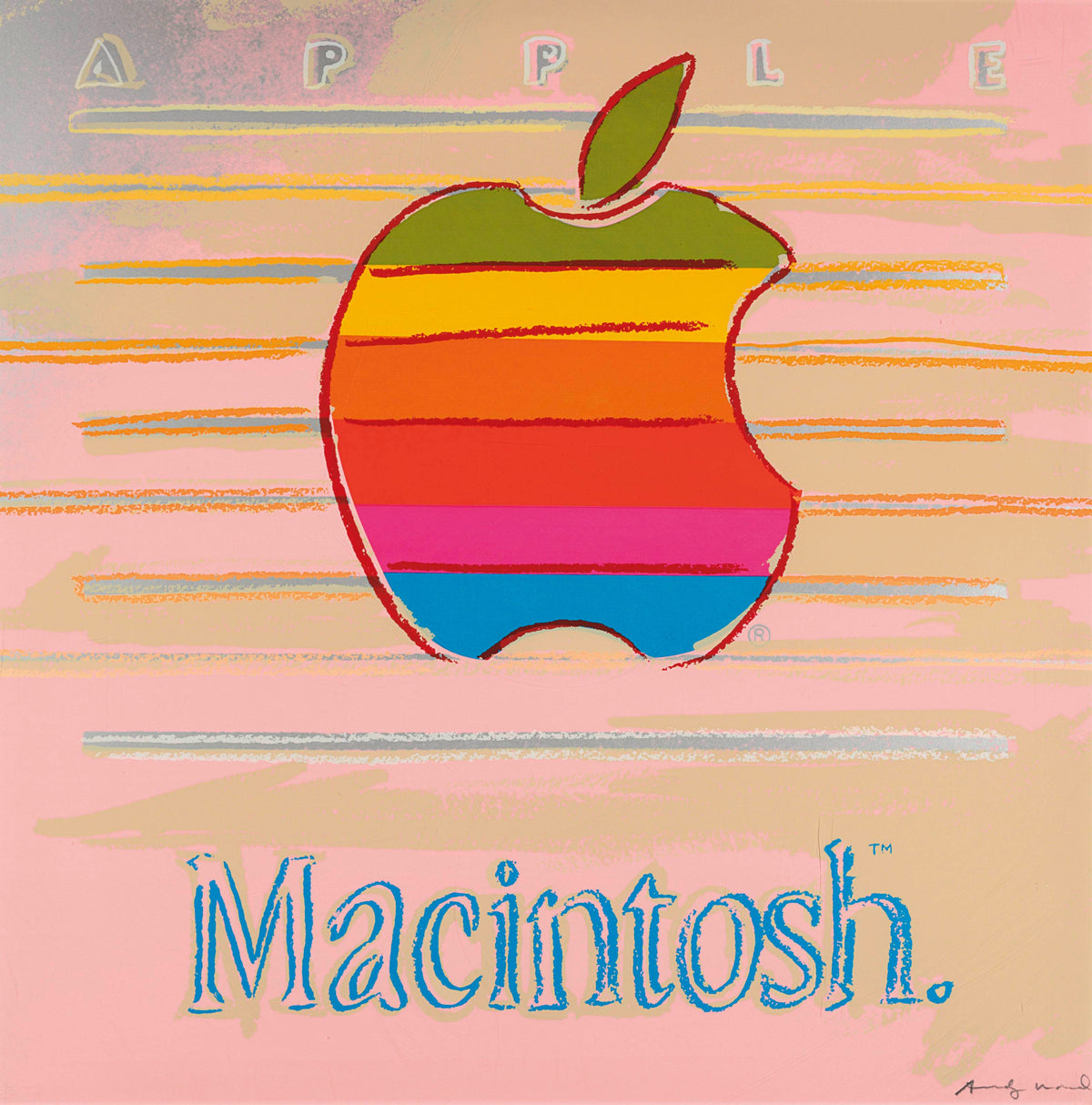
Explore Andy Warhol prints and editions currently available from Dovehouse Contemporary, including examples connected to the artist’s celebrated 1985 Ads portfolio.
Andy Warhol’s relationship with advertising was never simply a matter of borrowing commercial imagery. He understood advertising from the inside. Before Pop Art made him famous, he worked as a commercial illustrator in New York; later, he turned the mechanisms of promotion, repetition and brand recognition into the very substance of his art. The Ads portfolio of 1985 brings those two halves of his career into unusually direct contact.
Across ten screenprints, Warhol treated familiar campaigns, corporate marks and publicity images as a ready-made portrait of American desire. The portfolio includes subjects associated with Apple, Blackglama, Mobil, Paramount, Life Savers, Volkswagen, Chanel, Van Heusen and the film Rebel Without a Cause. Seen together, they do not read like a conventional advertising campaign. They form a compressed cultural landscape: technology, fashion, cinema, fuel, luxury and celebrity, all levelled by the same square format and the same deliberate insistence of screenprinted colour.
What is Andy Warhol’s Ads portfolio?
In 1985, Ronald Feldman proposed that Warhol create a portfolio based on American advertising. The resulting suite comprises ten screenprints, catalogued in Feldman and Schellmann as F. & S. II.350–359. The principal edition was produced on Lenox Museum Board, with the individual images sharing a large square format of approximately 38 by 38 inches (96.5 by 96.5 cm). Individual impressions from the suite are now frequently encountered separately, which makes precise identification—title, catalogue number, edition designation, signature and sheet specification—particularly important.
The project arrived late in Warhol’s career, but its premise reaches back to his earliest work. Advertising had always offered him a language built for immediate recognition. In Ads, however, recognition is only the beginning. Logos are enlarged, colours are uncoupled from ordinary product presentation, and photographic or graphic sources are pushed towards the status of icons. Warhol does not conceal the commercial origin of the images; he makes that origin impossible to ignore.
Apple: a new kind of American emblem
Apple (F. & S. II.359) is the final image in the portfolio’s catalogue sequence and one of its most immediately legible. The rainbow-striped apple is held against a dark field, while the company name and “Macintosh” appear above and below. Warhol’s handling preserves the clarity of the logo but changes its atmosphere. In the print’s large square format, the device becomes less a piece of branding than an emblem—bright, frontal and strangely self-contained.
The Dovehouse example is recorded as a colour screenprint on Lenox Museum Board from 1985, measuring 38 by 38 inches, from the edition of 190 plus artist’s proofs, signed and numbered in pencil and published by Ronald Feldman Fine Arts, New York. Those details matter. The same motif circulates in different contexts and formats, so a collector should distinguish an original impression from the Ads portfolio from later reproductions or related promotional material.

Celebrity without a portrait
Several works in Ads demonstrate that Warhol could evoke celebrity without relying on a conventional head-and-shoulders portrait. Blackglama transforms a fur advertisement into an image about performance, surface and public identity. The campaign’s glamour is already theatrical; Warhol intensifies it through high contrast and synthetic colour, making the image feel both familiar and slightly detached from the product it once promoted.
The active Dovehouse listing for Blackglama records a 1985 colour screenprint in the 38-inch square format, from an edition of 190, signed, dated and numbered. Its scale is important to the experience of the work. What may begin as a recognisable magazine-derived image occupies the wall with the physical presence of a painting.

Van Heusen (Ronald Reagan) works through a related tension. The source presents Reagan as a model of polished American confidence, but historical hindsight inevitably alters the image. By 1985, its subject was President of the United States. The print therefore sits between advertisement, celebrity portrait and political image. The Dovehouse impression is recorded as an artist’s proof from a group of 30, signed, and printed in colour on Lenox Museum Board.

Why the portfolio still feels contemporary
The Ads portfolio predates social media, but its central subject is recognisably current: the way identity is assembled through images designed to be remembered. Warhol isolates each advertisement from its original flow of magazines, billboards or cinema publicity. Once removed from that context, the image can be examined as a system of colour, typography, aspiration and repetition.
This is why the portfolio is more than a nostalgic inventory of 1980s brands. It asks what happens when commercial recognition becomes cultural memory. Some subjects retain immediate global familiarity; others now arrive with a layer of historical distance. That unevenness is part of the portfolio’s interest. Warhol understood that fame is neither stable nor neutral: it is produced, circulated and revised.
The suite also provides a particularly clear example of why Warhol chose screenprinting. The process allowed him to retain the directness of found imagery while changing its colour, emphasis and material presence. For a wider account of that method, read Why Andy Warhol Chose Screenprinting.
What collectors should examine
Portfolio identification
An image derived from an advertisement is not automatically an impression from Warhol’s 1985 Ads portfolio. Confirm the exact title and Feldman and Schellmann reference, the medium, sheet size, paper or board, signature, numbering and edition designation. Compare the work with the documented specification rather than relying on the image alone.
Signature and edition
The principal edition, artist’s proofs and other proof designations are related but distinct. A description should state clearly how the impression is signed and numbered, and whether it belongs to the numbered edition or a proof group. Pencil signatures, inscriptions and numbering should be examined in person or through clear detailed photographs.
Condition of the sheet
Lenox Museum Board gives the portfolio a substantial physical character, but condition still deserves careful inspection. Corners and edges, the printed surface, colour, handling marks and any evidence of previous mounting should all be considered. Framed works should ideally be assessed outside the frame where practical, with attention to archival mounting and glazing. Condition is work-specific; a general statement about the series cannot replace a report for the individual impression.
Provenance and documentation
Good documentation should connect the physical work to its recorded edition history. Provenance, invoices, labels and prior cataloguing can support that assessment, but they should agree with the object itself. A catalogue raisonné reference is a tool for identification, not a substitute for physical examination.
Our broader guide, Collecting Andy Warhol Prints: Editions, Signatures and Condition, sets these questions within the wider market for Warhol editions.
Ads within Warhol’s printmaking
Compared with the earlier Campbell’s Soup portfolios, Ads is less concerned with the repetition of one product category and more interested in the whole ecology of consumer attention. The Soup Can images turn supermarket packaging into serial portraiture; Ads moves across industries and media, joining corporate identity to Hollywood, politics and fashion. For that earlier foundation, see Andy Warhol’s Campbell’s Soup Cans and the Invention of an Icon.
The portfolio also demonstrates the range within Warhol’s apparently impersonal style. Apple is graphic and emblematic; Blackglama is photographic and theatrical; Van Heusen carries a biographical and political charge. Their shared format creates unity, but it does not erase those differences. Collectors can approach the suite as a complete statement or consider individual images whose subjects and visual language stand independently.
Available Andy Warhol works
Dovehouse Contemporary currently offers several works connected to the Ads portfolio, including Apple (F. & S. II.359), Blackglama, Van Heusen (Ronald Reagan) and Rebel Without a Cause (James Dean) (F. & S. II.355).
View the current Andy Warhol collection or contact Dovehouse Contemporary to request condition information, provenance details, framing guidance or assistance sourcing a particular impression from the Ads portfolio.

Leave a comment
This site is protected by hCaptcha and the hCaptcha Privacy Policy and Terms of Service apply.