
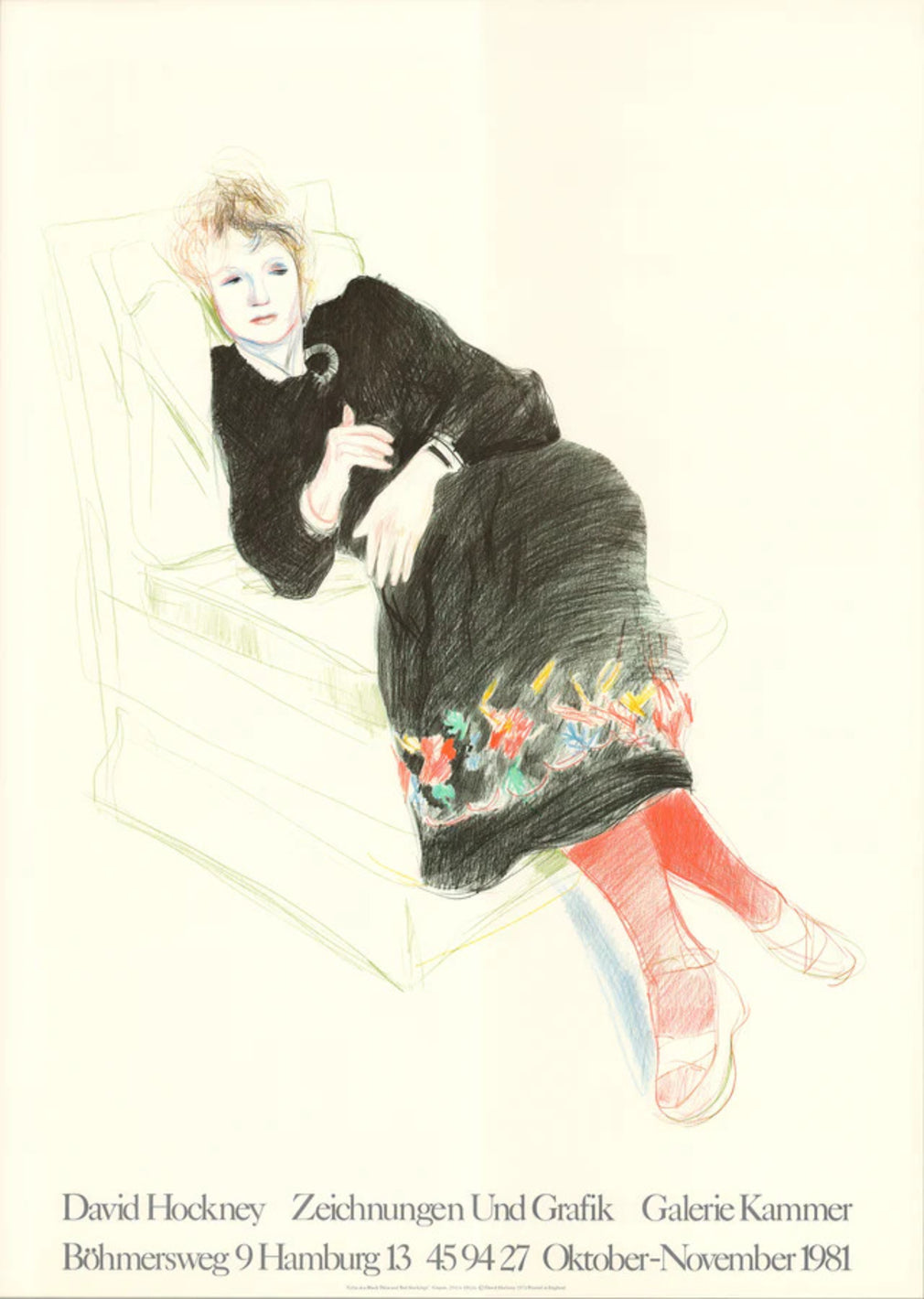
David Hockney’s portraits are among the most intimate parts of his wider graphic practice. While his landscapes, swimming pools and experiments with perspective may be more immediately recognisable, the portraits reveal something equally important: Hockney’s sustained interest in looking at people he knows well. For collectors, prints featuring figures such as Celia Birtwell and Gregory Evans offer a particularly direct route into this aspect of his work.

The attraction is not simply biographical. Hockney’s portraits repeatedly test how much can be communicated through line, posture, clothing, facial expression and the relationship between sitter and artist. Across drawing, painting and printmaking, familiar subjects allowed him to return to the same faces without the formality that can accompany commissioned portraiture. The result is an unusually personal strand of post-war British printmaking.
Why are Celia Birtwell and Gregory Evans important in Hockney’s portraits?
Celia Birtwell and Gregory Evans belong to the group of friends and associates whom Hockney portrayed repeatedly. Their importance lies partly in that continuity. Rather than treating portraiture as a sequence of isolated likenesses, Hockney could revisit familiar people over long periods, allowing changes in age, style, mood and technique to become part of the work.
This is one reason collectors should look beyond the question of whether a portrait depicts a famous sitter. In Hockney’s case, repeated subjects can function almost like recurring motifs. A portrait of Celia or Gregory sits within a larger visual conversation. The individual image remains complete in itself, but knowledge of Hockney’s continuing engagement with the sitter gives the print additional context.
Celia Birtwell is particularly closely associated with Hockney’s portrait practice. Her distinctive appearance, clothing and presence gave the artist a subject through which he could explore both likeness and design. Gregory Evans likewise appears within Hockney’s circle of close personal subjects, and portraits of him can carry a quietness that differs markedly from the artist’s more overtly colourful compositions.
What makes a Hockney portrait print distinctive?
Hockney’s strongest portraits often appear deceptively economical. A limited number of lines can establish a face, a seated pose or the fall of clothing. That apparent simplicity should not be confused with casual execution. In printmaking, every mark has to work within the demands of the chosen process, and the reduction of a sitter to essential visual information can make small differences unusually significant.
Collectors should therefore spend time with the details. Look at the way an eye is described, the angle of a shoulder, the treatment of hair or the point at which a contour is deliberately left open. In many Hockney portraits, empty paper is as important as the printed mark. The surrounding space prevents the image from becoming visually crowded and gives the sitter room to register.
Colour can operate differently from work to work. Some portraits depend primarily on drawing and tonal restraint; others use clothing, borders or selected passages of colour to create rhythm. This variety is one reason the category is richer than a single search for “Hockney portraits” might suggest. Two prints of comparable scale can feel entirely different depending on the balance between line, colour and untouched paper.
Celia: portraiture, clothing and graphic structure
Portraits of Celia are especially interesting because Hockney’s attention frequently extends beyond the face. Clothing can become part of the architecture of the image. Checks, sleeves, dark dresses, borders and other graphic elements establish a structure around the sitter, creating tension between descriptive portraiture and pattern.
For a collector, this means that a Celia portrait can appeal on several levels at once. There is the personal connection to one of Hockney’s recurring sitters, but there is also the formal relationship between figure, costume and page. A work such as Celia Adjusting Her Eyelash, for example, can be approached not only as a likeness but as an observation of gesture: the small action gives the image a sense of immediacy that a rigid pose would not.
This kind of moment is central to Hockney’s appeal as a portraitist. The sitter is not simply presented to the viewer; she appears to be doing something, thinking, waiting or momentarily absorbed. The best portraits feel observed rather than staged.
Gregory Evans: familiarity and restraint
Portraits of Gregory Evans offer another way into Hockney’s treatment of people close to him. Where some works attract attention through colour or decorative detail, others are compelling because of their restraint. The relationship between artist and sitter can be felt in the absence of theatricality.
That quality matters when comparing Hockney portrait prints. A collector should not automatically equate visual complexity with importance. A quieter image may reward prolonged viewing precisely because the composition depends on small adjustments of line, expression and spacing. This is particularly relevant when a portrait is intended for a domestic setting, where a work is experienced repeatedly rather than encountered once in an exhibition.
How should collectors compare Hockney portrait prints?
The first step is to identify the specific print rather than relying on a generic image search. Hockney’s graphic output is extensive, and similar subjects may appear in different works, techniques or editions. Confirm the title, date, medium, edition information and signature details from the individual work being offered.
Condition should then be considered in relation to the medium. Paper-based works can be affected by handling, framing, light exposure, foxing, staining, creasing or other changes. These issues do not all carry the same significance, and their importance depends on the particular print. Collectors should ask for a current condition description and, where appropriate, detailed photographs rather than assuming that two examples of the same edition are equivalent.
Framing is another practical consideration. Older framing materials can affect paper over time, while a good contemporary frame can materially improve both presentation and protection. A frame should never substitute for examining the work itself, however. If condition is central to a purchase decision, the underlying sheet and relevant margins need to be understood.

Edition, signature and documentation
Edition information is fundamental when buying any Hockney print. Collectors should establish whether the work belongs to a numbered edition, an artist’s proof or another recognised edition category, and whether the information corresponds with reliable cataloguing for that specific image. The same principle applies to signatures: verify what is actually present on the work rather than assuming a signature format from another example online.
Documentation should be read as a chain of useful evidence rather than as marketing language. An invoice, prior gallery record, auction record or other ownership documentation can help establish the history of an impression. The relevance of each document depends on what it actually demonstrates.
Dovehouse Contemporary takes a work-specific approach to these questions. Collectors considering a Hockney portrait can request the available details for the individual impression rather than relying on general assumptions about the edition.
Where do portrait prints sit within a Hockney collection?
For an established Hockney collector, a portrait can provide a useful counterpoint to landscapes, pools or more overtly experimental works. It introduces the human relationships that run through his practice and can make a collection feel less centred on a single famous motif.
For a first Hockney acquisition, portrait prints can also be a compelling starting point because they connect several important aspects of his work: drawing, observation, printmaking and personal history. The decision should still begin with the individual image. A recognisable sitter is not, by itself, a reason to acquire a work. The strongest purchase is one in which the composition continues to hold attention after the biographical context is understood.
Looking at Hockney portraits slowly
Hockney’s portraits reward exactly the kind of looking that online browsing can discourage. A thumbnail gives the subject; it rarely gives the experience. Scale, paper, the pressure and character of the printed line, subtle colour and the amount of untouched space all become clearer when the work is considered carefully.
This is particularly true of images that initially seem straightforward. The apparent ease of Hockney’s line can disguise how deliberately the composition is organised. Spend time moving between the face and the edges of the image. Notice how the sitter occupies the sheet, where the eye is directed and which details have been omitted. Those omissions are often as revealing as the marks that remain.
Buying David Hockney portrait prints
Collectors looking specifically for portraits should begin with the David Hockney works currently available through Dovehouse Contemporary. Availability changes, so the collection page is a better source for current stock than an older editorial article.
When evaluating a particular work, ask for the current edition, signature, condition and provenance information attached to that impression. Where several Hockney works are under consideration, it can also be useful to compare them side by side rather than making a decision solely on subject recognition.
Dovehouse can also assist collectors looking for a particular Hockney sitter, period or type of print that is not currently listed. Portraits of recurring figures such as Celia Birtwell and Gregory Evans are especially suited to this focused approach because individual works can differ considerably in mood and technique even when the sitter is familiar.
Frequently asked questions
Are David Hockney portrait prints collectible?
They form an established part of Hockney’s graphic practice and attract collectors for their combination of printmaking, drawing and personal subject matter. The merits of any purchase should still be assessed work by work, including edition, condition, signature and documentation.
Why did Hockney portray the same people repeatedly?
Working with familiar sitters allowed Hockney to return to the act of looking without treating every portrait as a formal introduction. Repetition also lets viewers see how his methods and the appearance of his subjects changed over time.
What should I check before buying a Hockney portrait print?
Confirm the exact title, medium, edition information, signature status, dimensions, condition and available provenance for the specific impression. Do not assume that information attached to another example of the same image automatically applies to the work being offered.
To discuss a particular portrait or a work you are trying to source, view the current David Hockney selection or contact Dovehouse Contemporary for work-specific details.

Leave a comment
This site is protected by hCaptcha and the hCaptcha Privacy Policy and Terms of Service apply.