
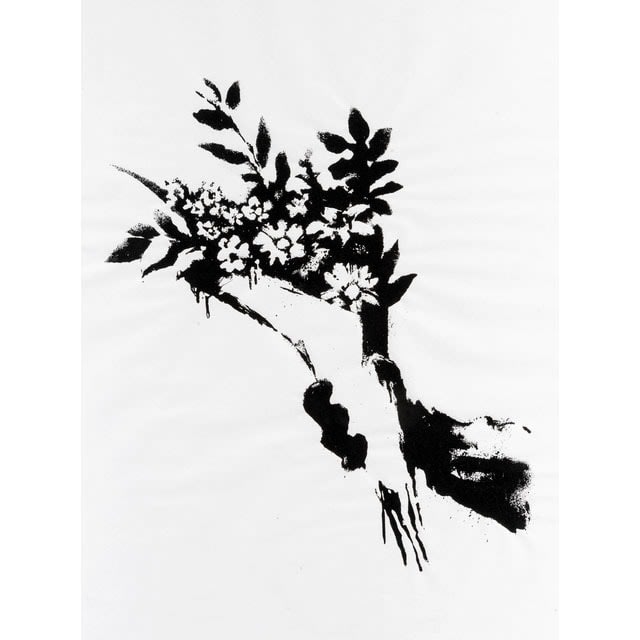
Banksy’s Gross Domestic Product appeared in Croydon in October 2019 as a shopfront, an installation and a pointed argument about who controls the commercial use of an artist’s images. The premises displayed a deliberately unruly range of objects—among them the stab vest made for Stormzy’s Glastonbury performance, a rug depicting Tony the Tiger and a disco ball constructed from police riot helmets—while purchases were handled online rather than across a conventional counter. For collectors, the project is important because it joins several strands of Banksy’s practice in one place: street imagery, institutional satire, consumer culture, authorship and the uneasy border between artwork and merchandise.
Two works connected to that moment, GDP Rat and GDP Thrower, are currently represented by Dovehouse Contemporary. Both are one-colour screenprints on newsprint made in 2019. Their modest materials are not incidental. Newsprint belongs to announcements, headlines and disposable public information; screenprinting permits an image to travel. Together, they make the works feel closer to street communication than to a polished luxury object, even when they later enter a collection.
What was Banksy’s Gross Domestic Product?
Gross Domestic Product was a temporary Banksy installation presented behind the windows of a disused retail unit in Croydon, South London. It appeared at the junction of Frith Road and Church Road on 1 October 2019 and was publicly described by Croydon Council as one of the artist’s largest UK projects at the time. The physical shop was made to be looked at rather than entered; products were subsequently offered through an online store.
The immediate context was a trademark dispute. Banksy said that a greetings-card company was attempting to trade using his name and imagery, and that he had been advised to demonstrate commercial use. That legal origin is part of the project, but it does not exhaust its meaning. Banksy turned a practical problem into a work about retail itself: a shop that withheld access, useful objects made deliberately strange, and consumer goods recast as vehicles for arguments about migration, policing, branding and ownership.
The title carries the joke. “Gross domestic product” is an economic measure, but here it became the name of a domestic-goods business whose products resisted ordinary consumption. The project treated the shop window as a public exhibition space and the online checkout as part of the artwork’s distribution system. It was simultaneously sincere commerce and a parody of commerce—an ambiguity that remains central to the surviving editions and objects.
Why the 2019 project still matters
Banksy has long used familiar formats to make an audience reconsider what it is seeing. A stencil resembles a public sign; an auction becomes a performance; a hotel becomes an artwork; a shop becomes a legal and artistic proposition. Gross Domestic Product belongs to that pattern. Its strength came from using the language of retail without accepting the usual promise that shopping should be frictionless, aspirational or reassuring.
It also placed questions of authenticity and control in unusually direct view. Banksy’s images circulate widely, often without permission and sometimes with misleading claims. The 2019 project did not resolve that tension. Instead, it made the contradiction visible: an artist associated with anti-commercial gestures was using commerce to defend the distinction between authorised work and unauthorised merchandise. For a collector, this history makes documentation more—not less—important.

GDP Rat: a small figure with a public voice
The rat is one of Banksy’s most persistent figures. It can be read as survivor, trespasser, observer or stand-in for those excluded from official power. In GDP Rat, that familiar character is tied to the Croydon project and printed on the same kind of inexpensive paper associated with short-lived public messages. The Dovehouse example measures 50.5 × 38.5 cm.
The work rewards close looking precisely because it is materially spare. A restricted palette directs attention to silhouette, gesture and the grain of the paper. That economy is consistent with the speed and clarity of street communication, where an image must register before its audience moves on. Collectors interested in the broader motif can read our guide to Banksy’s rats and their political voice.

GDP Thrower: an established image in a new context
GDP Thrower revisits the throwing figure associated with one of Banksy’s best-known compositions. Within Gross Domestic Product, the image acquired another layer: a work entangled in the very debate over trademark, reproduction and commercial control that prompted the Croydon display. The Dovehouse example is a one-colour screenprint on newsprint measuring 76.5 × 57.5 cm.
The larger format gives the figure a different physical presence from GDP Rat, but both depend on the same graphic compression. Banksy’s method removes descriptive excess so that pose and direction do most of the work. The result feels immediate at a distance and more materially vulnerable at close range. For more on how that visual economy developed, see how Banksy uses the stencil.
What should collectors check before buying a GDP work?
1. The precise object and medium
Begin with the individual work rather than the general story. Confirm the title, date, process, support and measurements against the seller’s description. GDP Rat and GDP Thrower are distinct compositions and formats. A photograph alone is not enough to establish which version is being offered or how it was produced.
2. Condition of the newsprint
Newsprint is inherently more delicate than a heavyweight fine-art paper. Ask for a current condition report and clear photographs in neutral light. Points to inspect include creases, edge handling, small tears, surface abrasion, cockling, discolouration and any evidence of adhesive or unsuitable backing. These observations do not automatically disqualify a work; they help establish whether its condition is consistent with its material and history.
3. Provenance and supporting paperwork
Because Gross Domestic Product had a specific place, date and method of distribution, provenance should be coherent and recorded. Ask what documentation accompanies the work and whether the chain of ownership is clear. Do not treat an online image, a familiar motif or a signature-like mark as a substitute for evidence. Our guide to Banksy authentication and Pest Control explains the distinction between visual familiarity and formal authentication.
4. Framing and long-term care
A work on newsprint should be framed with conservation in mind. The sheet should not be permanently adhered to a backing board, and glazing should not sit directly against the paper. Acid-free materials, appropriate hinges and protection from strong or sustained light are sensible starting points. Request photographs of the work outside the frame where possible, because glazing can hide undulation, edge condition and previous mounting.
5. The work’s place within a collection
A GDP work can appeal for several reasons. It may extend a collection of Banksy prints; it may sit within a group focused on art and consumer culture; or it may be collected as a document of a specific public project. Clarifying that purpose helps when comparing the quieter, emblematic GDP Rat with the larger and more immediately recognisable GDP Thrower.
How do GDP Rat and GDP Thrower differ?
The clearest differences are image, scale and emphasis. GDP Rat uses a recurring Banksy character associated with marginality and persistence, while GDP Thrower draws on a figure that has become central to the artist’s public visual language. The former is smaller at 50.5 × 38.5 cm; the latter measures 76.5 × 57.5 cm. Both are described in the Dovehouse catalogue as one-colour screenprints on newsprint from 2019.
Neither should be reduced to a generic “Banksy print.” Their meaning is anchored in the Croydon project: the shopfront, the online sale, the trademark dispute and the artist’s deliberate collision of public art with retail. That context is a substantial part of what a collector is acquiring.
Collecting Banksy’s Gross Domestic Product works
The most convincing examples are those that combine a legible history with carefully recorded condition. Buyers should expect direct answers about the individual sheet, its paperwork, its framing and any restoration or mounting. Price comparisons are only useful when the object being compared is genuinely comparable in medium, size, condition and documentation.
Explore the current Banksy collection at Dovehouse Contemporary, including GDP Rat and GDP Thrower. To request condition information, supporting documentation, framing details or worldwide delivery options for either work, contact Dovehouse Contemporary for a focused discussion.


Leave a comment
This site is protected by hCaptcha and the hCaptcha Privacy Policy and Terms of Service apply.