
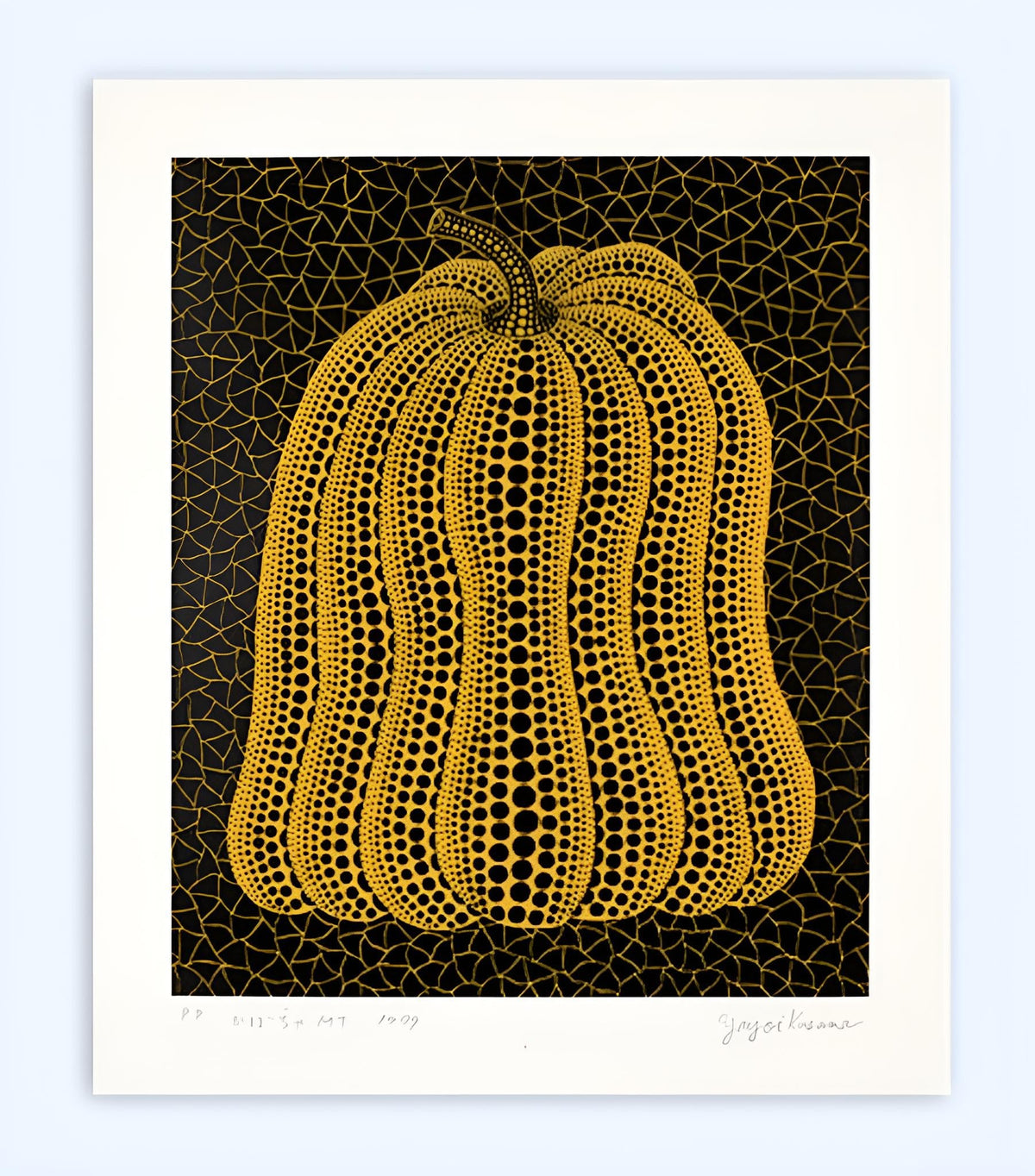
Yayoi Kusama’s pumpkin is one of the most recognisable motifs in contemporary art. It appears in paintings, drawings, prints, sculptures, installations and artist multiples, often covered in the polka dots that have become inseparable from Kusama’s visual language. For collectors, that visibility creates both opportunity and confusion: a “Kusama pumpkin” can range from a signed screenprint to a small resin multiple, and those categories should never be treated as interchangeable.

Dovehouse Contemporary regularly handles Kusama prints and editions. Browse the current Yayoi Kusama collection, and read our broader overview of collecting Kusama prints and editions.
Why does Yayoi Kusama use pumpkins?
Kusama’s relationship with pumpkins reaches back to childhood. Growing up in Matsumoto, Japan, around her family’s seed nursery, she became fascinated by the pumpkin’s rounded, irregular form. The motif appeared in drawings from the late 1940s and later became a recurring image across her practice.
The pumpkin is visually useful because it combines a simple silhouette with a highly structured surface. Its ribs create natural divisions, while Kusama’s dots can expand and contract across the form. That gives her a way to explore repetition without losing the recognisable object underneath.
Over time the pumpkin has moved between intimate works on paper and monumental sculpture. Kusama also incorporated pumpkins into immersive installations, including mirrored environments in which the motif multiplies into apparently endless space. The same idea—one form becoming many—helps explain why printmaking and editioned work are such natural parts of her practice.
What is the relationship between pumpkins and polka dots?
Polka dots are not simply decoration in Kusama’s work. Repetition is a central method through which she dissolves the boundary between one object and the wider field around it. On a pumpkin, dots follow the curved surface while the ribs of the gourd create a second rhythm.
This combination makes pumpkin images unusually effective as prints. A screenprint can deliver flat, saturated colour and crisp repeating shapes, while variations in palette can transform the emotional effect of the same motif.
For a wider introduction to her graphic work, see Yayoi Kusama in Print.
Kusama pumpkin prints versus pumpkin multiples
Collectors should begin by separating two broad categories.
Prints on paper may include screenprints and other editioned works. These can be signed and numbered and may have a clearly defined edition structure. Paper, printing method, image size and margins are all part of the object.
Sculptural multiples are three-dimensional editions made in materials such as resin or metal. They may be numbered or produced in another documented format and are assessed partly through their physical condition, original packaging and surface finish.
Dovehouse currently catalogues examples across these categories, including the screenprints Pumpkin MT and Pumpkin GB-D, as well as small sculptural pumpkin editions such as the red and yellow cast-resin pumpkin set.
These objects may share a motif, but they belong to different collecting categories. A paper print should be compared with the same print edition; a resin multiple should be compared with the same sculptural edition.
What should collectors check on a Kusama pumpkin print?
1. Exact title and catalogue description. Kusama has produced numerous pumpkin images. Small differences in title, colour and date can identify entirely different editions.
2. Printing technique. Screenprint is particularly associated with the crisp colour and repeated pattern of many Kusama editions, but collectors should verify the stated medium rather than assume.
3. Edition number. Check the numbered edition and whether artist’s proofs, printer’s proofs or other proofs are documented. A proof should be identified by its correct notation.
4. Signature. Determine whether the signature is hand-signed and where it appears. A printed signature or copyright statement is not the same as a pencil signature by the artist.
5. Condition. Strong colour, clean paper and careful framing matter. Look for fading, surface marks, foxing, rippling, staining and poor mounting. Our condition and framing guide provides a practical starting point.
6. Provenance. Reliable invoices, gallery records and prior ownership documentation add clarity. With an artist whose imagery is reproduced widely, documentation is especially useful.

What should collectors check on a Kusama pumpkin sculpture or multiple?
Three-dimensional multiples require a slightly different condition checklist. Inspect the surface for scratches, chips, dents, discolouration and repairs. Ask whether the original box, insert, label or certificate remains with the object where relevant. Packaging can be practically important because it protects the work and helps establish that the object has been cared for properly.
Collectors should also verify dimensions. Kusama pumpkin multiples exist in different sizes and materials, so photographs can make two distinct editions appear deceptively similar online.
For more on this category, see Yayoi Kusama’s Sculptural Pumpkins and Artist Multiples.
Why do Kusama pumpkin editions attract new collectors?
The motif is immediately recognisable, but that alone does not explain its appeal. Pumpkins also offer a clear path into Kusama’s wider ideas. They connect repetition, organic form, childhood memory, immersive installation and the artist’s use of dots. A collector can therefore start with a relatively compact object and still engage with a theme that runs through decades of the artist’s work.
The range of media is another factor. Someone interested in works on paper may focus on signed screenprints. A collector who prefers objects may choose sculptural multiples. Others may build a group across both categories, using colour or date as the organising principle.
How should you compare prices?
Compare like with like. A signed screenprint from a documented edition should not be priced by reference to an unsigned poster, a museum product or a resin object simply because each shows a pumpkin. Useful comparisons should match as many variables as possible: exact title, medium, size, edition, signature status, date and condition.
This is especially important when searching online, where product titles can compress very different objects into the same broad keyword phrase. “Kusama pumpkin print” is a useful search term; it is not, by itself, a complete catalogue description.
Building a focused Kusama collection
One approach is to collect pumpkins across media: for example, one screenprint, one sculptural multiple and one exhibition-related work. Another is to focus tightly on signed prints and compare how the motif changes through colour. A third approach is to build around repetition more broadly, linking pumpkins with Infinity Net imagery, dots and other recurring forms.
The strongest collections usually have a reason for putting works together. That reason does not need to be academic. It can be as simple as a preference for red-and-black works, compact editions, Japanese post-war art or images built around repeated pattern. What matters is consistency in how each object is described and assessed.
Frequently asked questions
When did Kusama first use pumpkins?
The pumpkin motif appears in her work from the late 1940s and has continued across later paintings, prints, sculpture and installations.
Are Kusama pumpkin prints signed?
Many important print editions are signed and numbered, but not every object carrying a Kusama pumpkin image is hand-signed. Check the exact edition rather than assuming.
Is a Kusama pumpkin sculpture the same as a print edition?
No. A sculptural multiple and a print are different categories of object even when they use closely related imagery. They should be catalogued and compared separately.
Are printer’s proofs collectible?
Yes, where they are a documented part of the edition structure. A printer’s proof should be described accurately rather than treated as automatically superior to the numbered edition.
Where can I see Kusama works available through Dovehouse?
Browse the current Yayoi Kusama collection at Dovehouse Contemporary. Availability changes, and individual works may sell or move to enquiry-only status.
Collecting takeaway: Kusama’s pumpkin is simple enough to recognise instantly but complex enough to sustain a lifetime of variation. For collectors, the safest approach is equally simple: identify the exact object, understand its medium and edition, verify signature and provenance, inspect condition, and compare only with genuinely equivalent examples. That provides a much stronger foundation than buying on the strength of the motif alone.


Leave a comment
This site is protected by hCaptcha and the hCaptcha Privacy Policy and Terms of Service apply.