
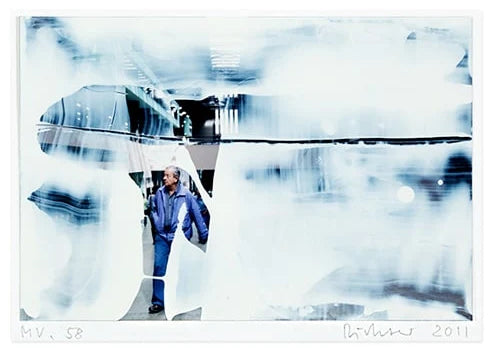
A small photograph can demand a surprisingly large amount of attention. Gerhard Richter’s M.V 58 measures just 10 × 15 cm, yet its surface holds two distinct kinds of image-making in tension: a colour photograph and an intervention in black and white lacquer. The photograph offers a recognisable world; the lacquer interrupts it. Neither is merely a ground for the other.
For collectors, that distinction matters. M.V 58 is not a reproduction of one of Richter’s paintings and it is not one of his larger photographic editions. It belongs to the overpainted-photograph strand of his practice, where paint or lacquer is applied directly to an individual photographic print. The work is dated 2011 and is signed, dated and titled in pencil. Its modest scale, material sensitivity and place within the Museum Visit sequence all call for a different kind of looking, and a more exacting approach to due diligence.
In brief: M.V 58 is a 2011 work in black and white lacquer on colour photography, measuring 10 × 15 cm. Its title identifies it with Richter’s Museum Visit sequence, made around his 2011–12 Panorama retrospective at Tate Modern. The work is currently listed by Dovehouse Contemporary and may be viewed on the M.V 58 product page.
What is an overpainted photograph?
Richter began painting over photographs in the mid-1980s. The format allowed him to bring together two methods that are often treated as opposites. A photograph records light and fixes a fraction of time; paint is physical, opaque and responsive to the artist’s movement. In these works, the photograph remains visible as a printed object, but its apparent certainty is disturbed by a layer that can conceal, redirect or fracture what we see.
The overpainted photographs are often compact. Many use ordinary snapshots rather than staged or monumental images. Richter has worked with oil paint, enamel and lacquer, applying material by pressing, dragging, scraping or depositing it onto the photographic surface. The result is not a preparatory study. Nor is it simply a photograph with decoration added. The collision between the mechanically produced image and the hand-worked surface is the work.

Why M.V 58 belongs to Museum Visit
The “M.V” designation refers to Museum Visit, Richter’s largest group of overpainted photographs. The series was made from photographs taken at Tate Modern during preparations for Panorama, his 2011–12 retrospective. Across more than two hundred images, the museum appears not as a static temple but as a place of movement: people pass through galleries, gather and disperse, while lacquer alters the clarity and rhythm of the photographic scene.
This context changes how M.V 58 should be read. It is not an abstract passage placed over an anonymous stock image. The underlying photograph belongs to a numbered sequence concerned with how a museum is occupied and perceived. In related works, white lacquer is associated with quieter moments and stronger colour with greater activity. In M.V 58, black and white lacquer creates its own push and pull between interruption and visibility. What remains legible is as important as what has been blocked.
That is one reason the work rewards close viewing. At 10 × 15 cm, the scale is familiar from domestic photography. The size encourages the eye to move between minute changes in the lacquer and the photographic information beneath it. Enlarging the image on a screen may be useful for orientation, but it cannot substitute for understanding the physical surface, the edges of the print or the relationship between the photograph and its mount.
Original surface or photographic edition?
Richter has repeatedly used photography in very different ways, and the distinctions are commercially important. An overpainted photograph such as M.V 58 contains an artist-applied layer on the individual photographic print. By contrast, a photographic edition can reproduce the image of a painting or another source work without carrying that hand-applied surface.
Bagdad I (09), for example, is catalogued by Dovehouse as a 2014 C-print on aluminium, measuring 50 × 40 cm, from an edition of 500 and numbered. It is an editioned photographic object with a deliberately smooth presentation. It should not be described as an individually overpainted photograph. The comparison is useful because both works make photography central, but they occupy different positions within Richter’s practice and require different questions from a buyer.

What should a collector examine?
Begin with the catalogue entry, not an assumption based on appearance. Confirm the title, year, medium and dimensions against the work and its documentation. For M.V 58, the current Dovehouse record states black and white lacquer on colour photography, 10 × 15 cm, signed, dated and titled in pencil. A prospective buyer should ask to see clear images of the inscription and the complete object, including the mount and reverse where access is possible.
Condition must be considered across two materials. The photographic print can be vulnerable to fading, surface abrasion, handling marks and changes at the edges. The lacquer may present its own texture, gloss and impasto, so an irregular surface is not automatically damage. What matters is whether there is any later cracking, lifting, loss or contact with glazing. Those points should be assessed by a qualified specialist and recorded in a current condition report. We would also want to know whether the work has remained in its original mount or frame, and what glazing and backing materials have been used.
Scale makes careful framing essential. A heavy mount can overwhelm a 10 × 15 cm work, while glazing placed too close to a raised lacquer surface may create a physical risk. Conservation-grade materials, stable hinges and UV-filtering glazing are sensible considerations, but any reframing should follow professional advice. The object should be protected without making the photograph feel like a specimen.
Documentation and provenance
With a work of this type, documentation should establish a continuous, plausible history and identify the work precisely. The title is a sequence number, so a missing digit or inconsistent punctuation is not trivial. Compare invoices, labels and published references with the inscription and image. Ask whether the work appears in relevant literature, exhibition records or the comprehensive catalogue of Richter’s overpainted photographs. Any certificate or gallery document should be examined as part of the whole file, not treated as a substitute for the work itself.
Richter’s market includes paintings, works on paper, photographs, facsimile objects and editioned prints. Similar imagery can appear across more than one category. A clean invoice should therefore state the medium and dimensions in full. “Photograph” alone is not sufficiently precise for M.V 58; the lacquer is central to its identity.
How M.V 58 fits a Richter collection
The work is particularly relevant to collectors interested in the unstable boundary between depiction and abstraction. Dovehouse’s essay on Gerhard Richter and the meaning of blur considers how he complicates photographic certainty in paint. M.V 58 approaches that problem from the opposite direction: the photograph remains materially present, while lacquer interrupts its legibility.
It also sits naturally beside our account of Richter’s abstract language. Here abstraction is not a separate image but an event on top of another one. For a wider view of how originals and editions differ, our guide to collecting Gerhard Richter prints and editions sets out the broader categories a buyer will encounter.
The strength of M.V 58 lies in concentration. It takes the scale of an ordinary photographic print and makes every decision consequential: the width of a black passage, the interruption of a figure, the remaining sliver of colour. It is a work to live with at close range, not one that relies on spectacle.
Explore the current Gerhard Richter collection, or contact Dovehouse Contemporary about M.V 58 to request the latest condition, provenance, framing and availability information.

Leave a comment
This site is protected by hCaptcha and the hCaptcha Privacy Policy and Terms of Service apply.