
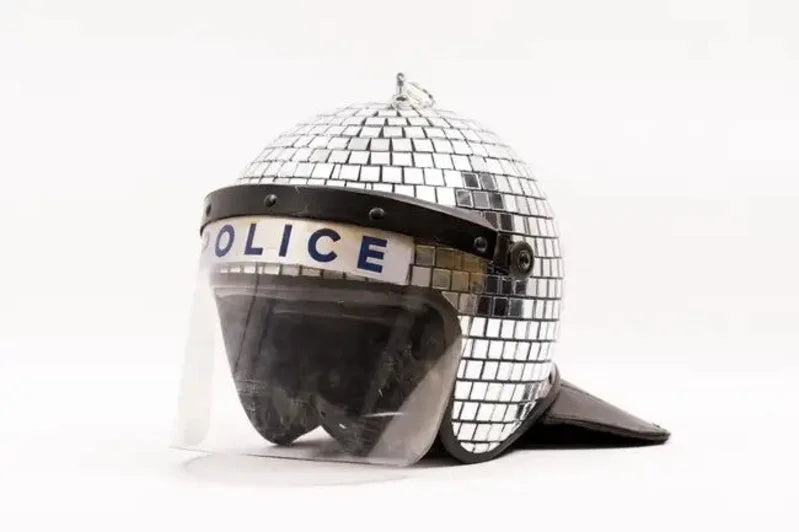
There is an immediate visual joke in Banksy’s Met Ball. A police riot helmet, an object designed for control and protection, has been covered with hundreds of small mirrors until it resembles a disco ball. The title turns the Metropolitan Police into the Met Gala. Yet the work rewards slower attention. For a collector, the important questions concern the underlying object, the edition, the interior inscription, documentation and the condition of a mirrored surface that is very different from paper.
First released through Banksy’s Gross Domestic Product project in 2019, Met Ball belongs to an edition of 50. It is made from a reclaimed police riot helmet faced with approximately 650 mirrored tiles. Examples are signed and numbered inside. That concise description establishes the work, but it does not settle every due-diligence point. Three-dimensional works need to be assessed as objects, not treated as prints with an unusual shape.
Banksy’s Met Ball at a glance
- Artist: Banksy
- Title and date: Met Ball, 2019
- Medium: reclaimed police riot helmet and mirrored tiles
- Edition: 50
- Signature and numbering: signed and numbered inside
- Original context: Gross Domestic Product, Banksy’s Croydon shop project
The current Dovehouse Contemporary listing for Met Ball records approximate dimensions of 46 × 32 cm. Published measurements for other numbered examples vary, which is understandable with an irregular helmet and several possible measuring orientations. A prospective buyer should therefore ask for the dimensions of the exact object under consideration rather than assuming that every catalogue has measured it in the same way.
Why Gross Domestic Product matters
Banksy opened Gross Domestic Product in Croydon in October 2019. Its window display presented dysfunctional homewares and artist-designed objects, while sales were handled online. The project also had a legal context: it was established amid a dispute over the commercial use of Banksy’s name and imagery. That background matters because Met Ball is not a later translation of a familiar stencil into a decorative object. It was conceived as one of the project’s products.
The official Gross Domestic Product description called it a “home entertainment lighting system”. The phrase is dry, almost administrative, and precisely tuned to the work. A device associated with public-order policing becomes a reflective domestic light object. Its mirrored surface sends an image of the room back at the viewer in fragments. The transformation is comic, but it does not neutralise the helmet’s original purpose. The tension remains visible beneath the sparkle.
This is what gives Met Ball more than novelty value within Banksy’s output. It compresses institutional authority, consumer design and a visual pun into a single object. It also demonstrates how the artist’s practice extends beyond stencilled imagery. Our broader guide to Banksy’s Gross Domestic Product, GDP Rat and GDP Thrower explains the wider shop project; the present guide is deliberately narrower, focused on the practical questions raised by this particular sculpture.

Edition, signature and the interior of the helmet
Met Ball was produced in an edition of 50. Auction records for numbered examples show the signature and edition number on the inside of the helmet, and Banksy’s original product page also states that the work is signed internally. That placement is logical: a signature painted over the mirrored exterior would interfere with the object’s visual effect and would be vulnerable to handling.
For the buyer, it means that a front-view photograph is not enough. Ask for clear images of the interior, including the full signature and edition number, as well as wider photographs that show where the inscription sits in relation to the helmet fittings. The number should correspond across the artwork, invoice, provenance record and any authentication paperwork. This is a basic check, but an important one. On an editioned sculpture, an unambiguous link between object and documentation is part of the work’s commercial identity.
The edition size does not make all 50 objects interchangeable. Each uses a reclaimed helmet and a labour-intensive tiled surface. Small differences in the underlying shell, fit of the tiles and signs of age can affect how an example presents. Those differences need not be defects. They do, however, make exact-object photographs and a current condition report more useful than a generic edition description.
Authentication: what the paperwork should establish
Pest Control Office is the only body authorised to authenticate Banksy’s art and the only source of its certificates of authenticity. Gross Domestic Product buyers did not automatically receive a Pest Control certificate with an online purchase; the official guidance explains that invoices and receipts are not substitutes for a certificate. On the secondary market, the practical question is therefore not simply whether Gross Domestic Product paperwork exists, but whether the exact work has the appropriate Pest Control documentation.
Before acquisition, request a legible view of the certificate and confirm that its details correspond with the interior edition number. Review the ownership trail from the original purchase onward. If a certificate is in the process of being updated, establish who is managing the application, what evidence has been submitted and how completion will be documented. Our separate article on Banksy authentication and Pest Control covers the process in greater depth.
A certificate is not a condition report. Nor does a Gross Domestic Product receipt, by itself, answer a condition or attribution question. The strongest acquisition file brings the object, its interior markings, its transaction history and its authentication documents into agreement.
How to inspect a mirrored Banksy sculpture
The materials require a different inspection from a screenprint. Begin with the mirrored skin. Check whether any tiles are missing, cracked, noticeably scratched, loose or replaced. Look closely at edges and high points, where contact is most likely. Ask whether adhesive is visible or has discoloured, and whether there is evidence of later repair. Raking-light photographs can reveal surface marks that disappear in a bright, frontal image.
Then consider the helmet itself. The shell should be checked for cracks, distortion and impact damage. Interior components and the signed area deserve separate photographs. Any display stand or electrical lighting arrangement should be described clearly, including whether it is original to the sale or a later display solution. Neither should be assumed from an installation photograph.
Transport matters as well. Mirror tiles introduce numerous vulnerable edges, while the helmet’s curved form can make pressure points difficult to predict. A collector should ask how the work will be supported inside its crate, whether the surface will remain free from direct contact, and who will be responsible for specialist packing. These are not secondary details. A well-documented packing plan protects both the object and its condition history.
Met Ball in relation to other GDP objects
Gross Domestic Product repeatedly took familiar, functional things and made their contradictions visible. The Spray Can from 2019, for example, turns a basic tool associated with graffiti into a signed sculptural object. The current Dovehouse example is a cylindrical metal can with black overspray, signed in white paint and accompanied by Banksy paint card no. 1681. It shares Met Ball’s project history, but its edition structure and physical risks are different. Collectors should resist treating all GDP objects as a single category.

Welcome Mat offers another contrast. The textile work was made from material taken from life jackets abandoned on Mediterranean beaches and produced with Love Welcomes, an organisation working with women in detainment camps in Greece. Its social and material history is integral to the object. Met Ball, by comparison, takes an instrument of authority and converts its hard shell into a fractured reflector. Both show why an object-specific approach is essential: provenance, materials and conservation questions change from work to work.
A practical checklist before buying Banksy’s Met Ball
- Identify the exact edition number. Obtain a clear photograph of the signed and numbered interior.
- Match object and documents. Check that the edition number and descriptive details agree across the certificate, invoice and provenance record.
- Verify authentication. Confirm the status of the Pest Control certificate rather than relying on a Gross Domestic Product receipt alone.
- Read a current condition report. Pay particular attention to mirrored tiles, adhesive, the helmet shell and any repairs.
- Confirm exact dimensions. Three-dimensional measurements can vary with orientation, so use the record for the specific example.
- Understand the display arrangement. Establish what stand, fitting or lighting equipment is included and whether it is original or later.
- Plan specialist transport. Agree packing, insurance and installation responsibilities before the work moves.
Considering an example?
Met Ball succeeds because the joke is immediate but the object is not exhausted by it. The mirrored surface attracts attention; the reclaimed riot helmet keeps the work politically uncomfortable. For collectors, that combination makes careful object-level research especially worthwhile.
Explore the current Banksy collection at Dovehouse Contemporary, or speak with our team about the available Met Ball. We can provide current availability, detailed images, documentation and condition information, and discuss packing and international delivery. For further context, see how Banksy uses the stencil to compare the artist’s object practice with the graphic economy of his best-known prints.

Leave a comment
This site is protected by hCaptcha and the hCaptcha Privacy Policy and Terms of Service apply.