
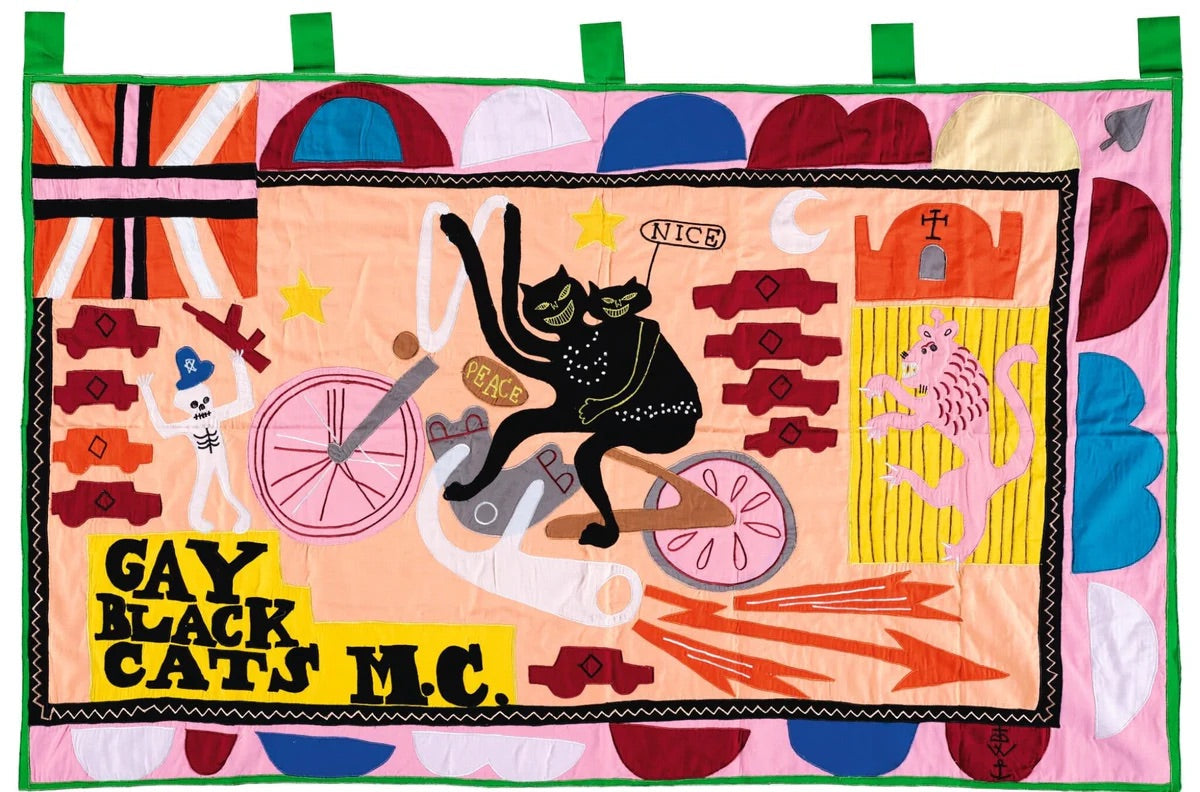
Grayson Perry has long occupied a singular space within contemporary art: a figure at once deeply traditional and radically subversive. Here at Dovehouse Contemporary, his work offers a compelling lens through which to examine the intersections of craft, identity, and social commentary in the 21st century.
At first glance, Perry’s ceramic vessels appear to echo the refined elegance of classical pottery. Their forms recall ancient amphorae, delicately balanced and meticulously glazed. Yet this surface familiarity is quickly disrupted. On closer inspection, the pots reveal densely layered imagery- scenes of modern life, biting satire, and deeply personal narratives. Perry uses the vessel not merely as an object, but as a storytelling device, one that challenges the historical divide between “high” art and craft.
In context

Lockdown From Islington (2022)
This tension lies at the heart of Perry’s practice. Working across ceramics and other media, he has consistently pushed against the marginalisation of craft within the contemporary art world. His Turner Prize win in 2003 marked a significant moment, not just for his career, but for the broader recognition of ceramics as a serious artistic medium. In short- Perry’s work resonates as both a continuation of tradition and a critique of it.

Beyond the medium itself, Perry’s exploration of identity is perhaps his most defining contribution. Through his alter ego, Claire- a flamboyantly dressed persona- he interrogates gender norms, class structures, and the construction of self. This performative aspect extends into his visual work, where autobiographical elements intertwine with broader cultural observations. His tapestries, for example, function almost as contemporary chronicles, mapping the complexities of British society with humour and poignancy.
What makes Perry particularly relevant today is his ability to engage audiences beyond the confines of the gallery. His work is accessible without being simplistic, provocative without being alienating. He invites viewers to confront uncomfortable truths- about consumerism, prejudice, and the myths we construct around identity- while maintaining a sense of wit and humanity.

Perry’s embrace of storytelling also speaks to a renewed interest in narrative within contemporary practice. In an era often dominated by abstraction and conceptual detachment, his work reasserts the power of the personal and the figurative. Each piece becomes a kind of visual essay, rich with symbols and references that reward sustained attention. For collectors and viewers alike, this depth offers an enduring appeal.
Ultimately, Grayson Perry’s work challenges us to reconsider what art can be. It asks us to look beyond hierarchies of medium and taste, to embrace complexity, and to find meaning in unexpected places. For us here at Dovehouse Contemporary, his practice serves as a reminder that the most impactful art is often that which bridges worlds: past and present, craft and concept, the personal and the universal.

In celebrating Perry’s work, we are also celebrating a broader shift in contemporary art- one that values diversity of expression, material intelligence, and the courage to question established norms. It is within this evolving landscape that his work continues to inspire, provoke, and endure.
The decorative surface can delay recognition
A patterned vessel or richly coloured image may attract the eye before its smaller details become legible. That delay is useful in Perry's work. The viewer enters through visual pleasure, then encounters words, symbols or scenes that complicate the first impression. Decoration becomes a way of organising attention rather than a layer that can be separated from the subject.
Try reading a work twice: first through its overall shape and colour, then through individual references. Notice whether the second reading changes the first. A seemingly comfortable image may become sharper, while a satirical detail may sit within an object whose craft remains inviting. The tension is sustained because neither encounter entirely cancels the other.
Maps can describe beliefs as well as places
Mapping offers a familiar structure for making complicated relationships appear legible. Names, routes and boundaries promise an organised account of a world. In an artwork, that structure can be used to examine identity, taste or social divisions as well as physical geography. The viewer recognises the authority of a map while discovering that what it classifies may be contested.
Read labels carefully and ask whose viewpoint gives them meaning. A map can seem comprehensive while revealing a highly particular set of assumptions. Humour may make those assumptions easier to approach, but it does not remove their consequences. The image invites a reader to examine the categories through which a culture describes itself.
Public familiarity should lead back to the object
Perry's recognisable public presence can provide an entry into the work, but it should not replace attention to medium and construction. A ceramic object, a textile and a print organise narratives differently. Curved surfaces reveal information as the viewer moves; a flat sheet can place many references in view at once. Those differences affect how the story is read.
Browse the Grayson Perry collection with the exact format beside each image. The edition-description guide explains the publication details needed for works on paper. For other media, ask about materials, fabrication, markings and condition appropriate to the object. The goal is a precise encounter with a particular work, informed by the wider practice but not overwhelmed by celebrity.
Related reading
- Tracey Emin: Confession, Intimacy, and Radical Honesty
- From Etching to iPad: David Hockney’s Restless Printmaking
- How to Read a Limited-Edition Print Description
Persona and object
Perry’s public presence is important, but it should not eclipse the precision of the objects. Ceramics, tapestries and prints combine decorative attraction with dense narratives about class, identity, taste and national mythology. Humour invites entry while text and historical references complicate the initial reading.
Collecting across media
A print, ceramic edition and textile each require different questions. Confirm medium, dimensions, edition, signature or studio marks, publisher and fabricator. For paper, examine colour and margins; for ceramics, check glaze, chips, cracks and restoration; for textiles, review fading, pulls and mounting. Provenance and a clear description protect the distinction between editions and associated merchandise.


Leave a comment
This site is protected by hCaptcha and the hCaptcha Privacy Policy and Terms of Service apply.