
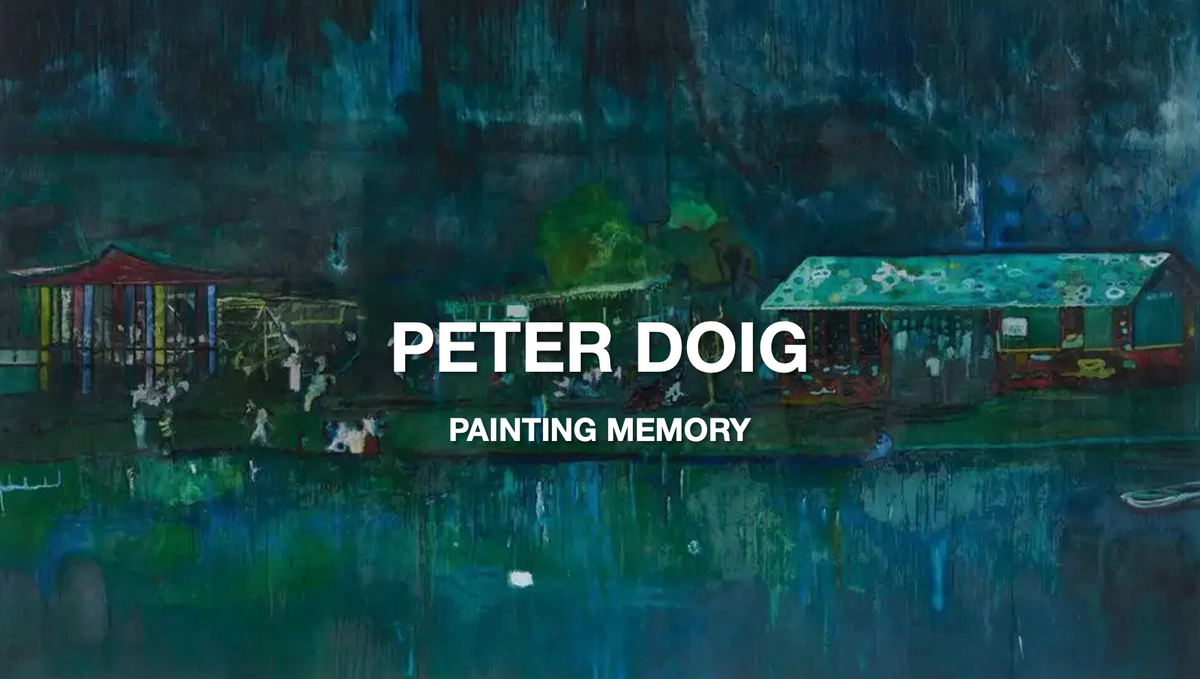
Few living painters have reshaped contemporary figurative painting as profoundly as Peter Doig.
Over the past three decades, the Scottish-born artist has established himself as one of the defining painters of his generation, creating works that occupy a unique space between landscape, memory and imagination. His paintings are immediately recognisable for their atmospheric beauty, luminous colour and dreamlike ambiguity, qualities that have secured his place among the most celebrated artists working today.

Unlike traditional landscape painters, Doig does not seek to document a place. Instead, he reconstructs remembered experiences, fragments of photographs, scenes from films and moments from his own life into compositions that feel both familiar and strangely elusive. His paintings invite viewers into worlds that appear suspended somewhere between reality and recollection.
Born in Edinburgh in 1959, Doig spent his childhood between Scotland, Trinidad and Canada before studying at Saint Martin's School of Art and Chelsea School of Art in London. These varied landscapes have remained central to his work throughout his career. Snow-covered forests, isolated cabins, still lakes, tropical beaches and dense jungles all reappear throughout his paintings, transformed through memory into richly layered psychological spaces.

A New Language for Landscape
Doig emerged during the late 1980s at a time when painting was often considered secondary to conceptual art. Rather than rejecting tradition, he reimagined it.
Drawing inspiration from artists as diverse as Edvard Munch, Claude Monet, Edward Hopper and Francis Bacon, while also borrowing imagery from cinema, postcards, newspapers and family photographs, Doig created a visual language that feels both deeply historical and unmistakably contemporary.
His paintings rarely provide straightforward narratives. Instead, they rely on atmosphere.
A solitary canoe floating across still water.
A cabin half-hidden within snow.
A skier disappearing into the forest.
These recurring motifs have become some of the most iconic images in contemporary painting, evoking feelings of nostalgia, isolation and quiet mystery.
The Power of Ambiguity
One of Doig's greatest strengths is his refusal to explain.
His paintings encourage viewers to complete the story themselves, allowing each image to remain open to multiple interpretations. This ambiguity has become one of the defining characteristics of his practice and one of the reasons collectors return to his work repeatedly.
The longer one spends with a Doig painting, the more it reveals.
Colours shift.
Figures emerge.
Landscapes dissolve.
Memory replaces observation.
This sense of continual discovery gives his work an enduring quality rarely found in contemporary painting.

Institutional Recognition
Today, Peter Doig is widely regarded as one of the most important living painters.
His work has been the subject of major exhibitions at institutions including the Tate Britain, The Courtauld Gallery, Musée d'Orsay and the Serpentine Galleries, while his paintings are held in many of the world's leading museum collections, including the Museum of Modern Art and the Tate.
This sustained institutional support has been mirrored by extraordinary collector demand.

Why Collect Peter Doig?
Collectors are drawn to Peter Doig because his paintings resist trends.
They reward slow looking rather than immediate consumption. They balance technical mastery with emotional depth, drawing on art history while remaining unmistakably contemporary.
Whether working in paint, printmaking or editioned works, Doig approaches every image with the same sensitivity to colour, atmosphere and memory. His editions provide collectors with an opportunity to engage directly with the visual language of one of the most influential painters of the last half-century.

In an art world that increasingly values authenticity, rarity and lasting cultural significance, Peter Doig occupies a position shared by only a handful of living artists.
His work is not simply collected.
It is studied, exhibited and continually rediscovered.
EXPLORE OUR COLLECTION OF PETER DOIG WORKS HERE
A barrier can make a landscape more compelling
A screen of trees, a reflection or a partly obscured building can keep the viewer from entering a scene easily. Instead of presenting landscape as an open view, Doig's imagery can make looking feel interrupted. We recognise enough to imagine a place, but the surface prevents complete access. That tension can make an apparently quiet image feel psychologically charged.
Follow the marks that lie between you and the apparent subject. Do they establish depth, or do they flatten the picture into a patterned surface? The answer may change as attention moves. A branch can be part of a represented forest and an emphatic line across the image at the same time.
Reflection doubles the uncertainty
Water can repeat a figure or landscape while changing its stability. An upright form may return as a broken or softened image below it. The viewer reads the reflection through knowledge of how water behaves, yet the painted or printed marks remain independent shapes. The scene can therefore move between spatial recognition and an awareness of its construction.
This makes reflection more than an atmospheric effect. It provides a way to ask whether the image is encountered directly, remembered or seen through another surface. The work need not supply a final answer. Its openness can arise from concrete relationships between forms rather than from a general claim that everything is dreamlike.
A source image is a beginning
A photograph or remembered scene can provide a starting point without determining the final work. Changes of colour, scale and emphasis alter how the image is experienced. The viewer may sense familiarity while being unable to identify a place securely. That combination is central to the distinction between recording a view and constructing a pictorial memory.
Compare the Richter seascape essay, which examines another relationship between photographic information and pictorial uncertainty. The artists' methods differ, but the comparison helps make the question more specific: what changes when an image is translated rather than merely repeated?
Read an edition through its own materials
In the Peter Doig collection, read the title, process, dimensions and publication details of each work. A printed edition can offer a distinct encounter with colour and scale without reproducing the physical surface of a painting. Condition, paper and signing information belong to that particular object and should be assessed independently of the artist's wider reputation.
A collecting decision is stronger when the image continues to reward attention after its familiar motifs have been recognised. Notice the obstruction, the reflection or the interval that keeps the scene from becoming fully settled. Those specific relationships are more durable reasons for interest than a headline about another work's market performance.


Leave a comment
This site is protected by hCaptcha and the hCaptcha Privacy Policy and Terms of Service apply.