
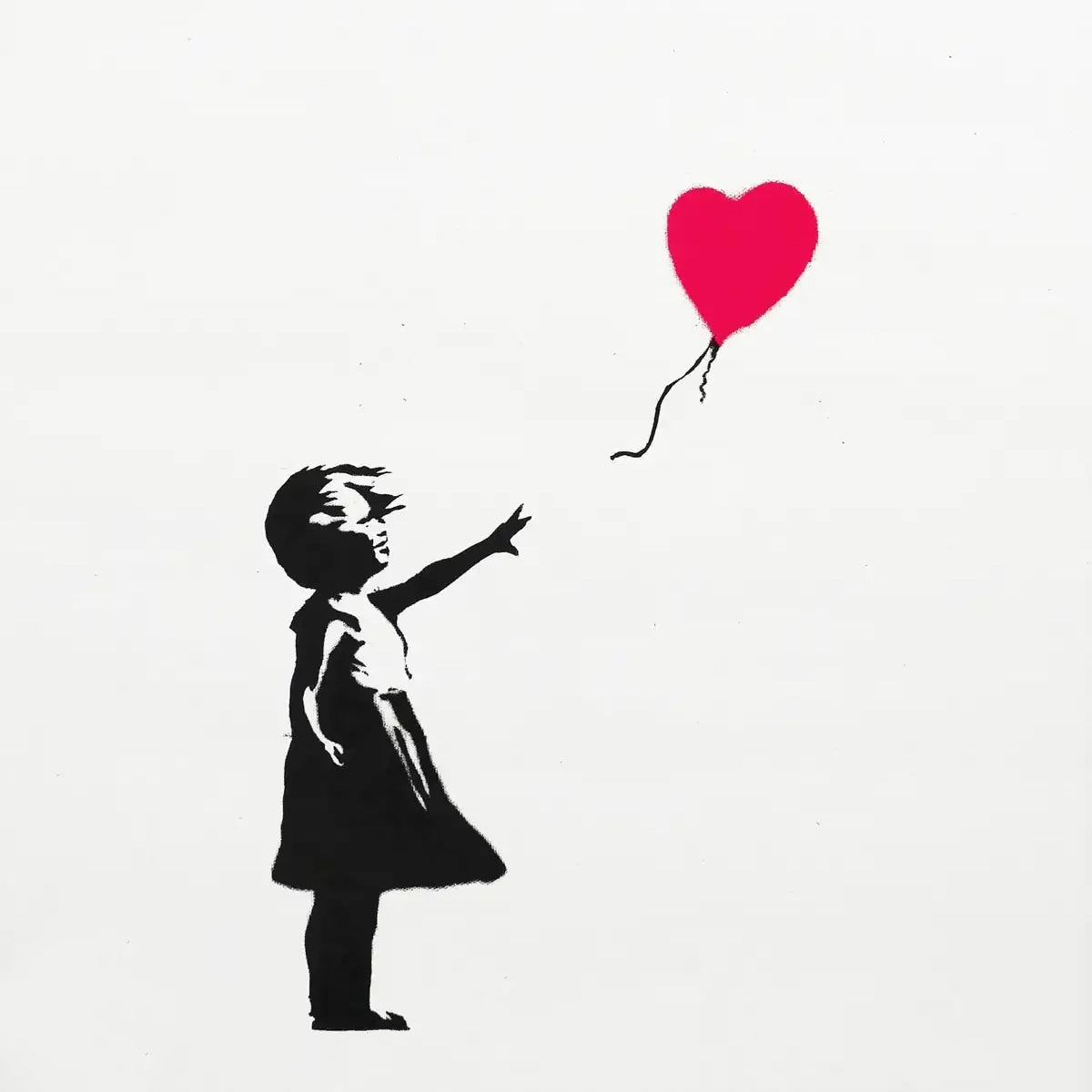
Banksy can put a joke and a threat into the same image. A child reaches for a balloon. A rat carries a placard. The stencil keeps the message legible from across the street, while the details complicate it when you stop to look.
That directness helps explain why the images travel so readily from walls to prints. The objects do not have the same history, though. A street intervention, a signed screenprint and a later publication need to be described on their own terms.
In context
What distinguishes Banksy from many of his contemporaries is his ability to speak simultaneously to the art world and the wider public. His works are instantly recognisable, yet they continue to reward closer inspection. Images such as Girl with Balloon, Flower Thrower, Napalm and Monkey Queen have become part of the visual fabric of modern society, reproduced across newspapers, television, social media and popular culture.
The artist's relationship with the traditional art market has always been complicated. While Banksy frequently critiques commercialisation and institutional structures, demand for his work has continued to grow. Major auction results, museum exhibitions and global media attention have elevated Banksy from street artist to one of the defining artistic voices of the twenty-first century. The now-famous shredding of Girl with Balloon immediately after its sale at auction in 2018 only reinforced his unique position—an artist capable of simultaneously participating in and satirising the art market.
At a time when much contemporary art can feel detached from everyday life, Banksy's work retains a directness and immediacy that few artists can match. Anonymous yet universally recognised, provocative yet accessible, Banksy has created a body of work that has moved far beyond the streets where it first appeared, securing his place as one of the most significant and enduring artists of our time.
Begin with the visual reversal
Banksy's most effective images often depend on changing one element within a familiar situation. A gesture appears recognisable, then a prop or participant makes it unexpected. The viewer understands enough of the scene to recognise the disruption quickly. That structure gives the work an accessible entry point while leaving room for questions about power, authority and the habits through which we read images.
Try describing the scene before explaining its message. What are the figures doing? Which detail would make the image ordinary if it were removed? Where does the eye go first? These questions keep interpretation tied to what is visible. They also reveal that the humour is constructed through precise relationships rather than added as a general tone of irreverence.
A familiar motif does not have one permanent meaning
The rat, balloon and repeated human figures can acquire different meanings through context. A wall, a printed sheet and a three-dimensional object establish different surroundings for the same broad visual language. Repetition creates recognition, but the action, scale and support determine the particular encounter. Treating every appearance as an identical symbol makes the work less specific than it is.
The rat essay follows one adaptable character, while the balloon essay examines a narrative that remains deliberately open. Reading them together shows how visual economy can support both political comedy and a more intimate emotional response.
The art market is part of the context
Banksy's participation in the circulation and sale of artworks creates tensions with images that criticise commercial systems. Those tensions should be examined rather than resolved through a slogan. A work can expose a contradiction while remaining involved in it. Publicity can broaden the audience for an image and also turn that image into a highly recognisable commodity.
For a collector, cultural visibility does not establish a reliable forecast of price or liquidity. The specific edition, condition, documentation and terms of sale remain central. A famous auction event involving one object should not be treated as a valuation model for every print carrying related imagery. The purchase needs to make sense through the work actually being offered.
Move from recognition to a documented object
Browse the Banksy collection by reading the medium and edition information as carefully as the title. Distinguish paper screenprints from canvas editions, objects and publications. If the description leaves the signing method or edition status unclear, ask the gallery to clarify it before comparing prices.
The stencil guide provides a way to examine the graphic construction, and the authentication guide linked below explains the documentation questions. Together they connect the image's immediate impact with the slower work of understanding its physical and historical identity.
That combination is the most useful starting point for a lasting interest in Banksy. Enjoy the wit and directness, but return to the exact gesture, setting and material through which they operate. The work becomes more revealing when its recognisability opens an enquiry rather than closes one.
When comparing two works, identify one visual decision that changes the experience: the position of a hand, the direction of a gaze or the amount of untouched space. This makes the comparison concrete and keeps the artist's fame from becoming the only thing the objects have in common.
For collectors, the first questions are concrete. Which image and colourway is it? Is the print signed or unsigned, and what documentation accompanies it? Check the edition, paper and condition of the individual sheet. The familiarity of a Banksy image can make those details seem secondary. In a transaction, they are central. A thumbnail tells you which work you recognise; it cannot tell you everything about the object offered.
Related reading
- Banksy Authentication and Pest Control Explained
- Signed or Unsigned Banksy Prints: What Collectors Need to Know
- Girl with a Balloon: Why Banksy’s Image Endures
- Banksy: The Voice of the Street
An artist built through public encounter
Banksy’s work first reaches viewers as an interruption to ordinary space: a wall, bridge or street becomes the site of an image that can be understood quickly but not exhausted immediately. Humour lowers the barrier to entry, while the collision between image and location supplies political force. Documentation, circulation and removal then become part of the work’s afterlife.
From wall to edition
Prints translate that public language into a collectable object. The shift changes scale, material and context, but strong editions retain the economy of the stencil and the tension between an accessible image and an uncomfortable subject. Collectors should identify the exact edition, signature status, condition and Pest Control documentation rather than treating every appearance of a familiar motif as equivalent.
Explore related works in the gallery
Girl With A Balloon is immediately recognisable, which makes precise identification more important. The linked signed work should be assessed through its own edition, condition and Pest Control documentation. We would not transfer those details to another impression simply because the motif is the same.


Leave a comment
This site is protected by hCaptcha and the hCaptcha Privacy Policy and Terms of Service apply.