
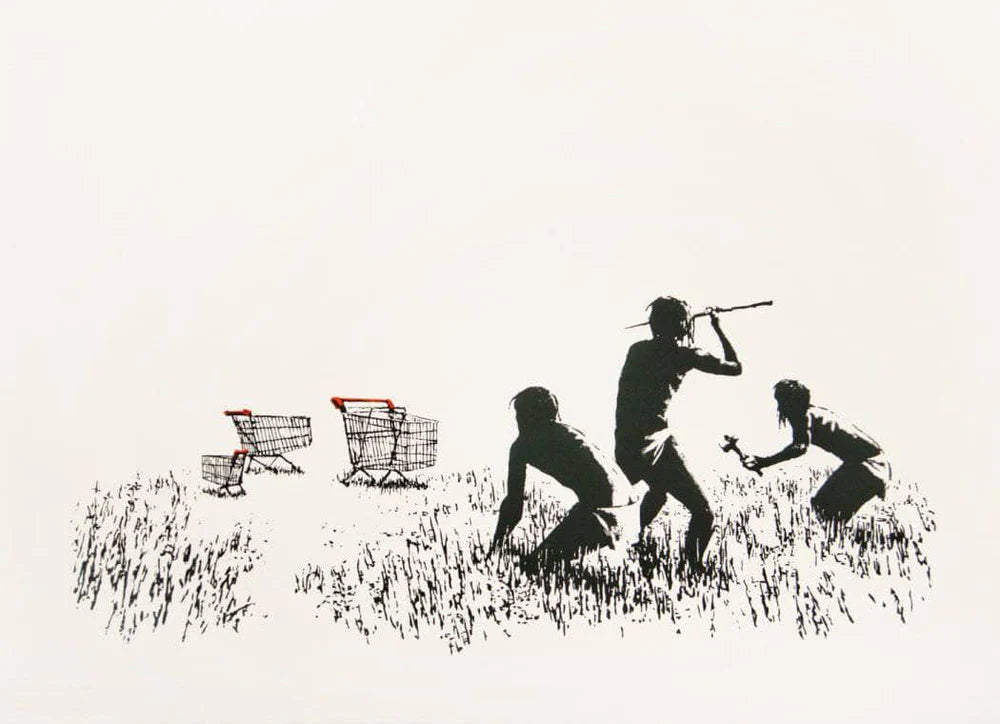
Banksy’s Trolleys is funny for about half a second. Three hunters move carefully through long grass, weapons ready, while their quarry waits ahead: a small group of empty shopping trolleys. The joke lands quickly, then turns. The supposedly primitive figures understand food as something that must be found and pursued; the modern objects promise abundance while containing nothing at all.
That economy is why the image has held up so well. Trolleys does not need a slogan or a named supermarket. It compresses a complicated argument about consumption, dependence and progress into one improbable meeting. For collectors, however, reading the image is only the beginning. The edition, paper, dimensions, authentication and condition all need to agree.
This guide focuses on the 2007 unsigned black-and-white edition currently represented in the Dovehouse Banksy collection. It explains what the image shows, how the edition is structured and which details deserve close attention before acquisition.
What is Banksy’s Trolleys print?
Trolleys is a screenprint in colours published in 2007 by Pictures on Walls, the London print publisher closely associated with Banksy’s editions of the period. In the black-and-white version, the landscape and hunters are rendered in black while the trolley handles introduce small, precise flashes of red. Christie’s records the unsigned edition at 500 and a separate signed edition at 150. The Dovehouse catalogue records the available unsigned work as 76 × 56 cm, from the edition of 500.
| Artist | Banksy |
|---|---|
| Title | Trolleys (unsigned) |
| Date | 2007 |
| Medium | Screenprint in colours |
| Dimensions | 76 × 56 cm (29 7/8 × 22 in) |
| Edition | 500 |
Those facts identify the edition, not every individual sheet. A prospective buyer should still check the number on the particular impression, the presence and form of publisher or artist blindstamps, and the wording of its Pest Control certificate. Auction records are useful comparators, but they cannot authenticate a different sheet.

Why the image still cuts cleanly
The composition is unusually spacious for Banksy. Most of the sheet is left open, with the encounter placed low across the paper. The hunters form a tense group on the right. Their bodies point towards the trolleys, but the distance between the two groups delays the collision. That gap is where the meaning develops.
The reversal is exact. Shopping trolleys are designed to receive goods that have already been gathered, processed and arranged for purchase. Here they sit in a field as if they were wild animals. The hunters’ tools look crude beside the wire geometry of the carts, yet the modern objects are useless without the vast retail system they represent. Remove the supermarket and the trolley is simply an empty cage on wheels.
The red handles matter. They are the only sharp colour note and they pull the eye towards the consumer objects before the narrative has fully registered. Banksy often uses stencil-based contrast to make an image readable at speed; our guide to how Banksy uses the stencil looks more closely at that visual economy. In Trolleys, the limited palette is not merely graphic. It makes the trace of retail branding feel conspicuous against an otherwise stripped-back scene.
Signed and unsigned editions: what changes?
The unsigned black-and-white Trolleys belongs to an edition of 500. Christie’s also records a signed edition of 150. Both are limited editions, and “unsigned” should not be confused with unnumbered, unlimited or unofficial. What changes is the form in which the edition was issued, not the underlying image.
Collectors should therefore resist shorthand comparisons. A signed impression and an unsigned impression are not interchangeable, and neither should be confused with the separate colour version of Trolleys. The most useful description names the variant, date, signature status, edition size, sheet dimensions and publisher. If one of those points is missing, ask for it.
The same discipline applies to price comparisons. An auction result for a signed or colour impression does not establish the value of an unsigned black-and-white example. Condition, certificate status, framing history and the exact impression all affect the comparison. Start by establishing that the works being compared are genuinely like for like.
Authentication: the certificate and the print must agree
Pest Control Office states that it is the only source of certificates of authenticity for Banksy’s paintings, prints and sculptures. Its current “check before you buy” service can examine an existing certificate against its database before payment. That makes the certificate essential, but not a substitute for looking at the work.
For an unsigned Trolleys, request clear images of the full recto and verso, the edition number, both lower corners, any blindstamps and the certificate. Check that the title, variant and number on the paperwork correspond to the print. Pest Control also recommends registering a change of ownership after a secondary-market purchase.
Our guide to Banksy authentication and Pest Control sets out the process in more detail. The practical point is simple: a convincing image is not enough. Edition identity, physical sheet and certificate should form one consistent record.
Condition: look beyond the framed view
Paper carries its history quietly. A print can appear clean behind glazing while still showing hinge marks, rippling, handling creases, staining or adhesive residue when examined out of the frame. Light exposure may also alter the paper tone or the red ink, so photographs should be taken in neutral, even light rather than through reflective glazing alone.
Ask whether the sheet has been trimmed and whether its edges remain intact. Confirm how it has been mounted. An archival hinge arrangement is fundamentally different from a sheet fixed directly to a backing board. If the work is sold framed, the frame can be useful, but it should never prevent a proper condition assessment.

Framing should protect the sheet without crowding it. The generous blank paper around the image is part of the composition, so a mount that reveals the full sheet can preserve both the work’s visual balance and important edition evidence. UV-filtering glazing and acid-free materials are sensible, although no glazing removes the need to control direct sunlight, heat and humidity.
Trolleys within Banksy’s consumer images
Banksy returns often to the language of buying and selling, but the tone shifts from work to work. Trolleys is almost archaeological: it imagines consumer equipment discovered outside the system that gives it purpose. The later GDP Rat places the artist’s familiar rat inside the explicitly commercial context of the 2019 Gross Domestic Product project. Our editorial on Banksy’s Gross Domestic Product prints explains that release and its shopfront setting.
The current Tesco Bomb Poster, an offset lithograph dated 2025 in the Dovehouse catalogue, approaches supermarket culture through a different format. It should be understood as a poster rather than folded into Banksy’s numbered screenprint editions. That distinction is useful. A collection can follow an idea across prints, posters and ephemera, but each object needs to be described on its own terms.
Within that group, Trolleys remains especially direct. It does not show a shop, a logo or a transaction. Instead it asks what the machinery of shopping looks like when the shelves and supply chains disappear. The answer is absurd, but not lightweight.
What to ask before acquiring an unsigned Trolleys
A useful enquiry should produce specific answers. Confirm the edition number and exact sheet dimensions. Ask for the Pest Control certificate status and whether the present owner is registered. Request unfiltered recto and verso photographs, close views of the lower corners and blindstamps, and a written condition report that addresses margins, mounting, creases, staining and colour. If framed, establish whether the sheet can be inspected safely outside the frame.
Dovehouse currently lists a 2007 unsigned Banksy Trolleys from the edition of 500. Contact our team for the current condition report, certificate details and further images of the specific impression. We will answer those questions directly, because with an edition such as this, precision is part of the work.

Leave a comment
This site is protected by hCaptcha and the hCaptcha Privacy Policy and Terms of Service apply.