
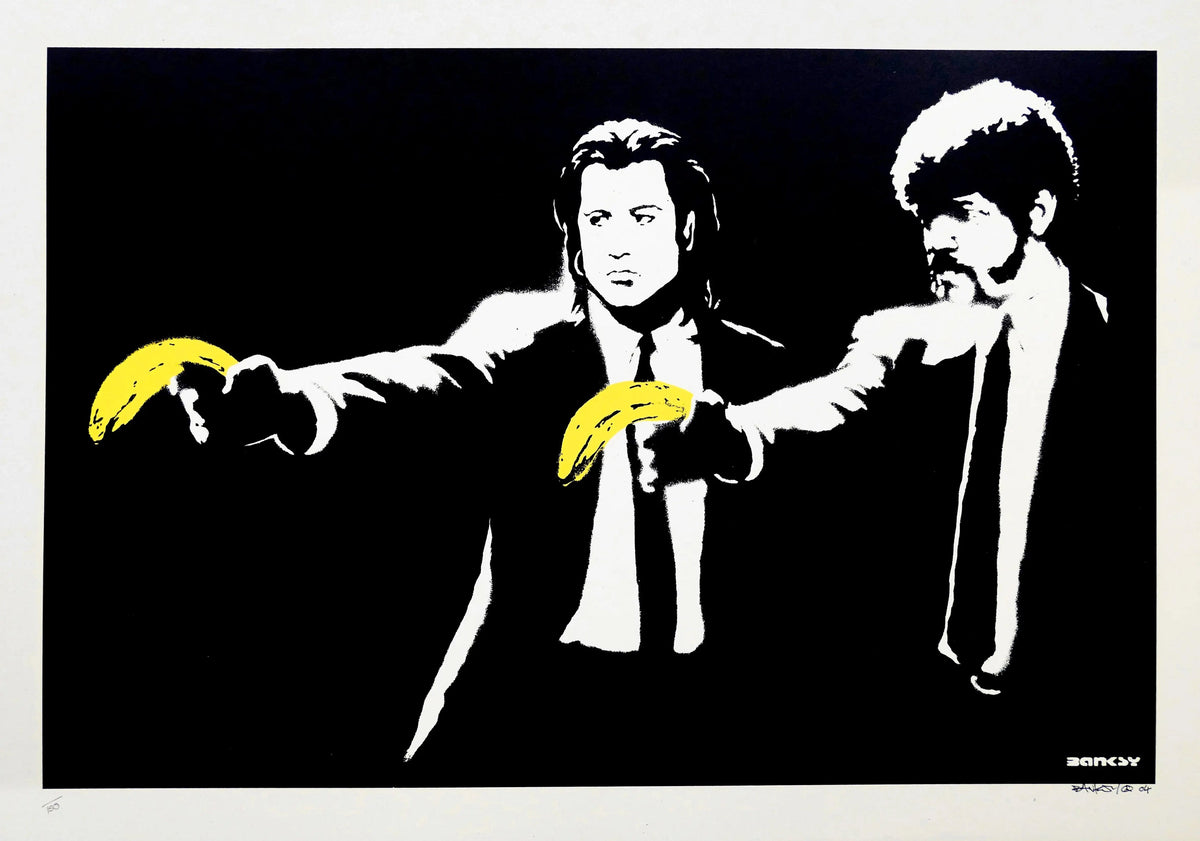
Why speed, repetition and interruption define the visual language.
The stencil provides practical speed in public space and a clean silhouette that translates powerfully into print.

Selected work: Pulp Fiction (unsigned).
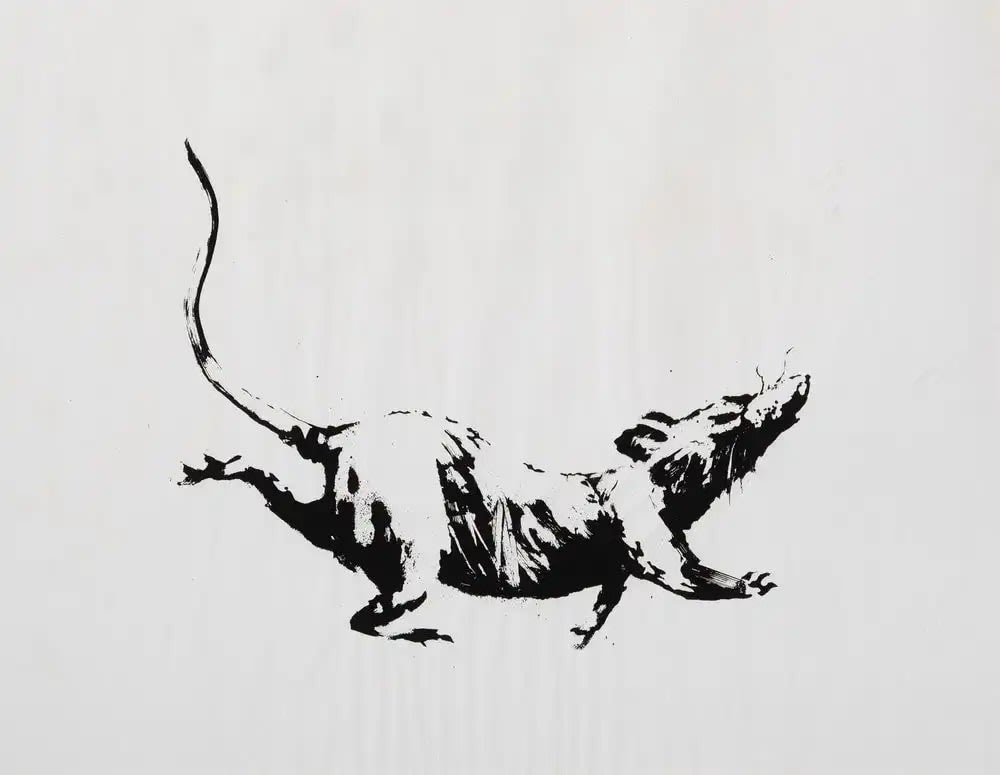
Current examples include GDP Rat, Pulp Fiction (unsigned) and Girl With A Balloon (unsigned). View the complete Banksy collection for current availability.
Explore available works by Banksy
Speed becomes a visual language
A stencil can be placed and sprayed rapidly, an obvious advantage for unauthorised street work. Banksy turns that practical method into an aesthetic of hard contours, limited tone and immediate recognition. Bridges in a stencil hold the design together, while overspray and interruptions can retain evidence of process. Apparent simplicity is the result of careful selection and reduction.
Stencil and print are related, not identical
Screenprints and other editions may preserve the crisp silhouette associated with the street works, but they are produced through different processes and for different contexts. The shared image can obscure this distinction. Collectors should identify medium, edition, paper, signature status and authentication, and should not describe every sharply bounded Banksy image as an original spray-painted stencil.
Looking more closely
The physical economy of a stencil is part of its meaning. Bridges hold separate areas together, hard edges preserve the speed of the gesture and a restricted palette keeps the image legible at a distance. In a print, those same decisions can be examined without the distraction of the street setting. Look closely at the junctions between black and white: they reveal how Banksy turns a practical method into a recognisable graphic syntax.
Designing for the wall
A successful stencil has to survive translation from a preparatory drawing to a cut template and then to an uneven surface. Fine details can disappear, isolated shapes need connecting bridges, and the final image must remain legible when seen quickly or from across a street. Banksy exploits those limitations. Faces are reduced to decisive shadows, gestures become silhouettes and a small prop—a bouquet, balloon, camera or placard—often carries the narrative. The result is not simply a shortcut to painting quickly. It is a visual system built around selection: what can be removed while the image still communicates?
The wall also participates in the composition. Brick joints, stains, signs and architectural edges can supply a horizon, barrier or frame. This is why photographs of street works should not be treated as interchangeable with editioned prints. The motif may be familiar, but the support and setting change how it functions.
From intervention to edition
In an edition such as Pulp Fiction, the street’s visual noise is replaced by controlled paper, ink and margins. That shift allows the graphic construction to become clearer. Negative space is active: it separates the figures, directs the eye and gives the black forms their speed. The work can be examined closely, but its impact still depends on the economy developed for public space.
For collectors, medium-specific language matters. A screenprint is not an “original stencil” merely because the image has stencil-like contours. The catalogue entry should identify the printing process, year, edition, dimensions, signature status and authentication. Asking for those details is not pedantry; it establishes exactly which object is being offered.
What to examine in a Banksy print
Begin with the silhouette. Look at the sharpness of the principal forms and at areas where black meets untouched paper. Then consider registration, ink density and the balance of the sheet. Condition problems can be especially disruptive in sparse images: a crease, stain, fade or poorly positioned mount may compete with marks that were meant to appear deliberate.
Finally, separate visual recognition from authentication. A convincing image is not sufficient evidence of authorship. Pest Control documentation, provenance and correspondence between the certificate and the physical work remain fundamental. The strongest buying decision combines an understanding of the image with a disciplined examination of the object.
The omitted detail can carry the idea
A reduced image depends on deciding which features can be omitted while a figure remains legible. Clothing may become a block of shadow, while the angle of an arm supplies the essential action. The viewer fills in what is absent from familiar patterns of posture and movement. This cooperation between a few decisive marks and learned recognition allows a sparse image to communicate quickly.
Look for the smallest element that changes the scene's meaning. It may be an object held in a hand or the direction in which a figure turns. If that detail were removed, the image might remain recognisable but lose its reversal or joke. The economy is therefore narrative as well as technical: a limited vocabulary concentrates attention on a selected relationship.
Positive and negative shapes work together
The black silhouette is only half the composition. The gaps between limbs, the opening around a prop and the unprinted area beside a figure define its action. Following those spaces can reveal how the design remains clear even at a distance. A cluttered surrounding field would change the speed with which the viewer recognises the scene.
On paper, those intervals become especially easy to inspect. They also make the condition of the support significant. A mark in a visually active gap can compete with the intended image, while a mount that covers part of the field can make the composition feel compressed. Looking at the whole sheet is therefore part of understanding the design, not merely a purchasing precaution.
Use technique to sharpen interpretation
The rat images show how a recurring silhouette can support changing actions. Girl with a Balloon shows how a small interval can carry an unresolved narrative. In each case, understanding the visual economy explains why the image works without reducing it to a technical demonstration.
A stencil-like appearance is a language that can move across media. The actual catalogue description still needs to identify the process used for the offered object. Keeping appearance and manufacture distinct makes both the interpretation and the collecting decision more precise.

Leave a comment
This site is protected by hCaptcha and the hCaptcha Privacy Policy and Terms of Service apply.