
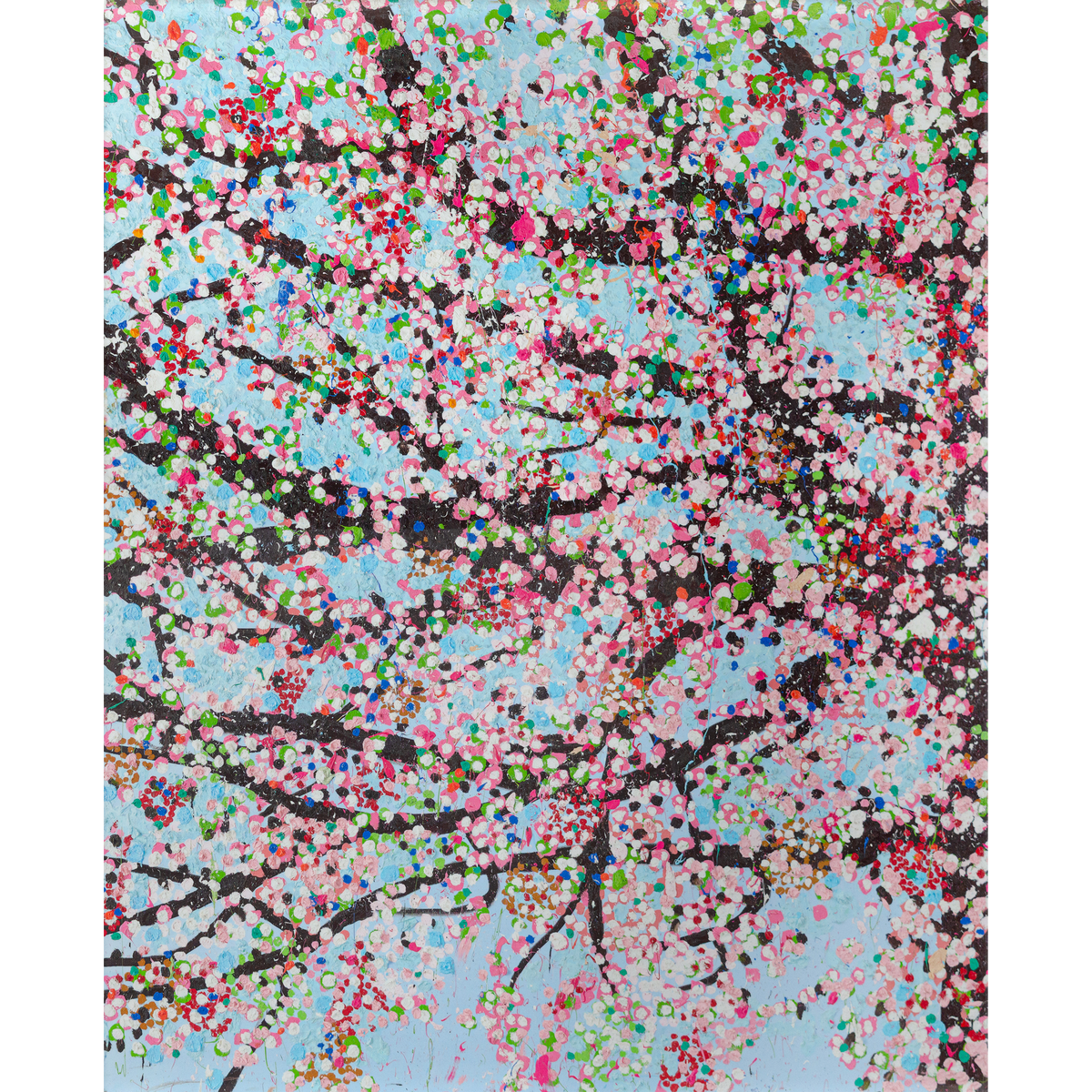
Damien Hirst’s The Virtues can look straightforward at first: flowering branches, bright colour and eight related images. For a collector, however, the series rewards a more exact reading. The works are not conventional paper prints, their edition sizes are not uniform, and the signature is not where someone accustomed to a hand-signed screenprint might expect it.
Released in 2021 as Hirst’s H9 series, The Virtues translates details from the artist’s large Cherry Blossoms paintings of 2018–20 into eight laminated giclée prints on aluminium composite panel. Each measures 120 × 96 cm. The format gives the images a physical presence closer to a panel than a sheet of paper, while the enlarged fragments preserve the crowded brushwork and abrupt shifts of colour that distinguish the paintings.
This guide explains what identifies the series, why the edition sizes differ and what we would check before acquiring an individual work or a complete set. You can also view the current Dovehouse selection of The Virtues or browse the wider Damien Hirst collection.
What is Damien Hirst’s The Virtues?
The Virtues comprises eight works: Justice (H9-1), Courage (H9-2), Mercy (H9-3), Politeness (H9-4), Honesty (H9-5), Honour (H9-6), Loyalty (H9-7) and Control (H9-8). HENI Editions, the publisher, records the titles as references to the eight virtues set out by Nitobe Inazō in his 1900 book Bushidō: The Soul of Japan.
The names impose a calm moral vocabulary on images that are anything but restrained. Branches cross the surface at speed. Dense pink, white and red blossoms sit against passages of blue, green and brown, and the paint sometimes appears piled up or dragged across the underlying image. That friction is central to the series. The flower is familiar, but the scale and cropping prevent the image from becoming merely decorative.
HENI describes H9 as the second print series derived from Hirst’s Cherry Blossoms. The original paintings were made between 2018 and 2020; the editions followed in 2021. The print process does not attempt to mimic the thickness of actual paint. Instead, the high-resolution image and smooth laminate sharpen the difference between depicted impasto and the flat, manufactured surface.

How were The Virtues prints made?
Every work in the series is a laminated giclée print mounted on an aluminium composite panel. “Giclée” refers to high-resolution inkjet printing, but the support changes how the work should be understood and handled. These are rigid, large-format editions. They do not have the deckled edges, plate marks or visible paper texture that collectors might associate with etching, lithography or screenprinting.
The laminate creates a direct, saturated surface and protects the printed image from ordinary handling, but it does not make the work impervious to damage. Corners and edges deserve close inspection. A knock can affect the panel or laminate even when the central image remains bright. Surface scratches, scuffs, lifting at the laminate, dents and any irregularity in the mounting system should be recorded in a condition report.
Presentation also needs planning. At 120 × 96 cm, each work occupies substantial wall space, and eight together form an installation rather than a casual grouping. Before purchasing a set, confirm packed dimensions, weight, hanging hardware and the route into the intended room. With an individual panel, think about sightlines and reflected light. The glossy surface can change considerably as the viewer moves.
Why do the edition sizes vary?
The publisher offered the editions for a limited period, with the final number determined by demand during that release. As a result, there is no single edition size for H9. This point is easy to miss when a listing refers broadly to “the edition” without identifying the title and H9 number.
The current Dovehouse examples make the difference clear. Mercy (H9-3) is from an edition of 817. Honour (H9-6) is from an edition of 693. Loyalty (H9-7) is from an edition of 1,067. HENI’s individual records confirm those figures, as well as the common medium, dimensions and 2021 date.
A smaller edition is one fact among several, not a verdict on quality. Image preference matters. So do condition, completeness, the clarity of the label and number, and the relationship between the particular composition and the room in which it will live. We would not choose between Mercy, Honour and Loyalty on the edition number alone.

Where are the signature and edition number?
HENI records each Virtues work as signed and numbered on a label. For a collector, that means the reverse is essential evidence, not secondary packaging information. Ask to see a clear photograph of the complete label and its position on the panel. The title, H9 reference, individual number and signature should agree with the invoice and any accompanying documentation.
This is also why a generic description such as “signed print” is insufficient. It should state that the signature and number are on the label. If the work has been framed or fitted with a backing board, make sure the label has not been obscured or separated from the panel. Any replacement hanging hardware or intervention to the reverse should be disclosed.
For a complete set, check all eight labels separately. Matching edition numbers can be desirable as a matter of completeness, but they should be evidenced rather than assumed. Confirm the number on each work, the sequence from H9-1 to H9-8 and whether all panels share a consistent ownership history. The set should be treated as eight individual records that happen to form one coherent group.
How should a collector compare individual works?
Start with composition, not the title. Mercy pushes a dark branch through a field of pale blossom, creating a strong diagonal. Honour distributes blossom more evenly across a cooler ground and allows the eye to move through several clusters. Loyalty has its own balance of compressed bloom and open colour. These differences are more consequential on the wall than the shared dimensions suggest.
Next, compare condition under raking light and from several angles. Ask for full-front, corner, edge and reverse photographs. Check that colour has not been unevenly affected by prolonged direct sunlight, and establish how the work has been stored. A flat online image can hide a dent or fine surface abrasion, especially on a reflective laminate.
Finally, decide whether you are collecting the subject, the series or the installation. One panel can stand alone. A pair may create a deliberate conversation. The full set makes the serial structure visible, but it also carries practical demands in transport, insurance and display. The right choice is the one whose documentation and condition are convincing and whose scale makes sense in the intended space.
Where does H9 sit within Hirst’s print practice?
The Virtues belongs to a broad edition practice in which Hirst repeatedly translates ideas across materials. The Cherry Blossoms paintings rely on physical deposits of paint; H9 turns selected details into smooth, repeatable panels. The result is not a substitute painting. It is a distinct edition designed around enlargement, cropping and consistency.
Collectors who want the wider context can read our overview of Damien Hirst’s art, materials and recurring themes. The earlier essay on the evolution of the Spot Paintings shows how serial structure operates elsewhere in his work, while our guide to pigment, giclée and digital printing explains terminology that is often used too loosely in secondary-market descriptions.
A practical checklist before buying
- Confirm the title and exact H9 reference.
- Match the stated edition size to the correct work.
- Request a clear image of the signed and numbered label.
- Inspect the laminate, corners, edges and reverse.
- Review provenance, invoice history and any condition report.
- Confirm dimensions, hanging method, packed size and delivery arrangements.
We currently hold several works from The Virtues and can discuss the differences between available examples, condition, documentation and international delivery. Contact Dovehouse Contemporary for a current condition report or to compare Mercy, Honour and Loyalty in detail.

Leave a comment
This site is protected by hCaptcha and the hCaptcha Privacy Policy and Terms of Service apply.