
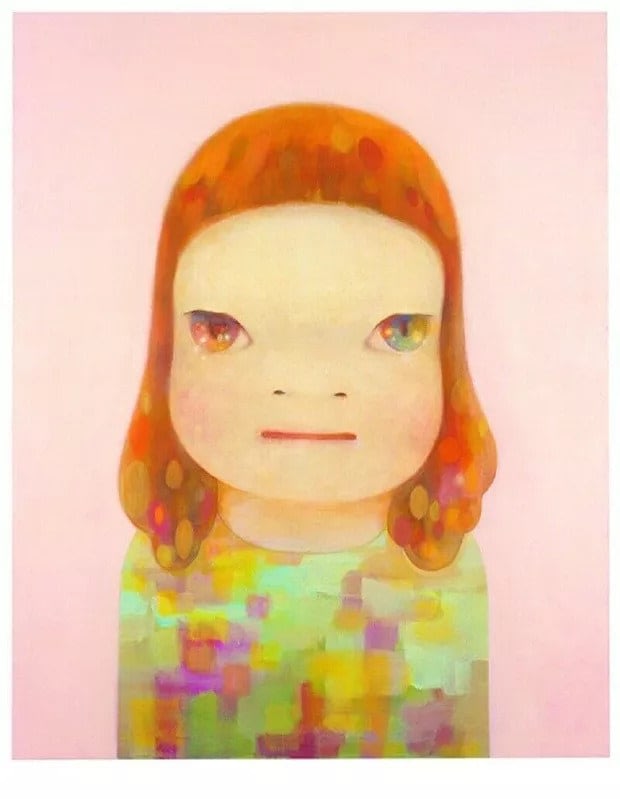
Yoshitomo Nara’s Miss Spring appears quiet at first. A young figure faces us against a pale pink ground, her mouth reduced to a narrow line. The colour does the moving. Orange and red gather in her hair; one eye glows warmer than the other; the sweater breaks into small fields of yellow, green, blue and violet.
The image began as a large painting in 2012 and returned in 2021 as a compact digital pigment print. That change of scale is central to the edition’s appeal. The painting confronts the viewer at more than two metres high. The print measures 27.9 × 22.9 cm and asks to be viewed at close range, almost like a page held in the hands.
For a collector, however, the image is only one part of the object. Miss Spring was issued with a dedicated portfolio, a substantial Phaidon monograph and a numbered certificate. Establishing which components remain together is as important as checking the print itself.
What is Yoshitomo Nara’s Miss Spring print?
Miss Spring is a digital pigment print on Takeo Deep PV Hakou paper, produced in Tokyo under the artist’s direction. Phaidon records the work as Miss Spring (2012/2021): the first date belongs to the painting on which the image is based, while the second identifies the edition’s publication.
The standard edition comprises 100 prints, with five artist’s proofs recorded separately. The current Dovehouse catalogue entry describes the available example as hand-numbered and accompanied by the hardback Yoshitomo Nara monograph, a 330-page book containing 380 illustrations. The print itself is 27.9 × 22.9 cm.
Phaidon’s original publication record adds useful information. Each print was issued with the 2020 monograph, a purpose-made print portfolio and a numbered, publisher-stamped certificate of authenticity carrying a registered serial number. Those are edition-level specifications. A buyer should still confirm which components accompany the particular example being offered.

Why are there two dates?
The double date should not be treated as a catalogue inconsistency. It describes two related objects. Nara made the original Miss Spring painting in 2012. The Los Angeles County Museum of Art records that painting as acrylic on canvas, measuring 227 × 182 cm, in the collection of the Yokohama Museum of Art. The digital pigment print followed in 2021.
This distinction matters in online searches, where images of the painting and edition can appear side by side. The print is not a small painting, nor should its date be shortened without explanation. A precise description identifies it as the 2021 edition after the 2012 composition.
The subject also has a particular historical context. Following the earthquake, tsunami and Fukushima nuclear disaster of March 2011, Nara returned to northeast Japan and took part in community arts workshops with children in the affected region. Phaidon describes Miss Spring as the first major work he began after returning to his studio in April 2012. LACMA notes that the image served as the cover for Ryūichi Sakamoto’s No Nukes 2012: Guidebook for Our Future and appeared as a banner during demonstrations.
That history gives the title more weight than a seasonal label. The figure’s direct stare is neither cheerful nor defeated. Her eyes contain bright, prism-like colour, but her expression remains held. The tension between renewal and uncertainty is what prevents the work from becoming sentimental.
How does the print differ from the painting?
Scale changes the encounter. The painting surrounds the viewer with layered colour. In the edition, the same image becomes intimate and concentrated. The pink field reads more like a margin, and the transitions in the hair, eyes and sweater reward close inspection.
Digital pigment printing is well suited to this kind of translation because it can retain a wide range of colour and subtle tonal shifts. Yet it remains a print on paper. The surface does not carry the physical build-up of acrylic paint found in the original canvas. Collectors should value it as an edition made under the artist’s direction, not as a substitute for the painting’s material presence.
The paper is specifically identified as Takeo Deep PV Hakou. That specification helps distinguish the published edition from an ordinary reproduction. So do the numbered certificate, registered serial number and publisher’s stamp described by Phaidon. The useful question is not simply whether the image looks right. It is whether the print, numbering and accompanying material form a coherent set.

What should accompany the edition?
Start with the print and its number. Ask for a clear photograph showing how the edition number is applied and where it appears. The Dovehouse listing records the work as hand-numbered, while Phaidon’s publication information states that the certificate is numbered and stamped. Those statements may describe separate parts of the set, so both should be seen rather than conflated.
Next, confirm the certificate. Phaidon states that the original edition was accompanied by a numbered certificate with a registered serial number and publisher’s stamp. The current Dovehouse record does not expressly state that a certificate is present. That does not mean it is absent; it means the point should be verified before purchase.
The hardback monograph and presentation portfolio are also part of the publication as issued. Their condition matters less than the print’s, but completeness affects how convincingly the set represents the original edition. Ask whether the book, portfolio, certificate and print numbers correspond and whether the original packaging has been retained.
What condition points matter?
Request an unframed report covering the full sheet, surface, edges and corners. A pigment print can appear clean in a front-facing photograph while still carrying handling marks, soft creases or pressure dents. Check the pale pink background carefully because small surface changes may be easier to see there than in the denser coloured passages.
Colour comparisons should be made cautiously. Screens, phone cameras and room lighting can shift the warmth of the background and the balance between the two eyes. Reliable reference images help, but they do not replace examination of the actual sheet. Ask whether the print has been exposed to direct light and what storage or framing materials have been used.
If the work is framed, establish whether it has been inspected outside the frame. Archival hinges, acid-free backing and glazing with ultraviolet protection are sensible, but any framing claim should be supported by the framer’s specification or direct examination. The certificate and book should be stored separately from the framed sheet in a dry, stable environment.
How does Miss Spring fit within Nara’s editions?
The work offers a different register from Nara’s more confrontational figures. There is no raised knife, slogan or aggressive stance. The resistance lies in the figure’s self-possession. She looks outward without volunteering an easy emotion.
Collectors can compare that stillness with the two-panel Cosmic Girl set from 2008, an edition of 500 in which the figure appears through offset lithographic posters mounted on board. Mini Mori Girl, a 2012 sculpture in resin, wood and plastic from an edition of 1,000, moves the artist’s figure into three dimensions. The comparison is useful because it shows how medium changes the sense of proximity even when Nara’s visual language remains recognisable.
Our essay on why Nara’s figures feel alive considers the emotional ambiguity of these faces. For the mechanics of translating drawings and paintings into editions, read Yoshitomo Nara in Print. The broader guide to collecting Nara prints and sculptural editions covers documentation, condition and the differences between formats.
Is Miss Spring a strong collecting choice?
It is particularly convincing for a collection interested in Nara’s quieter portraiture and in editions with a well-recorded publication history. The image has institutional context through the original painting, while the print was made in a small standard edition under the artist’s direction. Its scale also makes it practical to display without losing the concentration that gives the figure her presence.
The decision should rest on completeness and condition. Confirm the edition number, certificate, portfolio and monograph; then assess the paper and colour. Browse the current Yoshitomo Nara collection to compare prints, posters and sculptural multiples. To discuss this example of Miss Spring, contact Dovehouse Contemporary for current availability, detailed photographs, a condition report and confirmation of the accompanying material.
References: Phaidon, Miss Spring limited edition; LACMA, Miss Spring, 2012; Yoshitomo Nara Foundation catalogue entry YNF5620.

Leave a comment
This site is protected by hCaptcha and the hCaptcha Privacy Policy and Terms of Service apply.