
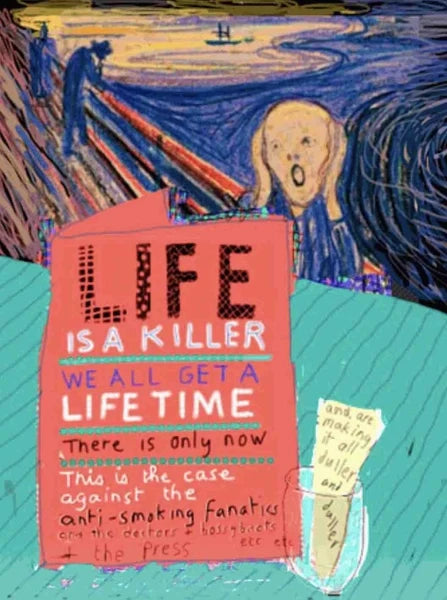
David Hockney’s Life (2012) begins with a sentence that refuses to sit quietly in the background. A red placard reads “LIFE IS A KILLER” above a smaller line about the lifetime each of us receives. Behind it, a pale face opens into a cry while the ground seems to tilt and run away. The image is funny, bleak and oddly buoyant at once. It also poses a practical collecting question: what, precisely, are we looking at when a drawing made on an iPad becomes a signed work on paper?
The answer matters. Hockney’s work with handheld devices is not a detachable technological episode in an otherwise analogue career. It belongs to his long examination of how marks are made, reproduced and circulated. For a collector assessing Life, the device is only the starting point. The object that enters a collection is a physical edition with a defined sheet, image area, signature, date and edition number.
This guide looks closely at the work itself, its place among Hockney’s early iPhone and iPad drawings, and the details worth checking on a particular impression. You can also view Dovehouse Contemporary’s current David Hockney collection.
What is David Hockney’s Life (2012)?
Life is an iPad drawing printed on paper, made in 2012 in an edition of 25. The image measures 32 by 24 inches, set on a sheet measuring 37 by 28 inches. Those dimensions and the edition size are documented by L.A. Louver, which presented the work within Hockney’s group of iPhone and iPad drawings made between 2009 and 2012.
The impression currently offered by Dovehouse Contemporary is numbered 18/25. It is signed and dated “Hockney 12” in pencil at the lower right, with the edition number in the lower-left margin. The catalogue description identifies the medium simply and accurately: iPad drawing printed on paper. That wording is useful because it distinguishes the original act of drawing from the finished physical edition without making unsupported assumptions about the printing process or paper stock.

The words are part of the image
Text is not an explanatory caption added after the drawing. It is the picture’s structural centre. The large white letters on red reach the eye before the face behind them, then the smaller sentence slows the reading down. Hockney turns an observation about mortality into something closer to a roadside warning, but the colour and rapid line keep the image from becoming solemn.
The open mouth and tapering landscape may recall earlier images of existential alarm, although Life does not need a single art-historical reference to function. Its pressure comes from the collision of registers: public sign and private drawing, joke and threat, digital luminosity and a sheet that can be held, framed and examined. In our view, that tension is the work’s particular strength. It rewards a quick first reading but does not finish there.
This is also why condition should be judged across the whole sheet, not only within the coloured image. The unprinted border is not empty surplus. It provides the space in which the pencil signature, date and edition number establish the work as a specific impression.
From an iPad drawing to a physical edition
Hockney began drawing on an iPhone in 2009 and moved to the larger iPad in 2010. L.A. Louver’s documentation of the 2009–12 group explains that the device drawings were transformed into physical prints and released by Hockney Studio. That sequence is important. A file on a screen can appear frictionless, but an edition on paper introduces scale, margins, surface and number. It fixes choices that were fluid at the drawing stage.
For Life, the image area is substantial. At 32 by 24 inches it is larger than the screen on which the drawing originated, while the 37-by-28-inch sheet leaves enough border for the image to breathe. This expansion changes the experience of the line. Marks that may have been made with a fingertip or stylus become visible as broad, energetic bands. Colour no longer depends on a backlit display; it is carried by paper and ambient light.
Collectors sometimes ask whether such a work is “original” or “a reproduction”. The sharper question is whether the object conforms to the artist’s defined edition. Life is not presented as a unique drawing on paper, and it should not be described as one. It is a signed, numbered physical edition produced from Hockney’s iPad drawing, with a declared edition size of 25. Its identity rests on that combination of source, format and edition structure.
For a wider view of this period, see our guide to David Hockney’s 2010 iPad drawings. The broader arc from traditional print media to digital drawing is examined in From Etching to iPad: David Hockney’s Restless Printmaking.
What should a collector verify?
With any signed edition, the particulars of the individual impression matter as much as the catalogue entry for the work in general. For Life, we recommend confirming the following points before acquisition:
- Edition number: it should be read directly from the sheet and recorded consistently in the invoice and condition report. The Dovehouse impression is 18/25.
- Signature and date: the current work is signed and dated in pencil “Hockney 12” at lower right.
- Sheet and image dimensions: verify both, since the 32-by-24-inch image sits within a 37-by-28-inch sheet.
- Margins: establish that the full sheet is present and ask whether it has been trimmed or mounted in a way that conceals the edges.
- Surface and colour: request clear images under neutral light and a written account of any handling marks, abrasions, creases or changes in colour.
- Framing history: note whether the work is framed and, if so, how it is hinged and kept away from the glazing.
These checks are not a substitute for provenance and professional condition reporting; they are the practical framework that makes those documents useful. The key is consistency. Title, date, medium, dimensions, signature placement and edition number should agree across the physical work, catalogue record and transaction paperwork.
Comparing Life with Hockney’s later iPad editions
Hockney continued to use the iPad long after the early 2009–12 group. A useful comparison is 23rd March 2021, Flowers in a Milk Bottle. It is catalogued as an iPad painting printed on paper, signed, dated and numbered, measuring 89 by 63.5 centimetres and issued in an edition of 50. The same format also describes 20th February 2021, Jug With Flowers.

The comparison clarifies rather than collapses the differences. Life belongs to the first concentrated years of Hockney’s device drawings and has a smaller edition of 25. Its subject is public and declarative. The 2021 flower works are larger sheets, editions of 50, and intimate observations of domestic arrangements. Both begin on an iPad and become works on paper, but they deliver very different kinds of looking.
That distinction is commercially and art-historically relevant. “Hockney iPad work” is too broad a category on its own. Date, subject, edition size, dimensions and physical presentation all shape what a collector is acquiring. The medium connects the works; it does not make them interchangeable.
Condition and framing
A paper work of this size needs a frame that supports the sheet without crowding it. The margins should remain visible if the signature and numbering are to be read as intended. We would normally look for archival mounting, a reversible hinging method and glazing that does not press against the printed surface. Light levels also matter. Strong daylight can alter colour and should be controlled even when UV-filtering glazing is used.
If an impression has already been framed, the back of the sheet may not be immediately accessible. That is not automatically a problem, but it should be recorded. A sensible condition report will state what could be examined, what remained concealed and whether the work was inspected out of frame. For more general buying criteria, our guide to collecting David Hockney prints and editions explains how edition data, condition and documentation fit together.
A work that keeps the present tense
Life is easy to recognise, yet it resists becoming a logo. The placard makes a blunt statement; the face and landscape keep unsettling it. Digital drawing allowed Hockney to work quickly and in saturated colour, but the finished edition asks for slower attention. Look at the red field, then the words, then the figure compressed behind them. The order changes from one viewing to the next.
For collectors, that is the point at which the technical history and the image meet. The work is significant because of when and how it was made, but those facts would be thin without the strange, forceful drawing they describe.
Dovehouse Contemporary currently offers impression 18/25 of David Hockney’s Life (2012). To discuss the work, request a current condition report, or review the signature, numbering and framing details, contact the gallery. We will provide the specific information needed to assess this impression rather than relying on general catalogue data.

Leave a comment
This site is protected by hCaptcha and the hCaptcha Privacy Policy and Terms of Service apply.