
How changing tools expanded Hockney’s language.
Etching, lithography, photocopying and digital drawing each create a different kind of line and a different pace of looking.

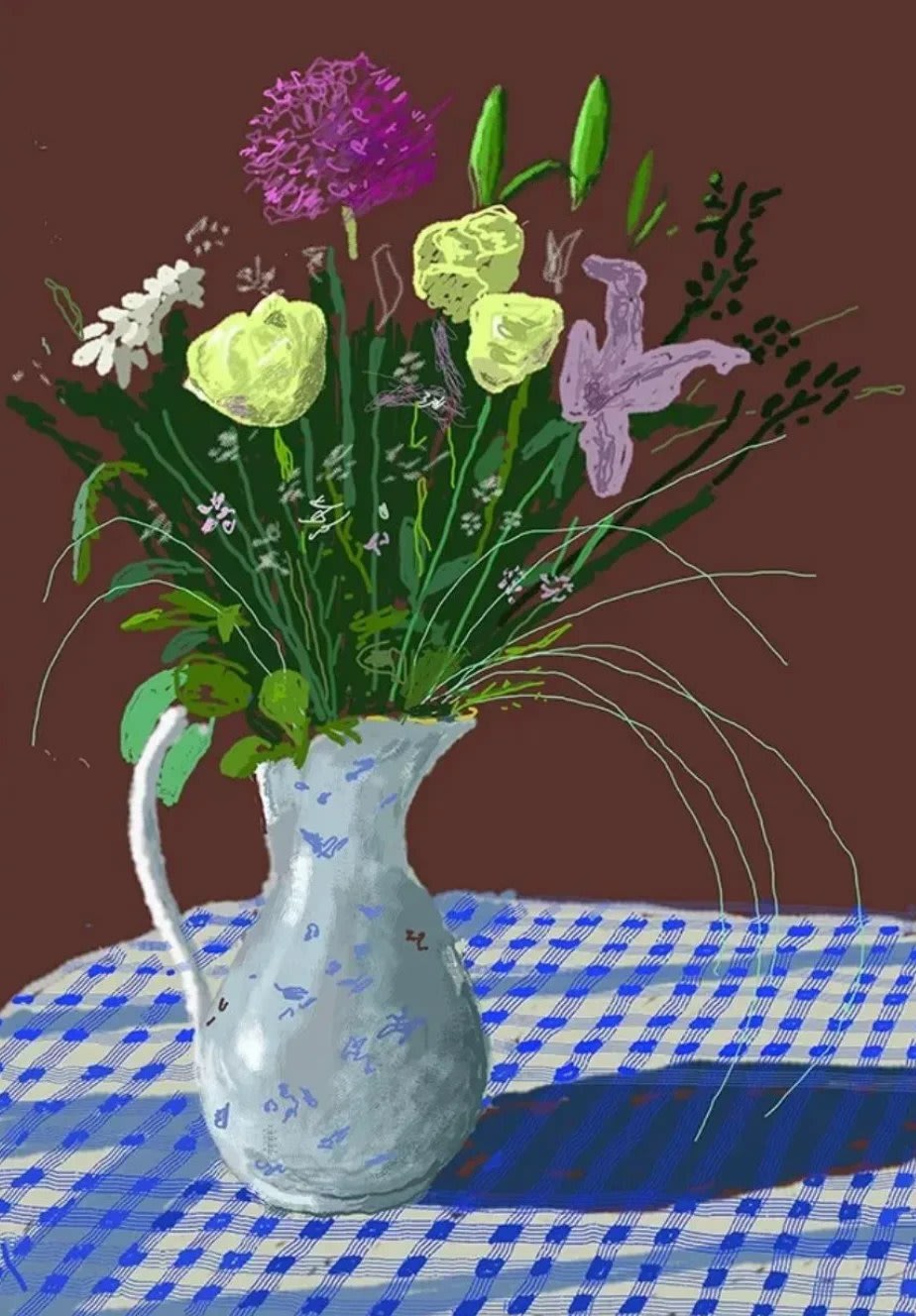
Selected work: 20th February 2021, Jug With Flowers.
Current examples include 20th February 2021, Jug With Flowers, Water Lilies in the Pond with Pots of Flowers (ashtray) and Hockney's Pool, Hollywood Hills (ashtray). View the complete David Hockney collection for current availability.
Explore available works by David Hockney
Technology follows curiosity
Hockney’s movement from traditional intaglio and lithography to fax, photocopy, digital drawing and iPad imagery is not a story of replacing old tools with new ones. He adopts a medium when its limitations open a fresh way of seeing. Etching can make line tactile; digital drawing can record and distribute colour with unusual immediacy.
The edition remains an original context
A digital tool does not automatically make a work an unlimited reproduction. Edition structure, artist involvement, output process and publication determine the object’s status. Buyers should verify whether the work was conceived as an edition, how it was printed, its dimensions, signature and publisher, rather than judging authenticity by whether the first mark was made on metal, stone, paper or screen.
Each tool proposes a different kind of mark
Printmaking is often described as a family of reproduction techniques, but for an artist it is also a family of ways to think. A line incised for an etching behaves differently from a greasy mark prepared for lithography. A photocopier separates and repeats information in another way. A digital drawing tool offers still another relationship between gesture, colour and revision.
Hockney’s interest in changing tools becomes more intelligible when these differences are taken seriously. The process is not simply chosen after an image is complete. It can influence what the image becomes: how a line turns, how colours overlap, how quickly a mark can be made and how separate parts are joined.
For the viewer, identifying the medium is therefore more than an administrative exercise. It provides clues about why the image looks as it does. A controlled contour, a broad field of colour and a visibly repeated mark may each belong to different technical decisions. The work’s particular catalogue description should guide that enquiry.
Lithography and the continuity of drawing
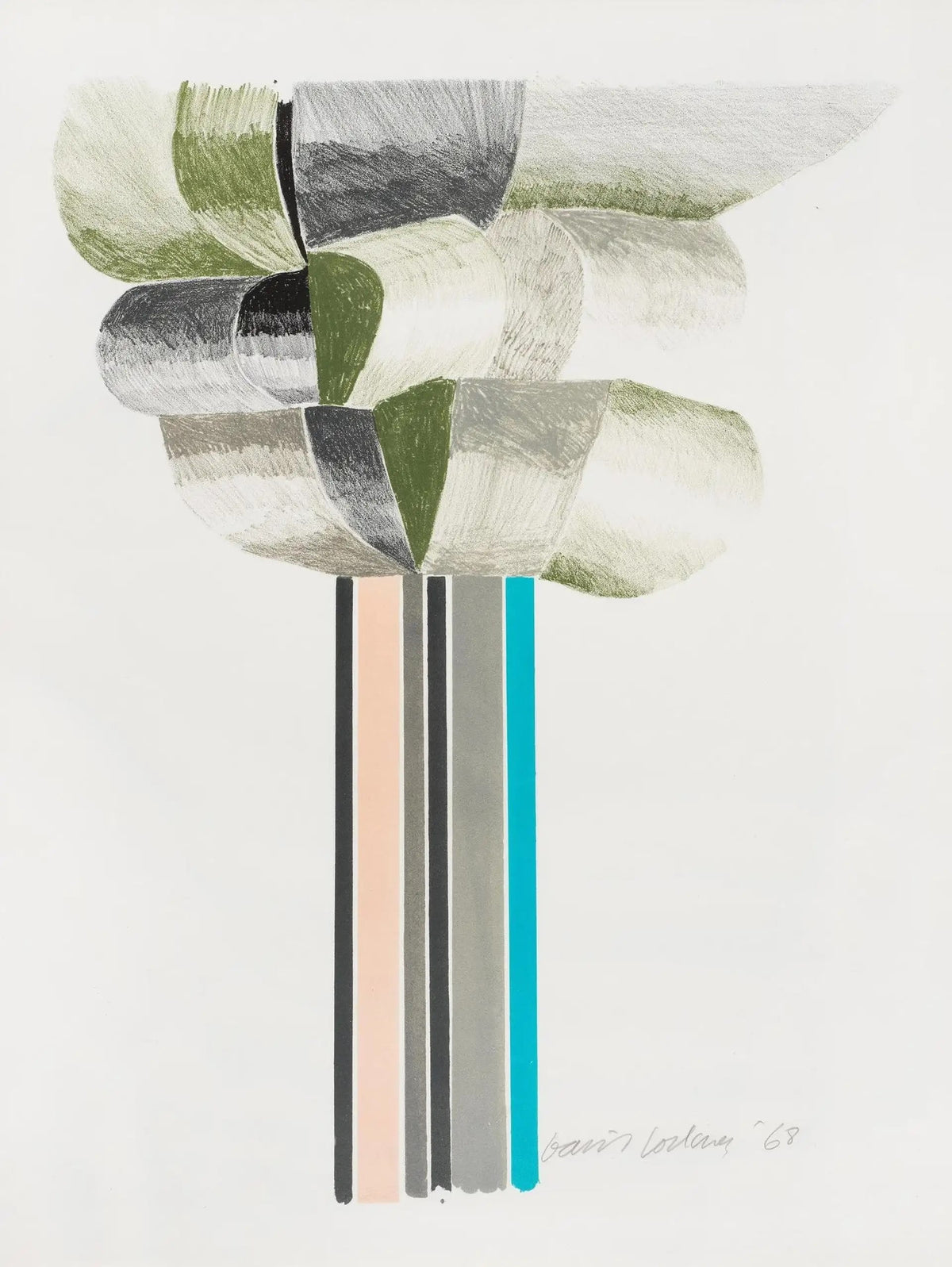
The current listing for Trees identifies a lithograph dated 1968. Its subject offers a useful way to think about the relationship between drawing and print. Branching forms, repeated verticals and the intervals around them can retain a sense of direct observation while existing as a printed image.
The important question is not whether a print looks as spontaneous as a drawing. It is how the printing process carries the decisions of the image. Line, tone and colour are organised through the chosen method, and the resulting sheet has its own scale and surface. A lithograph should be assessed as a lithograph, rather than as an incomplete substitute for a painting.
The same principle applies to the Alphabet lithographs. The relationship between the drawn letter, surrounding space and printed page is part of their character. Looking at a single sheet and looking through a complete publication are related but different experiences.
The office copier becomes an artistic instrument
Walking, June provides a particularly concrete example of a change in tools. Dovehouse’s catalogue describes it as a 1986 Home Made print in red, green and black, produced on Arches Text paper using an office copy machine. Those details explain why a familiar piece of office equipment belongs in a discussion of Hockney’s printmaking.
A copier invites an artist to work with repetition, layering and the limits of the machine’s colour and handling. The interest is not that an ordinary device can imitate a traditional print studio perfectly. It is that its particular capabilities create another route to an image. The artist’s decisions operate through those capabilities.
When comparing such a work with a lithograph, avoid treating the newer or less prestigious-sounding tool as evidence of lesser intention. Establish the actual publication and edition, then look at what the method contributes. A technical category describes how an object was made; it does not independently settle its visual interest.
From illuminated screen to printed paper
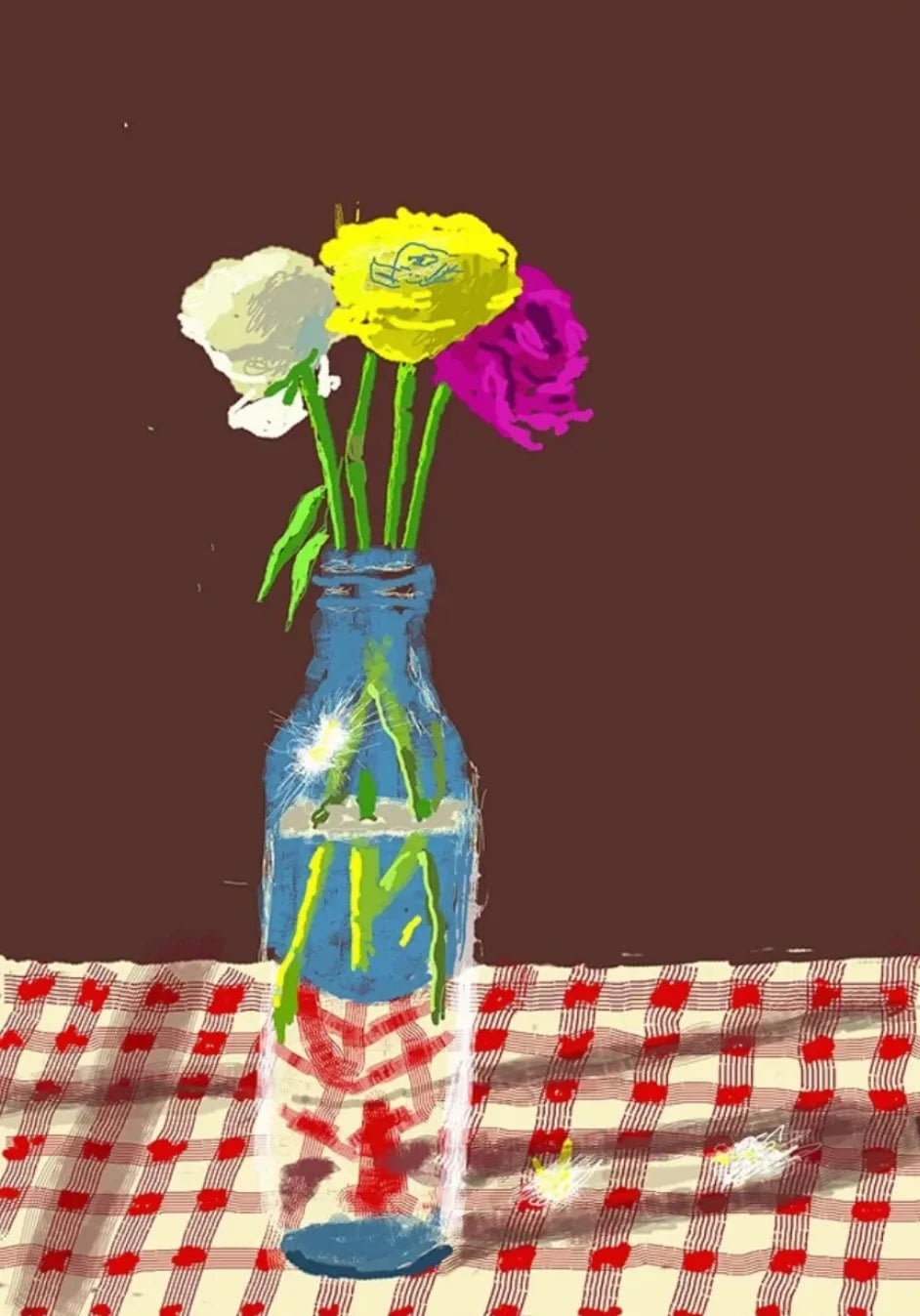
An iPad drawing begins in an illuminated environment, where colour is seen through the screen. A print is encountered through reflected light from a physical surface. That transition matters. The print has a fixed size, a particular paper and a relationship to the surrounding wall or frame that the screen image does not possess.
The gallery’s 20th February 2021, Jug With Flowers is described as an iPad painting printed on paper, with a recorded edition of 50. Read those words together: the first identifies the origin of the image, while the second identifies its physical presentation. Neither needs to be hidden or apologised for.
Digital origin also does not tell you whether a particular object is unlimited, signed or part of an edition. Those questions require the publisher’s and artist’s stated production details. A screen-based image can be issued in several different formats, just as an earlier painting can appear in a book, poster or separately described print.
How to compare processes without flattening their differences
Choose two works with a related subject, then compare their marks before their prices. Does one depend on a continuous line while the other is built from separate colour areas? Does the paper remain conspicuous? Is the image close to the edge or surrounded by a generous margin? Such observations help connect the catalogue terminology to the actual viewing experience.
Then restore the differences that a website tends to suppress: physical dimensions, surface, edition status and the condition of the particular example. A small photograph can make a large digital print and an intimate lithograph look equivalent. The objects may make quite different demands on a room and on the viewer’s distance.
A collection organised around Hockney’s tools can be especially rewarding because it follows curiosity rather than a single signature image. Etching, lithography, photocopying and digital drawing become chapters in an ongoing enquiry into seeing. The continuity lies in the attention given to the subject, while each method keeps the result from becoming predictable.

Leave a comment
This site is protected by hCaptcha and the hCaptcha Privacy Policy and Terms of Service apply.