
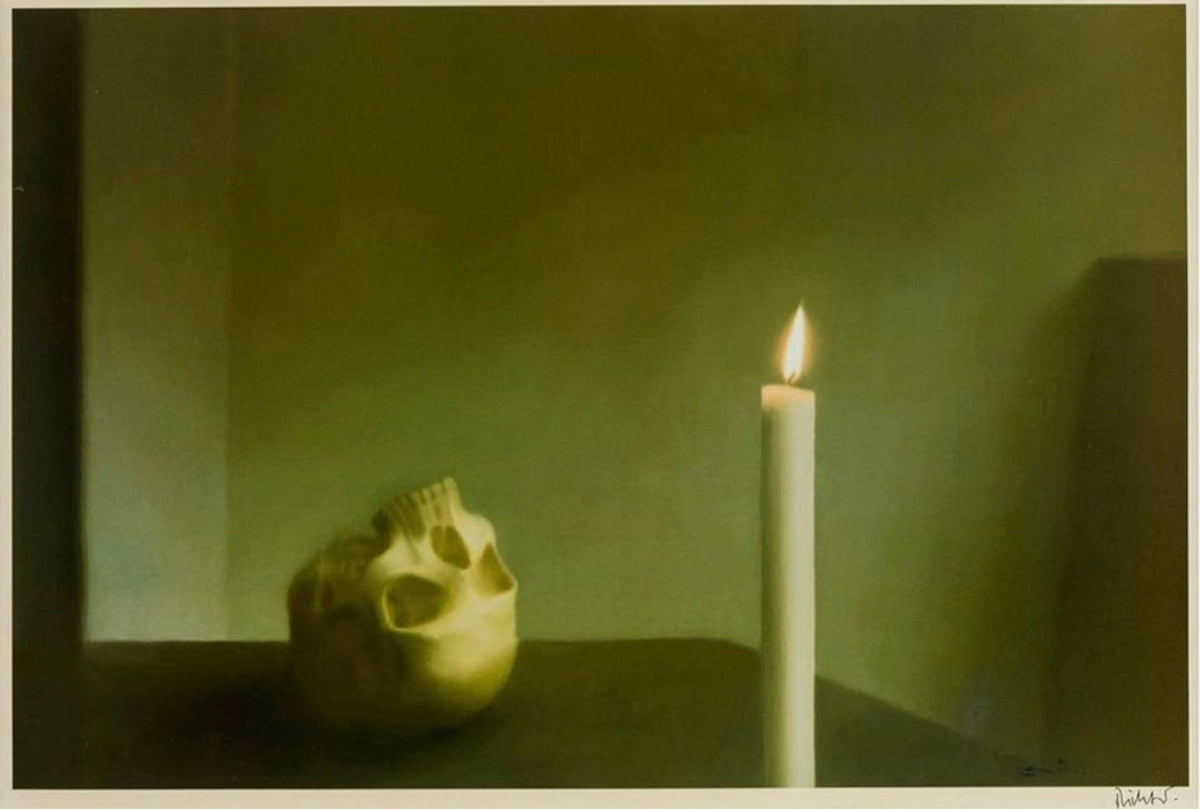
A skull and a burning candle would seem to offer an immediate reading: death beside light, extinction beside duration. Gerhard Richter makes the pairing less settled. The image is recognisable, but its soft focus withholds the crisp certainty we expect from either a still life or a photograph. Nothing is theatrical. The objects sit in a shallow, brown-grey space, close enough to inspect and strangely difficult to grasp.
That tension is why Skull with Candle deserves more than a glance, and why the 1995 offset lithograph needs to be understood on its own terms. It is not an original painting, nor simply a neutral reproduction. It translates one of Richter’s most concentrated photo-paintings into a printed format, carrying the image into a different scale, surface and collecting category.
Dovehouse currently holds two records for the 1995 image: Skull and Candle, described as hand-signed, and Skull with Candle, whose listing records the edition and dimensions but does not state a signature. Those differences matter. They also need to be read carefully rather than turned into assumptions.
The original image: a modern vanitas made through photography
Richter painted Skull with Candle in 1983. The original, catalogued as CR 547-2, is an oil on canvas measuring 100.5 by 150.5 cm in the collection of the Neues Museum Nürnberg. The museum connects the work to Richter’s photographic source material and to the older tradition of the vanitas still life, in which objects such as skulls, candles and timepieces remind the viewer that life is brief.
Yet Richter does not stage an elaborate table of symbols. He pares the scene down to two objects and a dark interior. The candle is upright but not triumphant. The skull is neither anatomically displayed nor sensationalised. The small flame creates just enough light to establish the objects, while the surrounding space absorbs detail.
The painting belongs to a concise sequence. Candles entered Richter’s work in 1982, followed by the skull paintings in 1983. Both subjects were rooted in photographs made or assembled as working material. This matters because the blur is not an atmospheric flourish added for mood. It marks the passage from photograph to painting. Edges are softened, spatial cues become uncertain and the authority of the source image is quietly disturbed.

What exactly is the 1995 Skull with Candle print?
The Dovehouse records describe the work as an offset lithograph from 1995, in an edition of 500. Offset lithography is a commercial printing process capable of reproducing smooth tonal transitions with considerable consistency. In this image, that is especially relevant. The print must hold the narrow separation between the candle’s pale glow, the skull’s chalky surface and the brown-black ground without turning the composition into a flat mass.
The printed image adds another step to Richter’s chain of translation: photographed objects became a painted image, which then became a printed image. A collector is therefore not buying a substitute for the 1983 canvas. The interest lies in how a work concerned with mediation moves into an edition. The offset process repeats the image, but repetition does not resolve it. The picture remains hesitant and materially indirect.
One Dovehouse record gives a sheet size of 48 by 64 cm and an image size of 41 by 62 cm. The other records 48.5 by 64.5 cm. Small differences of this kind can arise from measuring conventions, rounding, margins or the individual sheet. They should not be used alone to declare that two examples are separate editions or states. A serious comparison begins with photographs of the full sheet, front and back, alongside any inscriptions, edition number, signature and publisher or exhibition text.
Why “with” and “and” do not settle the identity
The English titles Skull with Candle and Skull and Candle both appear in market records. Title variation is common when a German title is translated, shortened or entered by different cataloguers. It may tell us something about the record; it does not necessarily prove a different image.
For that reason, collectors should identify the object from the physical evidence rather than the wording alone. Compare the composition, sheet size, image size, paper, printed text, numbering and signature. Ask whether the photograph shows the complete margins. If a certificate or invoice uses a different English title, check whether the dimensions and edition information still correspond.

Signed and not stated as signed are not the same thing
The most commercially important difference between the two Dovehouse records is the signature information. The Skull and Candle listing states “hand-signed”. The Skull with Candle listing does not state a signature. That silence should not be converted into a claim that the work is unsigned. It means the signature status needs confirmation against the object.
For the hand-signed example, request a clear close-up that shows the signature in relation to the paper surface, not only a cropped mark. Confirm whether it is in pencil or another medium, where it sits on the sheet and whether the edition number is written in the same hand. For the other example, ask for images of the lower margin and verso before drawing a conclusion.
A printed or facsimile signature is not equivalent to a hand signature. Nor does a hand signature, by itself, answer every question about the edition. It should be considered with the paper, measurements, inscriptions, provenance and condition. The right question is not simply “Is it signed?” but “How is the signature documented, and does the rest of the object support the description?”
How the print should look
Richter’s image depends on restraint. The candle flame should remain legible without becoming a hard white cut-out. The skull should emerge from the darkness gradually, with modelling across the forehead, cheek and jaw rather than a uniformly pale silhouette. The background is subdued, but it is not empty; slight changes in tone establish the shelf and surrounding room.
Condition can alter that balance quickly. Surface abrasion is particularly distracting in broad dark passages. Creases, pressure marks or scuffs may catch light more sharply than the printed image. Fading or prolonged exposure can weaken the already narrow tonal range. When reviewing a condition report, ask specifically about the dark field, the sheet edges, any rippling and evidence of previous mounting.
Framing should protect the work without compressing it visually. The margins help the printed object remain distinct from the painted composition it reproduces, so trimming or covering them too closely can remove useful evidence as well as alter the presentation. Archival hinges, acid-free backing and UV-filtering glazing are sensible. Permanent dry mounting should be avoided.
Where this print sits in Richter’s work
Skull with Candle belongs to a wider argument in Richter’s art about what images can be trusted to show. His photo-paintings often begin with apparently ordinary photographic information, then interrupt its certainty through scale, cropping, paint and blur. The candle and skull add the weight of art history, but Richter keeps the encounter cool. The familiar symbolism is present; the picture refuses to perform it for us.
Collectors who want the broader context should read Gerhard Richter and the Meaning of Blur. For a practical overview of editions, signatures and condition, see Collecting Gerhard Richter Prints and Editions. The more recent guide to Gerhard Richter’s portrait prints offers a useful comparison: there too, a recognisable subject becomes less stable as it passes through photographic and printed form.
A disciplined checklist before buying
- Match the title to the image, but do not rely on the English title alone.
- Record both sheet and image dimensions, and note exactly how they were measured.
- Confirm the edition number and photograph any printed or handwritten inscriptions.
- Verify whether a signature is hand-applied, printed, absent or simply not yet documented.
- Request front, back and raking-light images, with particular attention to the dark passages and margins.
- Review provenance, condition and framing separately from the visual appeal of the composition.
The strongest example will be the one whose physical evidence agrees with its description. That sounds elementary, but it is especially important here because small differences in title and measurement can distract from the larger task of identifying the sheet correctly.
Explore the current Gerhard Richter collection, or contact Dovehouse Contemporary to compare the two Skull with Candle records, request detailed photographs and discuss condition, documentation, framing and worldwide delivery.

Leave a comment
This site is protected by hCaptcha and the hCaptcha Privacy Policy and Terms of Service apply.