
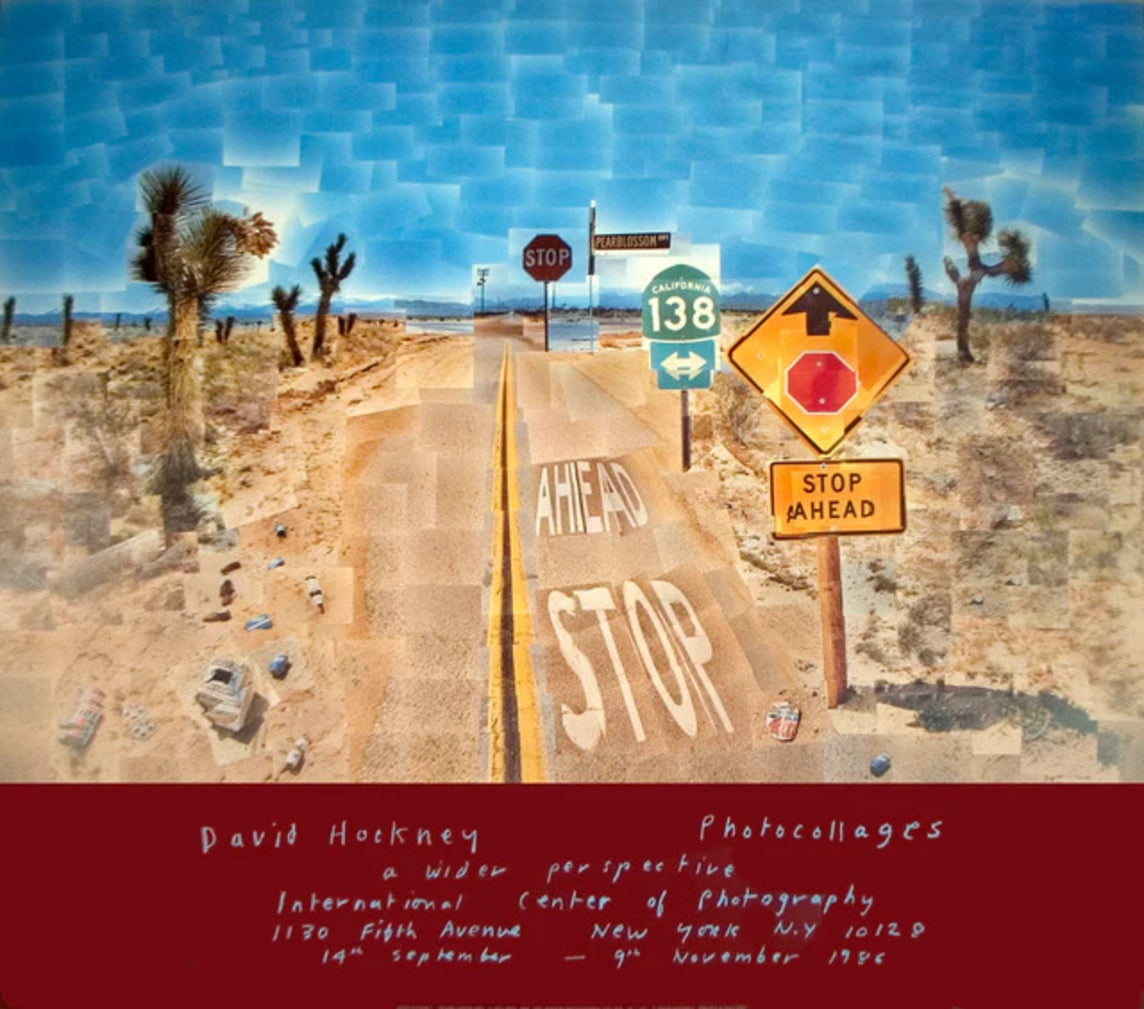
Pearblossom Highway looks immediate from a distance: a California road, a stop sign, desert scrub and a hard blue sky. Move closer and the scene starts to break apart. Every bottle, road marking, branch and letter has been photographed separately, then fitted into a larger field of vision. The road is recognisable. The act of looking is not simple at all.
David Hockney completed the photographic collage in April 1986 after years of testing what he called photographic “joiners”. For collectors, the image presents a useful problem. The original photocollages, the 1986 offset-lithograph edition and exhibition posters reproduce the same subject, but they are different objects with different materials, dimensions and purposes. A listing that says only “Pearblossom Highway” does not tell you enough.
Dovehouse Contemporary currently has two live versions: a large 1986 offset lithograph from an edition of 2,000 and a separate 1986 exhibition poster. Understanding the source image makes their distinctions clearer.
What is Hockney’s Pearblossom Highway?
The full title of the best-known museum work is Pearblossom Hwy., 11–18th April 1986, #2. The J. Paul Getty Museum records it as a chromogenic-print collage measuring 181.6 × 271.8 cm. Hockney made it in California over the dates embedded in the title. His official chronology describes the work as the culmination of his experiments with photocollage, while the Getty notes that the composition was assembled from almost 800 photographs.
That distinction matters. The original is not one photograph enlarged to mural scale. It is a constructed surface made from many exposures. Each small image records a slightly different position and moment. The finished road therefore contains more visual information than a conventional camera could take from a single fixed point.
Hockney made two versions. His official list of works in public collections records both #1 and the larger second version at the Getty. Collectors should retain the version number when discussing the museum objects; shortening every related print or poster to Pearblossom Highway can blur the line between the source collages and later works on paper.
A road seen by a driver and a passenger
The composition is divided by more than the centre line. Hockney explained the right side as the driver’s field of attention: road signs are sharp, legible and directive. The left behaves more like the passenger’s view, free to wander towards scattered objects, vegetation and the edge of the desert. The car never appears, yet its two occupants organise the picture.
This is a particularly Hockney-like solution to perspective. A single camera normally imposes one lens, one viewpoint and one fraction of a second. Here, near objects receive as much attention as the horizon. The stop sign is not reduced to a minor detail by distance; it asserts itself. Bottles and scraps at the roadside are photographed closely enough to interrupt the grand landscape. The collage refuses to tell the eye where it must settle.
The joins are part of the work. Small changes in scale and angle prevent the road from becoming a seamless illusion. Rather than concealing those shifts, Hockney uses them to describe how looking unfolds over time. We turn our head, read a sign, glance down, then look back towards the vanishing point. Pearblossom Highway puts those consecutive acts into one image.

What is the 1986 offset lithograph?
The Dovehouse offset lithograph dates from the same year as the photocollage, but it is not a section of the original and should not be described as an original photographic joiner. Its product record gives a sheet size of 82 × 93 cm, an image size of 67 × 93 cm and an edition of 2,000. The medium is offset lithograph.
Offset printing translates the assembled image into a repeatable printed form. It preserves the subject and its deliberately fractured perspective while changing the physical experience. The original second version is nearly three metres wide and constructed from separate chromogenic prints. The edition is a single work on paper at a scale that can be framed in a domestic or corporate setting.
That does not make the offset lithograph a lesser substitute in every context. It is a period edition, produced in 1986, and it carries the complete composition into a collectable format. Its interest lies precisely in that combination: a major photographic image represented through commercial printing technology, in a numbered edition whose dimensions and edition size can be checked.
Collectors should nevertheless use accurate language. “After the photocollage” explains the relationship. “Offset lithograph, 1986, edition of 2,000” identifies the object being offered. Calling it simply an original Hockney photograph would collapse two very different things.
How does the exhibition poster differ?
Dovehouse’s second live example is catalogued as a 1986 exhibition poster measuring 101.6 × 76.2 cm. Its product record does not state an edition size or signature, so neither should be assumed. The term “poster” is not a casual description here; it is the object category recorded by the gallery.

The first practical difference is format. The poster and the offset edition have different overall dimensions, and only the offset listing supplies a separate image size and edition of 2,000. A collector comparing examples online should ask for a photograph of the entire sheet, including every margin and any printed text. Cropped product images can make distinct publications look deceptively similar.
Next, confirm the printing method and publication details in writing. “Vintage”, “1986” and “period” may all be accurate while still leaving the object insufficiently identified. The invoice should state whether the work is the editioned offset lithograph or the exhibition poster. If a seller claims a signature, number or publisher, ask for clear photographs rather than relying on a generic catalogue description.
Condition questions specific to Pearblossom Highway
Large works on paper tend to reveal their history at the edges. Ask whether the sheet has been examined out of its frame. Look for handling creases, short edge tears, pinholes, surface abrasion and pressure marks. Check the reverse for tape, dry mounting or acidic board. None of these points should be inferred from a front-facing online photograph.
Colour balance also deserves attention. The blue sky, pale road, red signage and dry vegetation establish the spatial structure of the image. Uneven fading can disturb that balance even when every element remains legible. Request images made in neutral light and compare the full sheet, not only a saturated detail supplied for a screen.
Folds are particularly important with a poster. Some exhibition posters were stored rolled; others were folded, pinned or mounted. That history is not automatically disqualifying, but it should be disclosed and reflected in the description. For the offset lithograph, compare the stated 82 × 93 cm sheet with the work in hand. A material difference may indicate trimming or a different publication.
Framing should allow the paper to remain reversible and visible. We favour conservation-grade materials, hinges that can be removed by a paper conservator and glazing with ultraviolet protection. The frame should support the sheet without flattening it permanently against an adhesive backing.
Where Pearblossom sits in Hockney’s work
The photocollage arrived at a decisive moment. In 1985 Hockney had spoken about his photographic experiments at the Rencontres Internationales de la Photographie in Arles. By spring 1986, according to the David Hockney Foundation chronology, those experiments culminated in Pearblossom Highway. In the same year he was also making layered “home-made prints” with an office copier. Photography, printing and drawing were not separate compartments for him; each offered another way to question fixed perspective.
The road also belongs to Hockney’s broader treatment of landscape. It is less about untouched desert than about movement through a designed environment: signs, tarmac, litter, sightlines and speed. Readers can place it beside our discussion of Hockney’s roads and shifting perspective, then compare the different printing problems explored in From Etching to iPad. Our guide to Hockney in France provides useful context for the Arles photography connection.
Explore the full David Hockney collection, or contact Dovehouse Contemporary for current condition information, unframed photographs and delivery options for either 1986 Pearblossom Highway format. The essential first step is simple: decide whether you are considering the editioned offset lithograph or the exhibition poster, then assess that particular sheet on its own evidence.

Leave a comment
This site is protected by hCaptcha and the hCaptcha Privacy Policy and Terms of Service apply.