
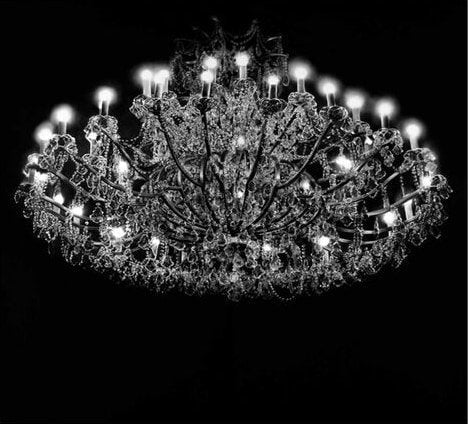
Robert Longo’s images often arrive with the force of something already known. A flag, a breaking wave, a chandelier, a nebula or an atomic detonation appears immediately legible, yet the longer one looks, the less stable that familiarity becomes. Scale, tonal intensity and isolation remove the subject from ordinary experience. What remains is not simply an image of an object, but an image charged with memory, power and unease.
Longo first came to prominence in New York in the late 1970s and early 1980s, particularly through Men in the Cities, his celebrated sequence of sharply dressed figures caught in exaggerated, ambiguous movement. That interest in the photographic image has remained central to his practice. Longo frequently begins with existing photographs, but translation is crucial: images are selected, enlarged, cropped and reworked until their original context gives way to something more physical and psychologically insistent.
Black, white and the weight of an image
Longo’s restricted palette is never neutral. Black and white can suggest documentary photography, cinema, newsprint or historical record, but in his hands it also heightens the artificiality of the image. In Crystal Chandelier, 2012, a familiar symbol of grandeur becomes spectral. The pigment print measures 127 × 151.5 cm and belongs to an edition of only 15; its scale and darkness turn ornament into atmosphere.
A related tension appears in Forest of Doxa, 2014. Here, the subject is ostensibly natural, yet the carefully controlled tonal range keeps the scene at a distance. The work is less a window onto a landscape than a meditation on how photographs shape our idea of one.
Longo repeatedly moves between the intimate and the geopolitical. Flag (Old Glory), 2013, stretches to more than two metres in width. The flag is both symbol and surface: recognisable at once, but enlarged to the point that its folds and contrasts take on an almost abstract force. By comparison, Horsehead Nebula, 2008, directs the same visual intensity towards deep space. Both works concern distance—political, physical and imaginative—and both make reproduction feel unexpectedly monumental.
Longo’s pigment prints
For collectors, Longo’s pigment prints are important because they preserve the drama of his larger practice without functioning as simple reductions of paintings or drawings. The printing process allows for dense blacks and fine tonal transitions, while the often ambitious dimensions give the images a strong architectural presence. Edition size, paper or mounting method, signature and condition should be considered individually; seemingly related subjects can differ substantially in scale and rarity.
The thirteen-part Freud Cycle, 2004, demonstrates another aspect of Longo’s thinking. Rather than presenting a single emblematic image, the portfolio creates meaning through accumulation and sequence. Domestic and biographical associations gather around Freud’s rooms and possessions, turning the portfolio into a study of absence as much as presence.
Available works
Dovehouse Contemporary’s current selection brings together individual pigment prints, photographic editions and portfolios spanning several of Longo’s recurring subjects. View the available Robert Longo works, or contact the gallery for condition reports, provenance information and guidance on a particular edition.
Scale changes what recognition feels like
An image that is easy to pass over in a newspaper or on a small screen can become difficult to ignore when enlarged. The viewer's body enters the comparison: a wave, flag or object may occupy more of the visual field than expected. Recognition arrives quickly, but the physical encounter can make the familiar subject feel newly imposing.
That effect should be assessed through actual dimensions. A catalogue grid tends to give every work the same apparent size. Imagine the printed sheet on the intended wall, including its margins and frame, and consider the normal viewing distance. The scale is part of the work's argument, not simply a purchasing specification.
Darkness is made from distinctions
A strongly monochrome image may appear to rely on an opposition between black and white, yet intermediate tones often carry much of its structure. They describe depth, surface and the transition between a highlight and a dense shadow. If those distinctions collapse in a poor photograph, the image can look flatter or more theatrical than the actual print.
Look for areas where detail emerges gradually from darkness. Notice whether the eye keeps returning to a small bright passage or whether several highlights compete. These relationships help explain why a familiar object can feel spectral or unstable without requiring an invented narrative about it.
Translation is not the same as documentation
Longo's use of photographic information raises questions about what happens when a source is selected, reworked and presented at another scale. The resulting image may retain associations with documentary evidence while making its construction emphatic. We are asked to look at an image of something and at the transformation that makes the image confront us differently.
Compare the Newton essay and the Goldin essay. Each addresses a different relationship between photograph, context and publication. The comparison makes clear why the generic word photograph is insufficient to identify the physical works within these practices.
For a particular Longo edition, return to the gallery catalogue and confirm process, scale, edition and condition. The image's force can be immediate, but understanding the object requires the slower precision that allows its tonal and spatial qualities to remain intact.
Related reading
- Helmut Newton: The Signed Photolithograph and the Theatre of Fashion
- Nan Goldin - Intimacy, Truth, and the Power of Personal Photography
- How Condition and Framing Affect a Contemporary Print
Translation creates distance
Longo often begins with photographic information but rebuilds it through drawing, print and dramatic shifts of scale. The result can appear photographically immediate while revealing a highly controlled surface. Enlarged waves, figures or weapons become less like documents and more like confrontations with power, spectacle and the limits of seeing.
Black, white and condition
Tonal range is structurally important in Longo’s work. Weak reproduction or abrasion can collapse distinctions between dense blacks, highlights and intermediate greys. Identify process, dimensions, edition, signature, printer and publisher, then examine the surface under even light. Posters and photographic reproductions using related imagery should be distinguished from original editioned prints.

Leave a comment
This site is protected by hCaptcha and the hCaptcha Privacy Policy and Terms of Service apply.