
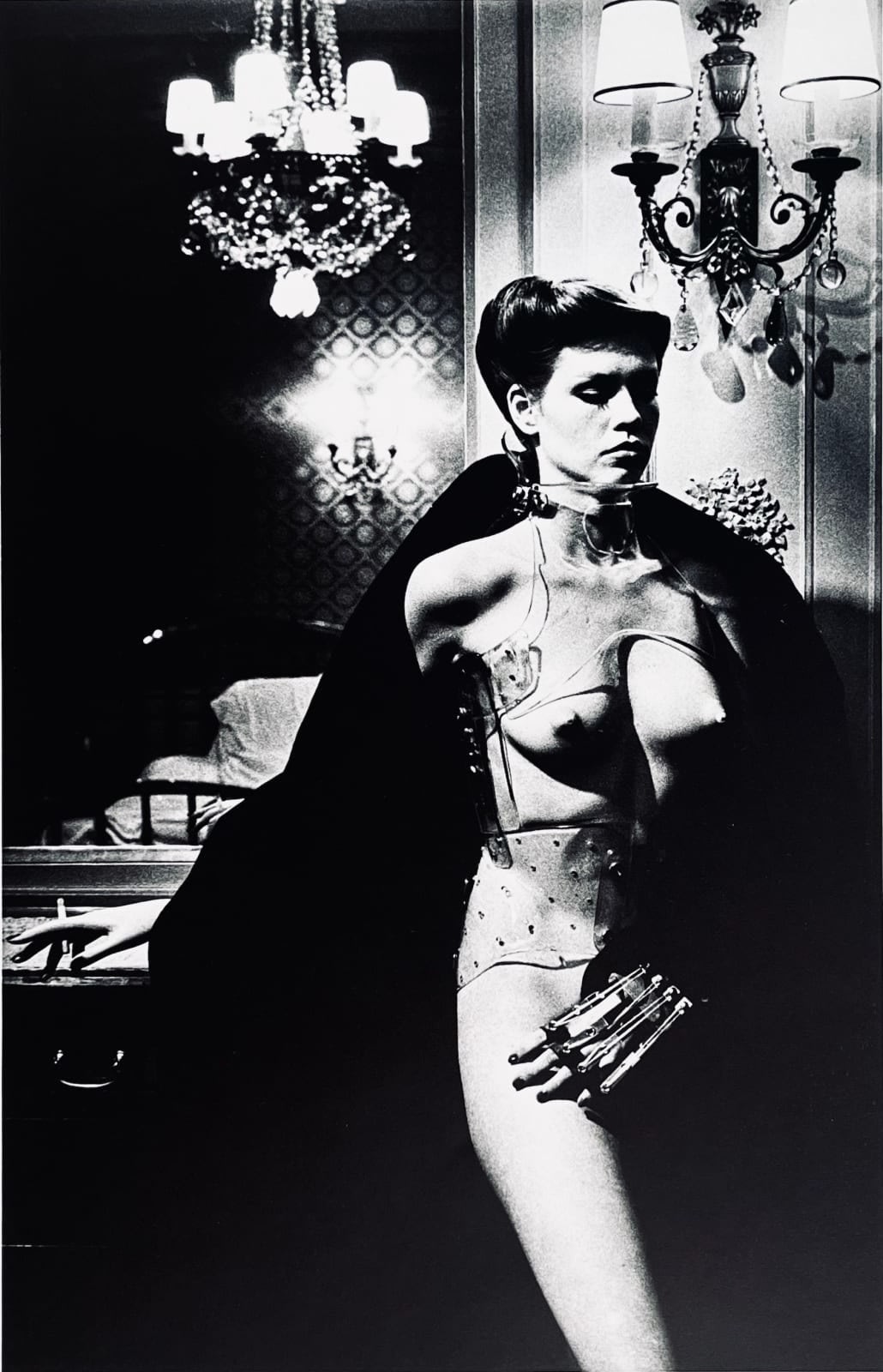
Helmut Newton understood that a fashion photograph could do more than describe clothes. It could establish a character, imply a before and after, and turn a hotel room, garden or Paris street into a stage. His pictures are controlled but rarely settled. Elegance coexists with tension; glamour is sharpened by distance, authority and ambiguity.
Born Helmut Neustädter in Berlin, Newton left Germany in 1938 and later established an international career that moved through Australia, Paris, Monte Carlo and Los Angeles. By the 1960s and 1970s, his work for leading fashion publications had become unmistakable. Strong directional light, assertive poses and precisely chosen locations made the images feel closer to cinema than conventional editorial illustration.
A photograph outside the magazine
The printed photograph changes when separated from the magazine sequence for which an image may originally have been conceived. Scale, paper, printing method, signature and inscription become visible as physical facts. A signed photolithograph is therefore not simply the same experience as encountering a photograph reproduced editorially.
A group of works produced in 1978 captures Newton at a particularly fertile moment. Jane Kirby, Ave Kléber, Paris, 1977 places the figure within the architecture of the city. The image is poised, but the setting introduces a narrative uncertainty: the viewer arrives in the middle of a scene rather than at its explanation.
In My Studio Paris, 1978 turns the working environment itself into a subject. Studio imagery can appear candid, yet Newton’s framing is never casual. The photograph remains constructed, with the apparent informality functioning as another layer of performance.
Location as character
Newton’s locations are rarely passive backdrops. In Capri at Night, 1977, the title alone establishes a mood of heat, darkness and temporary escape. In a Garden near Rome, 1977 shifts towards a more secluded theatrical setting, while Hollywood 1976 invokes a city already inseparable from projection and fantasy.
The portrait titles also matter. Gunilla Bergstrom, Paris, 1977 anchors sitter, place and year with documentary precision. Newton’s image then complicates that information, making identity feel performed rather than merely recorded.
What to look for in a Newton print
Collectors should distinguish between lifetime photographic prints, later estate prints, signed photolithographs, posters and images reproduced in books or portfolios. The same photograph may circulate in several materially and commercially different forms. Signature placement, inscriptions, printing date, dimensions, condition and provenance all require attention.
The signed 1978 photolithographs currently available through Dovehouse Contemporary measure approximately 41 × 28 cm, with horizontal works reversing those dimensions. Each is recorded as individually signed in pencil on the recto and inscribed with its title verso. Those details are central to understanding the objects and should not be collapsed into the generic description “photograph”.
Explore the available Helmut Newton works, or contact the gallery to request individual condition and provenance information.
A pose can imply a story without supplying one
Newton's figures often seem to have arrived from an event the viewer cannot see or to be preparing for one that has not yet occurred. The pose, gaze and setting create that sense of narrative time. The photograph remains a single moment, but it encourages an imagined before and after. This is one reason an image made in a fashion context can feel closer to a scene than to a simple description of clothing.
Look at how the figure relates to architecture or furniture. A doorway can frame an entrance, a chair can suggest authority or waiting, and an empty area can make a pose seem deliberately exposed. These relationships are visible decisions. They should be considered before treating the photograph as a transparent record of the sitter's personality.
Glamour can contain an uncomfortable distance
The polished image may invite admiration while making the viewer uncertain about their own position. Who controls the encounter? Does the figure meet the camera's attention, ignore it or appear to perform for it? Different images can support different answers. A serious reading leaves room for both the photograph's formal power and questions about how bodies are staged for looking.
That is more informative than assuming every assertive pose has the same meaning. Lighting, crop and the relationship between model and setting determine the particular image. The title supplies useful identification, but it cannot settle all the questions raised by the visual arrangement.
Two dates may describe two stages
A photograph's image date can differ from the date of a later printed publication. The catalogue should make that relationship clear. A photolithograph issued after the image was made is not automatically a photographic print produced directly from the negative in the original year. Signing and inscriptions add further information without changing the underlying process.
When considering the Helmut Newton works, ask for photographs of the complete sheet and the recorded inscriptions. Keep any publication information with the invoice, and distinguish condition of the paper from condition of a frame. The printmaking guide helps explain why a technically precise description matters. It allows the image's dramatic force to be appreciated through an accurately understood object.
Compare the printed image with its surrounding paper, not only with reproductions of the same photograph elsewhere. The sheet's size and margins establish a particular viewing distance, and its publication history gives that encounter a specific place within the image's wider circulation.
Related reading
- How Condition and Framing Affect a Contemporary Print
- Pigment Print, Giclée and Digital Print: A Collector’s Guide
- Lithograph vs Screenprint: How the Two Printmaking Methods Differ
Fashion as theatre
Newton’s photographs use fashion as a setting for power, performance and looking. The polished surface can coexist with discomfort: figures may appear dominant, exposed or deliberately artificial. Cropping, flash and architectural space organise that tension. Reading the work only as glamour misses the way it stages the relationship between photographer, model and viewer.
What a photolithograph is
A signed photolithograph is a printed object derived through lithographic reproduction of a photograph; it is not automatically a gelatin silver or other photographic print made from the negative. Identify publication, paper, dimensions, edition and signing information precisely. Condition should include ink surface, paper tone, margins and handling. A signature adds interest but does not change the underlying production process.

Leave a comment
This site is protected by hCaptcha and the hCaptcha Privacy Policy and Terms of Service apply.