
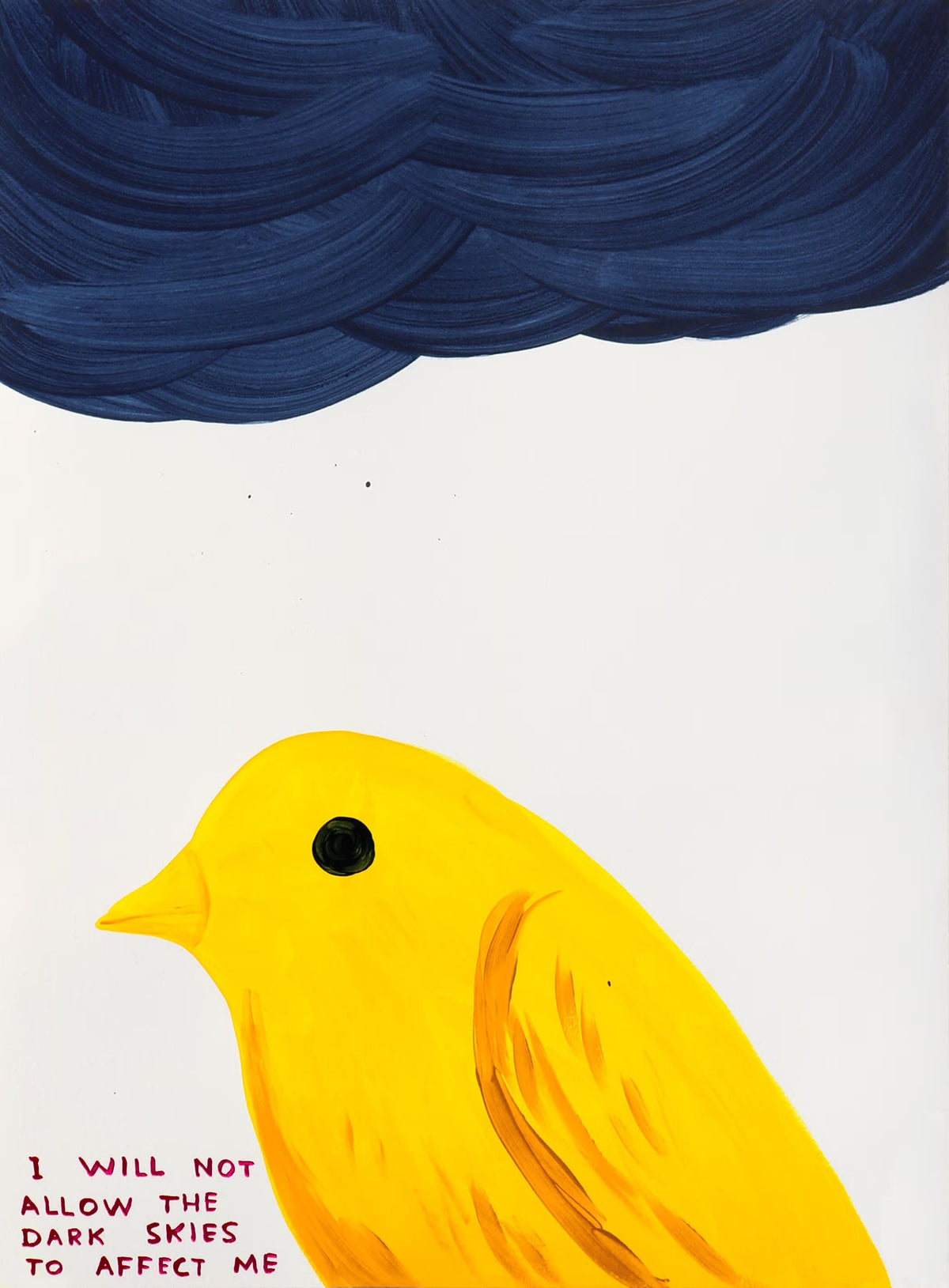
David Shrigley’s images can look wonderfully direct: a few words, an animal, an awkward proposition that becomes funnier the longer you consider it. Buying one takes a different kind of attention. The same visual language appears in editioned prints, posters, ceramics and other artist-designed objects, and those formats should be understood separately.
This guide is for someone choosing a work to live with. We explain how to compare the objects in the Dovehouse David Shrigley selection, what to request before buying and why a full catalogue description is more useful than a familiar phrase on a screen.
Choose the image, then identify the object
Start with the work that makes you want to look again. A text-led image may appeal because of its timing, its contradiction or a personal association. Another collector may prefer the animal drawings or the way a blunt patch of colour interrupts the page. Those responses are a better starting point than buying solely because an edition seems small.
Once an image interests you, establish exactly what is offered. Is it a screenprint, another printing process, a poster or a three-dimensional object? What is the publication date? Are the measurements for the image, the sheet or a framed example? A short title alone cannot answer these questions.
What a documented screenprint edition tells you
Shrigley’s official archive records Vibes (2018) as a screenprint on paper, measuring 76 × 56 cm, in an edition of 125. That combination of title, date, medium, dimensions and edition is the useful identification, rather than simply “a Shrigley print”.
Our catalogue includes I Will Not Allow the Dark Skies to Affect Me and Art Will Save The World. The individual listings record their specifications and asking prices. Read each one separately; belonging to the same artist’s print practice does not mean two works have identical signing, publication or condition details.

If the terminology is unfamiliar, our lithograph and screenprint guide explains the processes. Technique helps identify the object, but it does not by itself establish authenticity, condition or value.
Where are the signature and edition number?
Do not expect every print to be signed in the same place. Counter Editions’ record for Shrigley’s 2018 four-print set specifies that the works are signed, dated and numbered on the reverse. A photograph showing only the front would therefore leave an important part of the description unseen.
Ask where the marks are located and request clear images. If the work is framed, establish whether the reverse has been inspected and photographed. The absence of a visible front signature is not enough to decide that a print is unsigned; equally, a signature reproduced within an image is not automatically a hand-applied signature on the sheet.
Keep the wording precise. A signed certificate and a signed artwork are different things. Both may be relevant to a documented release, but one should not be described as the other. Our signature guide sets out the distinction.
Posters and other printed formats
A poster can be an enjoyable and appropriate purchase without being a signed limited-edition screenprint. The important point is accurate description. Look for the publisher, date, printing method, dimensions and whether an edition limit or signature is actually documented. Do not infer those details from the artist’s name or the popularity of the image.
This matters especially when comparing prices online. A search result may shorten a title or omit the medium. Open the complete entry before deciding that two offers are for the same thing. If the same phrase appears on different products, treat each publication as a separate object until the details establish otherwise.
Ceramics and artist-designed objects
Shrigley’s humour also moves into three dimensions. The official Shrig Shop describes The Tea Is Alive as fine bone china, in an edition of 999 with a numbered certificate. It is useful evidence that edition information belongs to the particular release, not just to works on paper.
Dovehouse’s Swan Thing listing is another route into the object side of the practice. Read its own medium, dimensions and recorded markings rather than applying the specifications of a screenprint to it. Consider how the object occupies a shelf or table, including its depth and stability, not only its height.

For a ceramic, ask about chips, cracks, repairs, surface wear and the condition of the base. Request photographs from several angles and ask what packaging is included. A certificate or box may be relevant to a release, but neither replaces inspection of the object itself.
Condition and framing of a print
Shrigley’s spare compositions can make the surrounding paper particularly noticeable. Ask for a full-sheet photograph in even light, with details of the corners and edges. Check for marks, creases, staining, fading and previous mounting. A close crop of the printed image does not show how the rest of the sheet has been treated.
If the work is framed, confirm whether the price includes that frame and whether its condition has been described separately. Ask for the overall framed dimensions as well as the sheet size. A frame that looks restrained in an online image may occupy much more wall space than expected.
For a new frame, discuss appropriate mounting and glazing with a framer rather than treating presentation as an afterthought. Our condition and framing guide provides questions to take into that conversation.
Comparing prices and setting a budget
Compare the same title and publication first, then the medium, dimensions, signing and edition. After that, examine differences in condition, documentation and what is included. Two examples of an edition can deserve different consideration if one has a disclosed condition issue or lacks information needed to assess it.
Edition size alone is not a pricing formula. Nor does an artist’s proof automatically make a work more suitable for you than a numbered impression. Subject, presentation and your response to the image still matter. Our guide to proofs explains the notation without treating it as a promise of financial performance.
Set a budget for the complete purchase, including any framing and delivery you need. Ask which costs are included and which remain to be confirmed for your destination. Avoid comparing an all-in offer with an artwork-only price as though the totals were equivalent.
Buying several works together
A group can work through a shared palette, format or sense of humour. It does not need to consist of matching images. If you plan to hang prints together, compare the actual sheet dimensions and leave space for mounts, frames and gaps. Equally sized thumbnails are not a reliable guide to a finished wall.
For a group purchase, request an itemised list of titles and descriptions. Check the condition and signing of each sheet separately. A seller’s phrase “set of four” may describe a group assembled for sale or a documented publisher-issued set; establish which before proceeding. Keep the invoice and supporting information together for future reference.
Tell us what you are looking for
If the work is a gift, mention when it is needed and whether it will be delivered framed. A preferred date helps establish what must be confirmed; it should not be treated as a delivery promise until the arrangements have been agreed for that purchase.
A useful enquiry can be short. Tell us the title or phrase you like, whether you want a signed editioned print or another format, your approximate budget and any size limit. If you are buying for a particular room, say whether the work needs to stand alone or sit beside other pieces.
Discuss a David Shrigley work or email the gallery. Browse the Shrigley listings for individual details and prices, then ask about current availability, condition photographs and the documentation accompanying the example you are considering.

Leave a comment
This site is protected by hCaptcha and the hCaptcha Privacy Policy and Terms of Service apply.