
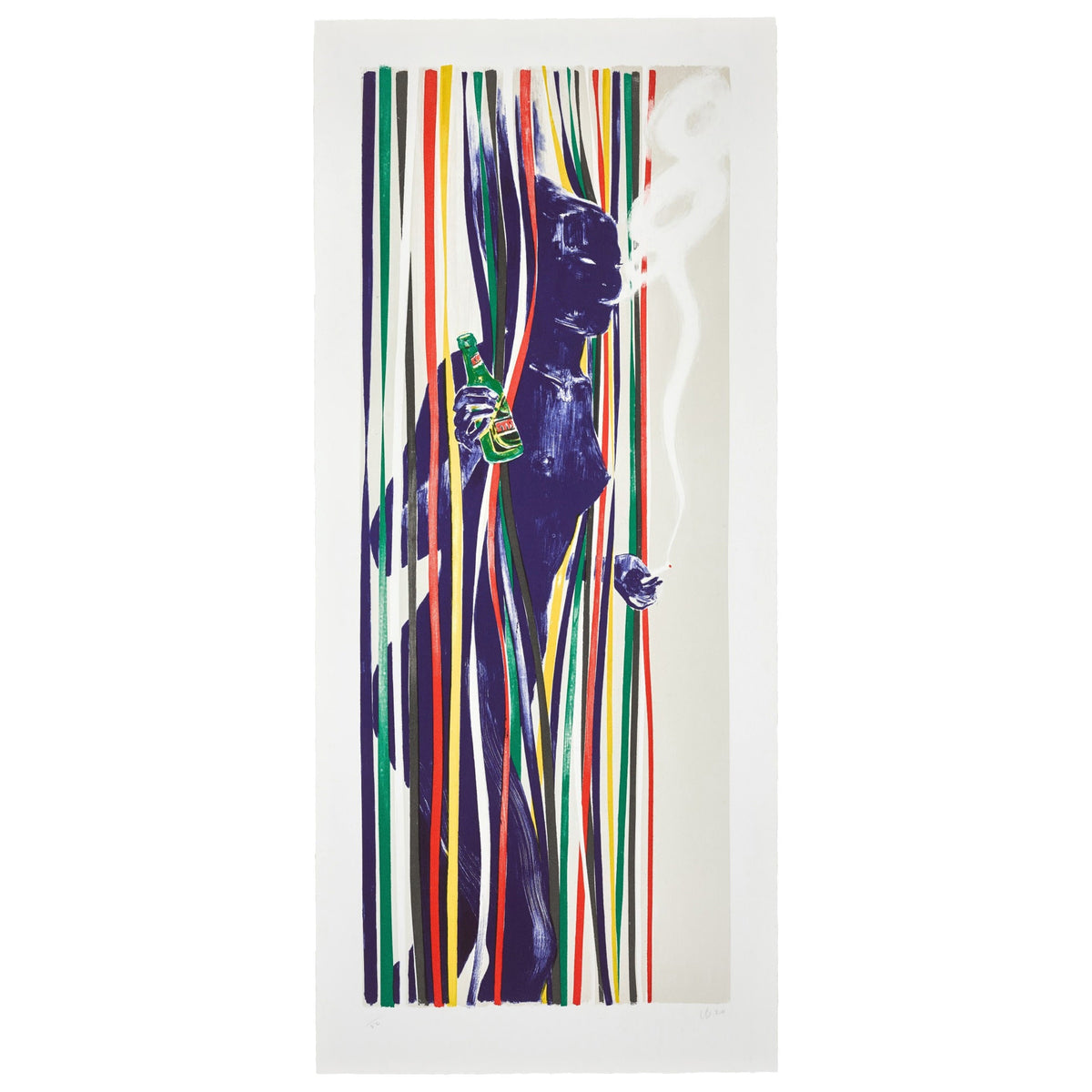
Lithograph and screenprint are two of the most important terms in the market for modern and contemporary editions. Both describe original printmaking processes, yet they produce images in fundamentally different ways. Understanding the distinction helps a collector read the surface of a work and appreciate the decisions behind it.
What is a lithograph?
Lithography is based on the resistance between grease and water. The artist’s image is drawn or transferred onto a prepared stone or metal plate. During printing, greasy ink adheres to the image areas while damp non-image areas repel it. The image is then transferred to paper under pressure.
Lithography is particularly responsive to drawing. It can retain the immediacy of crayon, wash and hand-drawn marks, while colour lithographs use separate stones or plates for different colours. Contemporary workshops may combine traditional and photo-based methods, but the principle remains planographic: the printable and non-printable areas occupy the same plane.
Lisa Brice’s Untitled (after Ophelia) and Tracey Emin’s A Deeper Place demonstrate how lithography can carry expressive line and tonal colour into an editioned form.
What is a screenprint?
In screenprinting, ink is pushed through a fine mesh onto the sheet. A stencil blocks the areas that are not to be printed, leaving the image open. Each colour normally requires a separate screen and pass. This makes the technique particularly effective for crisp shapes, saturated colour and layered graphic imagery.
Screenprinting became central to Pop art because it allowed artists to work with mass-media imagery while retaining the material presence of deposited ink. Andy Warhol’s Dollar Sign belongs to this tradition, while Invader’s CAMO XXL-3C-M1 shows how contemporary artists continue to use the medium at ambitious scale.
Can one method be considered better?
No. A technique should be judged by how it serves the image. Lithography can feel close to drawing or painting; screenprinting can produce exceptional flatness, density and precision. Both may involve extensive collaboration between artist and printer, multiple stages of proofing and highly specialised decisions about ink and paper.
How can you tell which process was used?
A catalogue or gallery description is the starting point. Under close examination, a screenprint may show distinct layers and a slightly raised ink surface, while a lithograph may reveal subtler tonal transitions and crayon-like textures. These characteristics vary, and visual inspection alone should not replace documentation.
Collectors should also note whether a listing says “lithograph,” “offset lithograph” or “after” an artwork. These phrases are not interchangeable. The exact description tells you how the object was produced and how it relates to the artist’s primary work.
Our limited-edition description guide explains how medium, paper, signature and edition size work together.
Explore: Discover available prints by leading modern and contemporary artists.

Leave a comment
This site is protected by hCaptcha and the hCaptcha Privacy Policy and Terms of Service apply.