
A swimmer breaks the surface of dark water. A boat crosses beneath a mountain. A man with a bird on his shoulder looks straight out of a sheet of paper. Billy Childish’s prints have an immediate human presence, whether the image is carried by a cut black line or by the shifting colour of a painted landscape.
For a collector, the pleasure begins there. The next step is to understand what kind of print is being offered. Childish’s editions include woodcuts, etchings and digitally printed works, with different papers, edition sizes and signing methods. Looking closely at those distinctions makes it easier to choose a work for its particular qualities.
Who is Billy Childish?
Born in Chatham, Kent, in 1959, Childish works across painting, printmaking, poetry, fiction and music. His subjects often come from familiar places and people: the Kent landscape, the American Pacific Northwest, self-portraits and figures drawn from his personal world. His biography at Lehmann Maupin places painting at the centre of a practice sustained since the late 1970s.
That breadth is useful context, but a print rewards attention on its own terms. A face can emerge from a few decisive cuts. Water can become a field of wavering lines. The apparent directness draws us in; the organisation of the image keeps us looking.
Start with the medium
“Billy Childish print” describes a varied group of objects. A woodcut is printed from the raised surface of a carved block. The areas removed from the block generally remain unprinted, making the relationship between ink and exposed paper central to the image. An etching works differently, holding ink in recessed lines in a plate. A pigment print uses a digital printing process, while the description “archival reproduction” tells us something further about the work’s relationship to an existing image.
These terms should stay distinct. An authorised, signed reproduction can be a considered choice for a collection without being described as a hand-pulled woodcut. Equally, the word “original” does not mean that a print is unique. An original print may belong to an edition of many impressions. Our guide to reading a limited-edition print description sets out the terminology in more detail.
The cut line: Man With Jackdaw
In Man With Jackdaw, the figure’s hat, face and jacket are built from dense black passages interrupted by white cuts. The bird forms a compact silhouette beside him. Scratched and broken marks keep the black from becoming a uniform mass, giving the image a rough, tactile rhythm.

The Dovehouse catalogue records this 2017 work as a woodcut on Japanese Masa paper, measuring 39.5 × 27 cm, from an edition of 250. The paper is part of its character. In a work organised around the contrast between black ink and an open ground, the unprinted areas carry as much visual weight as the carved image.
When considering a woodcut, ask for photographs that show the whole sheet as well as the inked surface. Unevenness may belong to the printing, but an online image alone cannot establish whether a particular mark is inherent or the result of later handling.
Colour, water and landscape
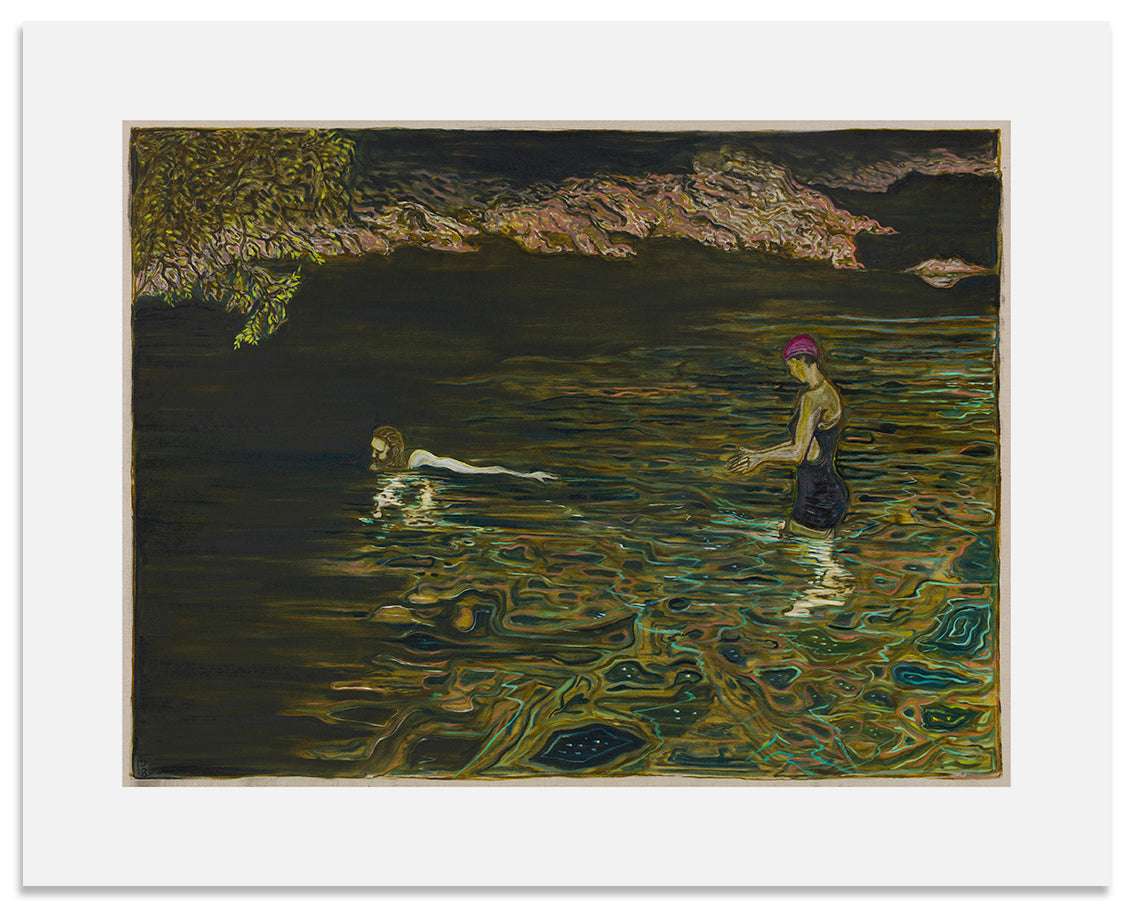
Childish’s colour prints offer a different encounter. In Swimmers, two figures occupy a broad stretch of dark water. Around them, green, gold and pale lines turn reflections into an almost restless pattern. The figures remain small within the scene, yet their presence changes how we read its scale and atmosphere.

The catalogue describes Swimmers as a 2020 archival pigment print on heavyweight acid-free matt stock, signed and numbered from an edition of 200. That description identifies the printed object. It does not make it a painting, even though the image preserves the movement and colour associated with painted marks.
Off Tahoe makes another useful comparison. The gallery records the 2023 edition as an archival reproduction on heavy matt stock, 30.5 × 38.4 cm, from an edition of 200. Its boat, mountain and patterned water create distinct horizontal bands, with the sails drawing the eye back towards the centre. The waves give the foreground a movement that contrasts with the mountain’s stillness.

Edition numbers and the hangman signature
Read the edition information separately from the image. The denominator in a fraction normally identifies the size of the numbered edition; it does not necessarily include artist’s proofs or other impressions. Nor is the first number a quality ranking. The useful question is whether the inscription agrees with the documented publication.
Childish’s distinctive hangman symbol also needs careful description. The Off Tahoe entry specifically records signing with that symbol and numbering. Other entries may state “signed”, “stamp signed” or a different marking method. Those phrases should not be treated as interchangeable. Ask for a clear detail of the actual inscription, together with a photograph showing its position on the sheet.
A signature is one part of the evidence. Medium, dimensions, paper, edition details and provenance should describe the same object. If an entry leaves a detail open, ask for it rather than borrowing the specification of a similar-looking work.
Choosing a print to live with
Consider the image at two distances. From across a room, a strong silhouette or broad colour arrangement may do most of the work. Nearby, the cut of a line or the rhythm of a reflected shape becomes more important. A print that holds attention at both distances can be particularly rewarding in a domestic setting.
Scale deserves the same care. Check whether the measurements describe the sheet, image or frame, and ask the gallery to clarify the order of height and width if it is unclear. Use the actual measurements when planning a wall. A generous mount can change the overall presence considerably without changing the printed image itself.
It is also worth comparing a figurative woodcut with a colour landscape before deciding. The former may offer the concentrated force of a face and a cut line; the latter can establish an atmosphere through repeated marks across a wider field. Your response to those differences matters more than choosing the smallest edition simply because it is smaller.
Condition and the final checks
Before acquiring a particular impression, request a current condition report and clear photographs of the front, margins and reverse. Ask about creases, staining, fading, surface marks and previous mounting. If the print is framed, establish whether it has been examined outside the frame and whether the quoted dimensions include the frame.
Keep the agreed description and supporting documents with the work. The title, date, medium, edition and signing method on the invoice should match the information you have checked. Our condition and framing guide explains the broader questions to consider.
Explore Billy Childish at Dovehouse
Childish’s prints offer several ways into a distinctive visual world: the economy of a woodcut, the quiet presence of a figure in water, the movement of a landscape organised through colour. Understanding the edition allows that initial attraction to become a precise, informed choice.
Browse the Billy Childish collection, or contact Dovehouse Contemporary with the title that interests you. Ask for current availability, photographs of the particular impression and any details you would like clarified before buying.
For more on the artist’s wider practice, read our introduction to Billy Childish’s painting, printmaking and creative life.


Leave a comment
This site is protected by hCaptcha and the hCaptcha Privacy Policy and Terms of Service apply.