
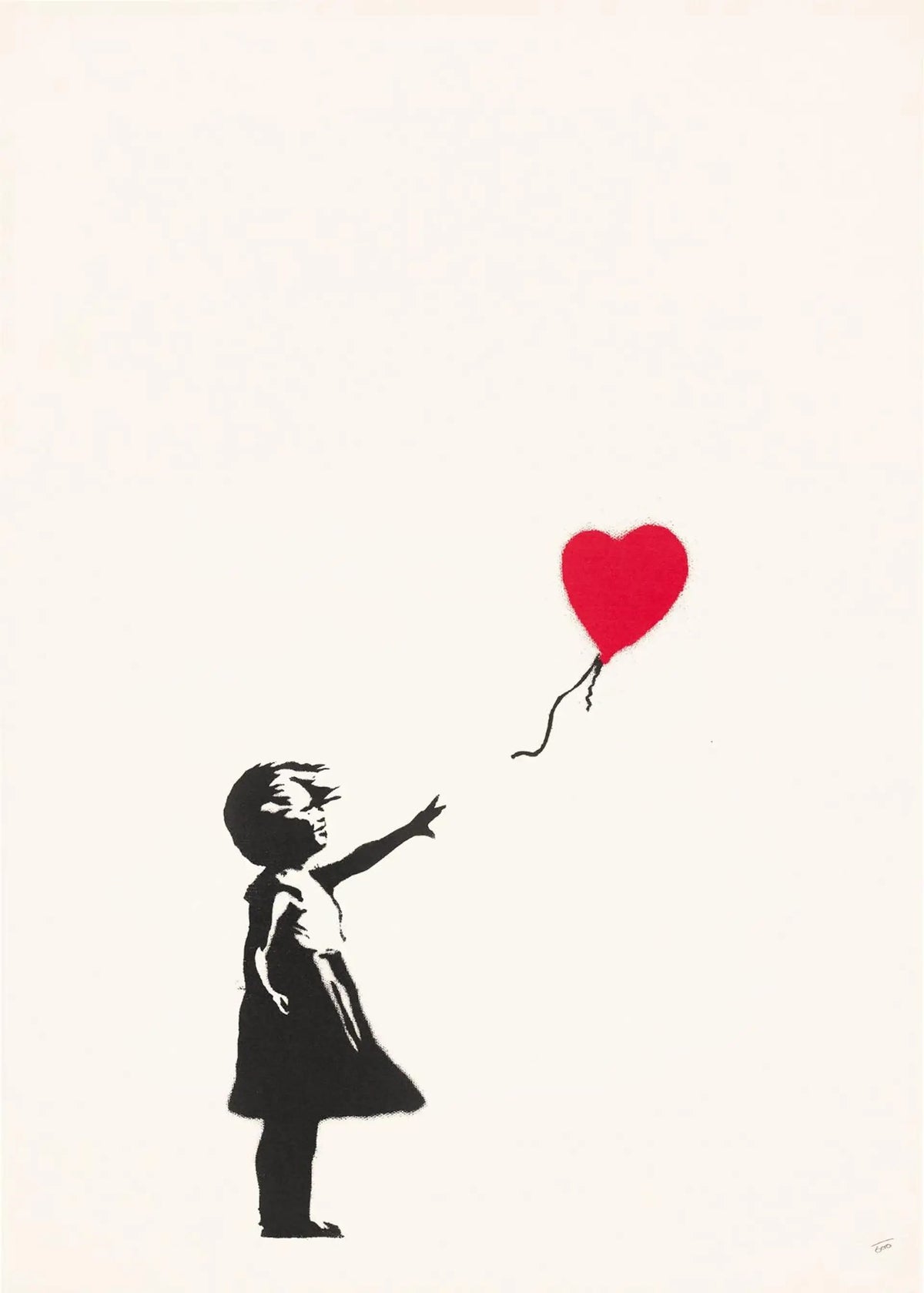
The visual economy behind a contemporary icon.
A child, an escaping balloon and a narrow palette hold hope, loss, distance and release in suspension.

Selected work: Girl With A Balloon (unsigned).
Current examples include Pulp Fiction (unsigned), Girl With A Balloon (unsigned) and Barcode (unsigned). View the complete Banksy collection for current availability.
Explore available works by Banksy
A deliberately open narrative
The separated child and heart-shaped balloon create a story with no confirmed ending. The balloon can be read as hope, love, loss or release, while the gesture can suggest reaching or letting go. That ambiguity allows the image to travel across political, personal and commercial contexts without becoming tied to a single explanation.
Fame increases the need for precision
The motif exists across street works, prints, posters and reproductions. Recognition alone says nothing about the status of a particular object. Identify the exact edition or publication, colour, dimensions, signature status and Pest Control documentation. Strong demand has produced extensive imitation, so condition photographs and a precise invoice are essential even when the image appears instantly familiar.
Looking more closely
The image survives because its emotional direction is unresolved. The balloon may be escaping, being released or remaining just within reach; the girl can signify hope, loss or deliberate letting go. That ambiguity prevents the motif becoming a closed slogan. When comparing editions, the placement of the heart, the balance of red and black and the amount of untouched paper are central to the work’s tension.
An image built from distance
The emotional charge of Girl with Balloon depends on the gap between two forms. The child leans towards the heart-shaped balloon, but the space between them prevents the scene from settling into a single explanation. Is the balloon escaping, being released or still within reach? Banksy provides no final answer. The empty space performs the drama.
Colour intensifies that economy. The girl is rendered in black while the balloon is red, isolating the object of attention without needing a detailed setting. The composition can be understood immediately, yet its direction remains unresolved. That combination—instant recognition and open interpretation—is central to the image’s durability.
Street image, print and cultural symbol
The motif has appeared in different public contexts and has also circulated through authorised prints and a vast number of reproductions. Those categories should not be collapsed. A street work is inseparable from its site and moment; a screenprint is a discrete editioned object with its own paper, dimensions, number and signature status; a poster or later reproduction has a different material and market position.
The 2018 Sotheby’s event, when a framed version began to pass through a shredder immediately after the auction, added another chapter to the image’s public life. The altered work was subsequently titled Love is in the Bin. The episode did not replace the earlier meanings of the balloon, but it showed how Banksy could redirect attention from an auction result to the mechanisms through which art is displayed, sold and reported.
Signed and unsigned editions
Collectors encounter both signed and unsigned Banksy prints. Unsigned does not mean unofficial: authorised unsigned editions form an established part of the artist’s print practice. The relevant comparison is between examples of the same edition type, colourway and condition, supported by appropriate Pest Control documentation.
A signature can affect scarcity and demand, but it does not establish authenticity by itself. Review the certificate, edition number, dimensions, paper, provenance and physical state as a complete group of evidence. Because Girl with Balloon is so widely copied, generic descriptions and cropped photographs are not enough.
Condition and presentation
The open areas of the sheet make damage easy to see. Look for fading in the red, discolouration of the paper, rippling, handling creases, abrasions and the effects of previous mounting. Ask whether the work has been examined out of its frame and whether restoration has been undertaken. Framing should protect the sheet without covering edition marks or placing pressure on the surface.
The best examples preserve the tension between the dark figure, the red heart and the surrounding paper. That balance is more than a matter of neatness: it is the visual structure that allows the image to hold hope and loss at the same time.
The string is a small but important line
The balloon's string connects a recognisable object with the possibility of an action. It suggests something that could be held, released or recovered, yet it does not settle which event has occurred. The girl's hand and the line's position create a relationship that the viewer mentally completes. Much of the narrative resides in that imagined connection rather than in a detailed setting.
Look at the image first as a balance of shapes: a dark figure, a smaller coloured form and the interval between them. Then return to the story. The emotional reading becomes more specific when we recognise how little material is needed to produce it. An apparently empty gap is doing work that an elaborate narrative might otherwise have supplied.
Recognition can obscure the particular version
Because the image is so familiar, a viewer may feel they know it before examining the actual object. Slow down at the point of identification. Read the title, publication, dimensions and signature status, and compare them with the supplied photographs. The signed and unsigned print guide explains why authorised editions need to be compared within their correct categories.
Then return to the image's particular scale and placement on the sheet. A famous motif does not remove the need for that encounter. The work's ability to hold hope and loss together depends on the exact balance visible before you, not simply on the cultural associations attached to its name.
That is a useful way to live with an icon: acknowledge what you already recognise, then allow the individual object to complicate it. Familiarity becomes an invitation to attention rather than a substitute for looking.

Leave a comment
This site is protected by hCaptcha and the hCaptcha Privacy Policy and Terms of Service apply.