
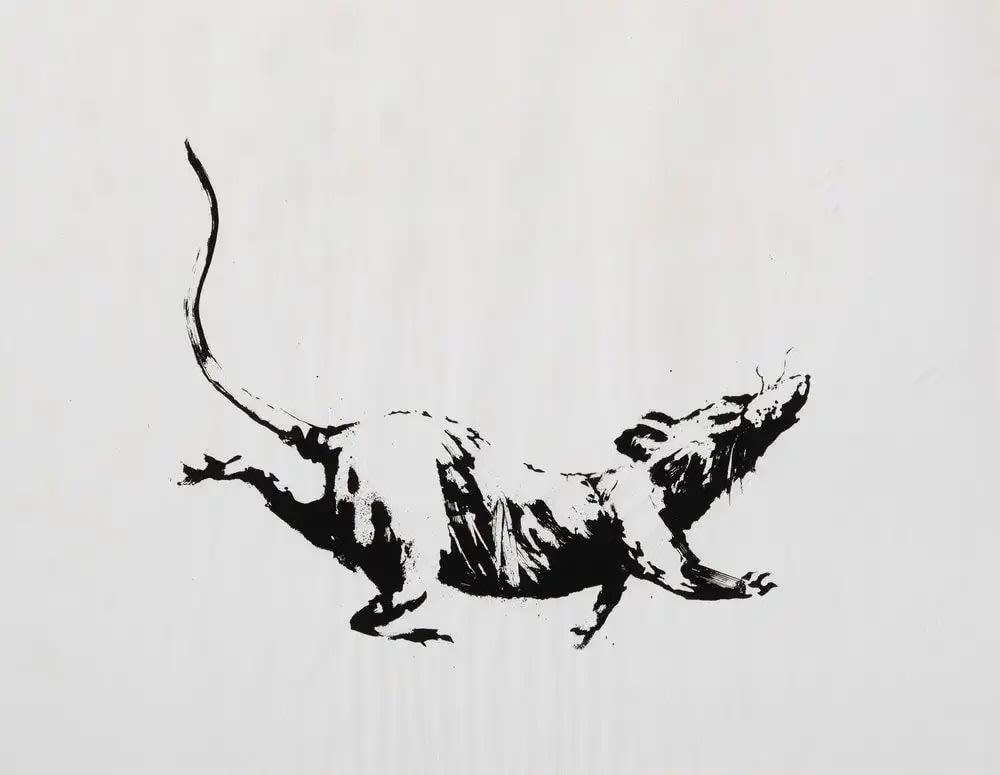
How the rat became an adaptable motif.
The rats occupy the margins as painters, protesters, organisers and survivors.

Selected work: GDP Rat.
Current examples include GDP Thrower, Heavy Weaponry and Barcode (signed). View the complete Banksy collection for current availability.
Explore available works by Banksy
Why the rat works
Rats survive at the edges of controlled environments. They are unwanted, adaptable and difficult to eradicate, making them effective stand-ins for outsiders and acts of resistance. Banksy’s rats may paint, carry tools or deliver slogans; their small scale often makes the surrounding city seem disproportionately powerful, yet their persistence reverses that hierarchy.
Repetition and variation
The rat is not one fixed symbol. Gesture, prop, text and location change the meaning from mischief to labour, protest or despair. In editions, verify the precise title and variation, because similar-looking images can differ in colour, signature status and edition structure. Condition is particularly visible in works whose impact depends on clean paper and sharp stencil-like contrast.
Looking more closely
Banksy’s rats gain force from their scale. They occupy corners, margins and low walls—the parts of a city that authority tends to overlook. Their tools and slogans change, but the basic character remains resourceful rather than heroic. In an edition, the surrounding blank paper performs the role of the street: it isolates the figure and makes its small act of defiance feel sharper.
A character made for the margins
The rat is unusually well suited to Banksy’s practice because it already belongs to the overlooked parts of a city. It moves through tunnels, alleys and service spaces, surviving beside systems designed to exclude it. In Banksy’s hands that position becomes political. The rat can represent the disregarded, the persistent and the collectively powerful, but it can also be comic, opportunistic or self-defeating. Its meaning depends on what it is doing.
Some rats paint or carry tools; others hold signs, listen, run or appear caught in the machinery of everyday life. These changes matter more than a single fixed definition. Banksy uses a recurring cast rather than a repeated logo, allowing each prop and location to shift the tone from resistance to exhaustion, mischief or warning.
Scale changes the balance of power
Rats are usually shown small against a large field. On the street, that field may be a wall controlled by property, advertising or municipal authority. On paper, the empty sheet takes over that role. The figure can look vulnerable, yet the surrounding space also makes its action conspicuous. A tiny mark becomes the focus because there is so little to distract from it.
This tension explains why condition is visually important. Clean margins and strong contrast support the intended imbalance between figure and field. Mount staining, fading, handling marks or trimming can alter that relationship even if the central image remains recognisable.
Identifying the exact rat
Collectors should resist treating “Banksy rat” as a sufficient description. Closely related motifs can have different titles, dates, colourways, edition structures and contexts. Establish whether the object is an authorised screenprint, another editioned work, a publication or a reproduction. Check dimensions, paper, numbering, signature status and Pest Control authentication against the specific work rather than against a generic image found online.
The distinction is particularly important because Banksy’s imagery circulates so widely. Familiarity can create false confidence. A careful catalogue entry should make the status of the object unambiguous and provide photographs that allow the edition marks, sheet edges and condition to be assessed.
Why the rats remain relevant
The motif endures because it avoids a heroic view of protest. Banksy’s rats are not monumental leaders; they are improvised actors working from below. Their persistence, anonymity and adaptability mirror the conditions of street art itself. They can be funny at first glance and unsettling on reflection—a combination that gives the series much of its continuing force.
Props turn a character into an action
A recurring animal becomes narratively flexible when the object it carries changes. A tool suggests work, a sign suggests an address to an audience and an everyday device can make the rat resemble a small participant in human systems. The viewer recognises the animal quickly, leaving attention free to register the changed action. The motif supplies continuity while the prop supplies a new situation.
This structure helps explain why the rat should not be treated as a single fixed political emblem. The same small figure can appear resourceful, absurd, exhausted or defiant. Describe what it is doing and how the surroundings respond before assigning a broad meaning. A precise account of the action is often more revealing than a general statement that rats represent outsiders.
The edge of the image matters
A figure placed close to an edge can seem to enter, escape or occupy a neglected corner. A figure surrounded by open paper may look exposed, but the emptiness can also give its action unusual emphasis. These effects depend on the complete composition. A tightly cropped photograph may enlarge the rat while removing the spatial relationship that makes it feel small.
When comparing editions, look at full-sheet photographs and actual dimensions. Consider whether the frame preserves the intended space and whether marks in the surrounding field compete with the image. The paper is not merely a carrier for a detachable character; it establishes the scale of the rat's action.
Compare persistence with spectacle
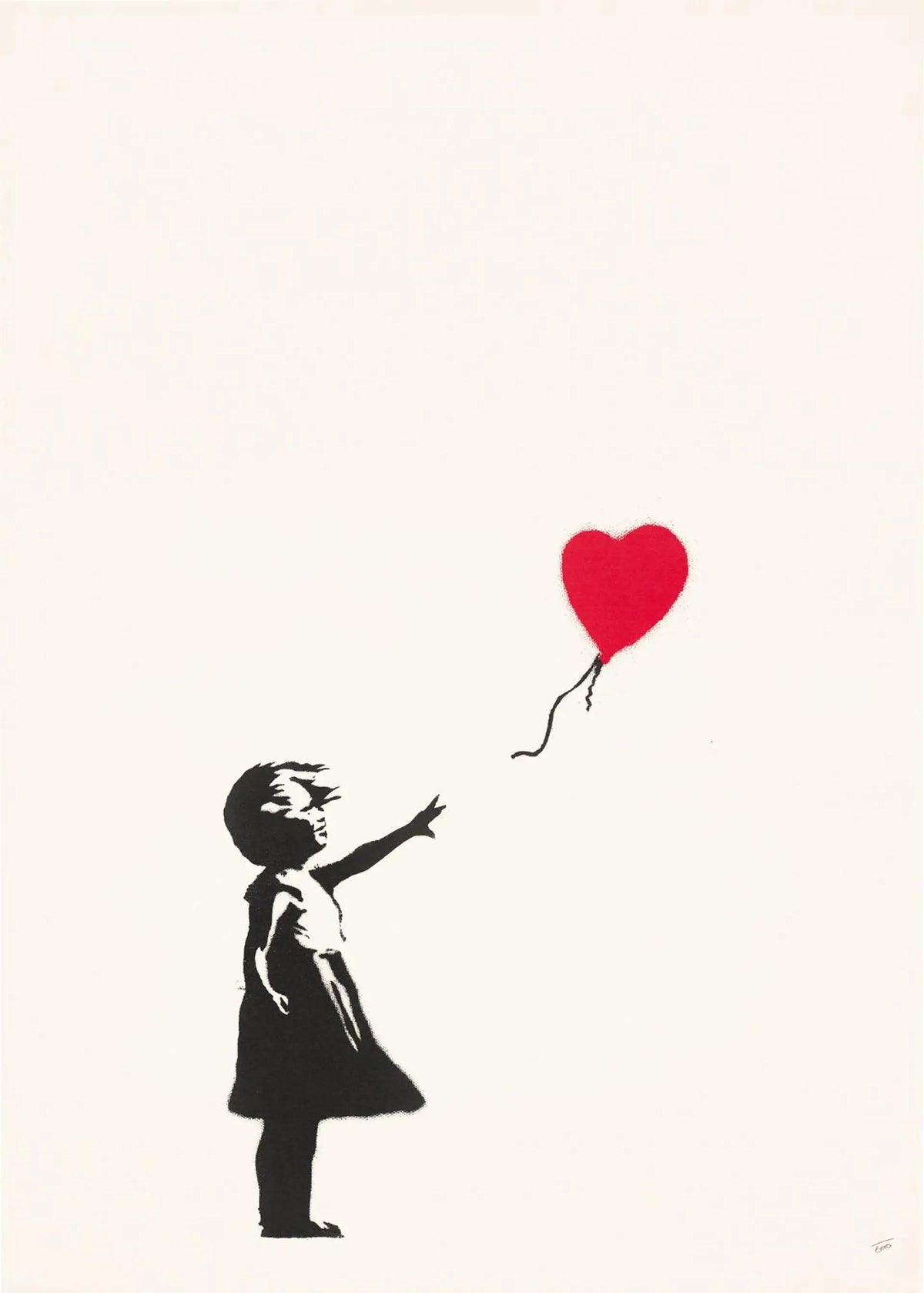
Place a rat image beside Girl with a Balloon. One may suggest improvised activity, the other a suspended emotional encounter. Both rely on a small number of elements and an active surrounding field, yet they use that economy differently. The comparison reveals the range of Banksy's graphic language without requiring every motif to deliver the same message.
For the actual works, continue through the artist collection and retain the distinctions between paper editions, objects and publications. Familiarity with a character is a beginning for interpretation, not evidence of the status or history of the individual example being offered.

Leave a comment
This site is protected by hCaptcha and the hCaptcha Privacy Policy and Terms of Service apply.