
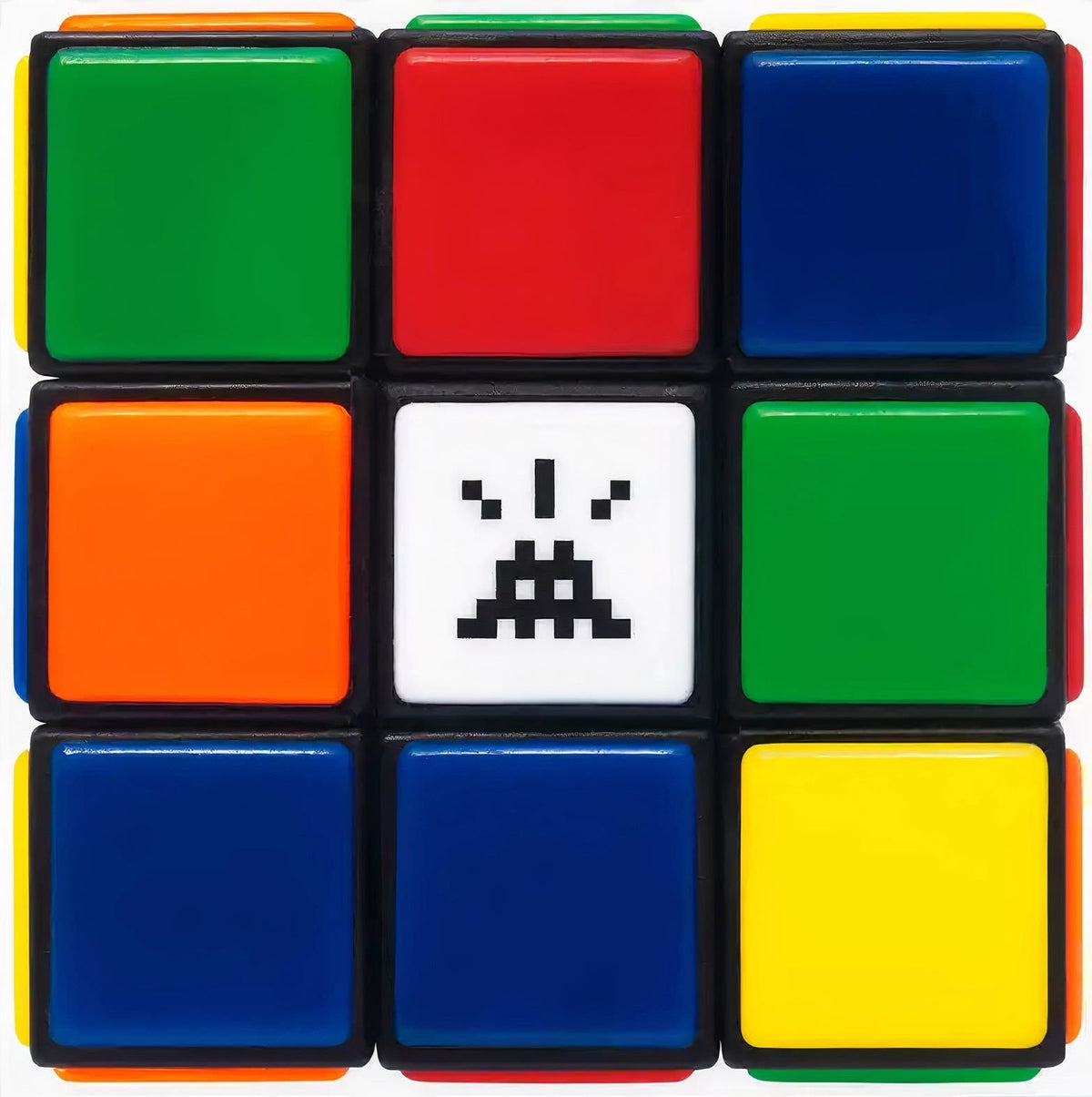
Invader is most readily associated with small ceramic mosaics placed, without announcement, across the architecture of cities. Their source is the primitive pixel: a unit of digital information translated into something physical, permanent and public. Yet to understand the artist only through those street interventions is to miss the breadth of the project. Prints, sculptures, maps and works made from Rubik’s Cubes all return to the same underlying question: how does an image travel between screen, object and city?
The artist began his invasion programme in Paris in the 1990s, adapting the visual language of early arcade games into mosaics that could occupy walls, bridges and street corners. Each intervention is documented and assigned a score, making the project at once geographic, archival and playfully systematic. Anonymity is part of that structure. The work circulates independently of a public persona, held together instead by a recognisable visual code.
From mosaic to screenprint
On paper, the pixel behaves differently. A screenprint has none of the architectural context of a street mosaic, so colour, pattern, scale and surface move to the foreground. Camo M-2C-M1, 2024, compresses the artist’s vocabulary into a dense camouflage arrangement. Printed on Somerset Satin Cotton in an edition of 100, the work makes concealment and recognition operate simultaneously.
The larger CAMO XXL-3C-M1, also from 2024, expands this idea to 120 × 142 cm. At that size, the pixel is no longer a small graphic reference; it becomes a field. The image can be read from a distance and then broken apart at close range, echoing the way an urban intervention alternates between symbol and material object.
L.E.D, 2017, uses a six-colour screenprint to explore a related visual economy. Its geometry feels electronic, but the Somerset paper and layered inks make the image decisively physical. This friction between digital source and analogue production is fundamental to Invader’s editions.
Rubikcubism and the image in disguise
In 2005, Invader began making pictures from Rubik’s Cubes, a development he named “Rubikcubism”. The restricted six-colour palette forces images towards abstraction; they often reveal themselves only when seen from a distance or through a camera screen. The process extends the logic of the pixel while replacing ceramic tiles with an immediately recognisable mass-produced object.
Rubik Camouflage NVDR1-2 and Rubik Country Life NVDR1-3, both 2022, translate that practice into Diasec-mounted giclée works on aluminium composite panel. Their edition sizes differ considerably, an important distinction for collectors comparing works from the same group.
The four-part HENI – set of 4, 2023, is particularly effective as a sequence. Seen together, the panels emphasise variation within an apparently rigid system. Repetition never produces sameness; small shifts in colour and arrangement alter the identity of each image.
Collecting Invader editions
Invader’s market includes signed screenprints, three-dimensional objects, maps, photographs and editioned works derived from Rubikcubism. Buyers should distinguish carefully between medium, edition size, signature, publisher and format rather than treating all pixel-based imagery as equivalent. Works on paper can be especially sensitive to handling and light, while Diasec-mounted panels require different condition considerations.
Explore the available Invader works at Dovehouse Contemporary, or contact the gallery for further information about condition, provenance and individual editions.
Distance can assemble an image
A block of colour may appear independent at close range and become part of a recognisable image from farther away. Invader makes this shift central to the encounter. The viewer moves between seeing units and seeing what those units collectively represent. Recognition becomes an event rather than a permanent property of the surface.
A camera screen can change the experience again by reducing the image and reorganising its apparent scale. That effect is useful for looking, but it should not make the digital view seem more authoritative than the physical object. The work includes both the close encounter with its construction and the more distant recognition that construction permits.
Camouflage reverses the promise of the pixel
A simple pixel-based figure is usually designed for rapid recognition. Camouflage complicates that clarity by making parts merge with their surroundings. The viewer searches for a figure inside a field that resists separation. This tension between visibility and concealment gives a familiar visual vocabulary another task beyond presenting an instantly readable character.
Compare the scale of the pattern with the size of the sheet. A dense arrangement can feel immersive in a large format and more like a compact code in a smaller one. Website thumbnails tend to erase that distinction, so dimensions are essential to understanding what kind of encounter the edition offers.
A translated image has a new support
A paper screenprint, a mounted digital edition and a mosaic are different objects. A print related to Rubikcubism does not consist of actual cubes unless the medium explicitly says so. The imagery can preserve the logic of a modular construction while its physical surface changes. Accurate description makes that translation visible rather than hiding it behind a familiar project name.
Read the digital print guide alongside the Invader collection. Check the support, edition and signing details for the individual work. The strongest comparison joins the pleasure of recognition with an understanding of the material system that produces it.
For a set, confirm that every component is included and that condition is reported for each panel. A shared publication does not mean every component has had the same handling or display history.
Related reading
- How Condition and Framing Affect a Contemporary Print
- Pigment Print, Giclée and Digital Print: A Collector’s Guide
- Lithograph vs Screenprint: How the Two Printmaking Methods Differ
From digital unit to physical object
Invader’s pixel is both an image and a method of construction. Mosaics translate the logic of a screen into ceramic units placed in public space; Rubikcubist works use coloured cubes as modular pixels. Prints then translate those systems again, making medium changes central to the practice rather than secondary reproduction.
Edition, map and provenance
Invader’s prints and multiples have varied publishers, edition structures and forms of documentation. Check title, date, technique, dimensions, edition, signature and provenance. Street-location maps and invasion records supply context but do not automatically authenticate a separate object. Crisp registration, colour, paper condition and any accompanying material should be assessed together.

Leave a comment
This site is protected by hCaptcha and the hCaptcha Privacy Policy and Terms of Service apply.