
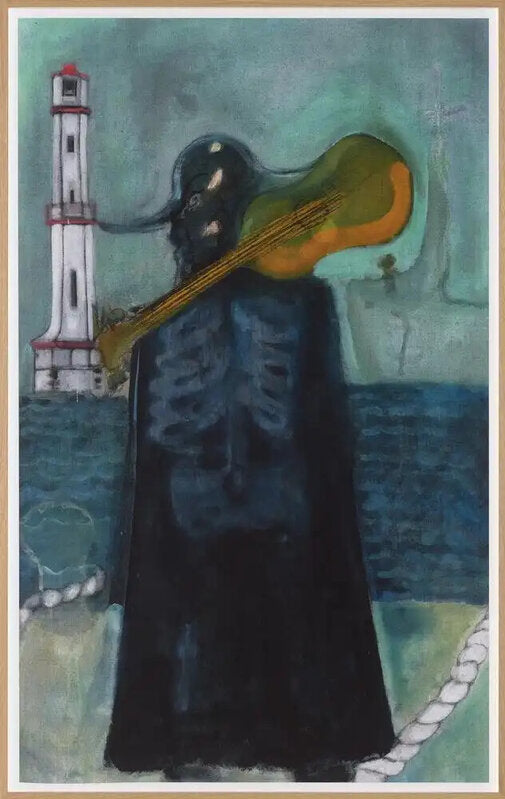
Peter Doig’s House of Music prints occupy an unusually direct place in his recent practice. Created in 2026 after paintings shown at Serpentine South in London, the editions carry forward a project in which music was not simply a subject but part of the experience of looking. The exhibition brought paintings into dialogue with restored analogue sound systems and music selected by Doig, extending a long-standing connection between his imagery, memory, place and listening.
For collectors, the resulting prints are interesting because they are neither generic reproductions nor detached afterthoughts. They translate a specific body of recent paintings into a tightly defined edition project, with consistent production details and imagery rooted in the same musical world. Dovehouse Contemporary currently represents several works from the series, alongside a broader selection of Peter Doig prints and editions. For a wider introduction to the artist’s visual language, see our earlier essay, Peter Doig: Painting Memory.
From Serpentine to House of Music
Peter Doig: House of Music ran at Serpentine South from 10 October 2025 to 8 February 2026. Serpentine described the exhibition as a project exploring music, film and places of communal gathering, listening and creative exchange within Doig’s practice. The gallery was transformed into a listening space: recent paintings were shown alongside restored analogue speakers, while music selected from Doig’s own archive played through the installation.
That context matters when reading the prints. Music in Doig’s work is not confined to depictions of performers or instruments. It can structure atmosphere, recollection and a sense of place. Many paintings in the Serpentine exhibition were made during or informed by Doig’s years in Trinidad, where sound-system culture, cinema and music became particularly important to his visual imagination. The exhibition title itself refers to lyrics from Dat Soca Boat by the Trinidadian calypsonian Winston “Shadow” Bailey, whom Doig has portrayed.
The 2026 editions were released by HENI on the occasion of the Serpentine exhibition. HENI records eight House of Music images, each produced in small and large formats. The small versions are giclée prints on smooth cotton rag in editions of 250, with an additional 25 artist’s proofs; the large versions are much scarcer, in editions of 15 plus five artist’s proofs. Each work is hand-signed on the front and hand-numbered. The application release closed in February 2026, placing subsequent availability into the secondary market.
Why the 2026 editions are distinct
Doig has worked extensively with printmaking, but the House of Music group has a particularly coherent identity. Rather than drawing together unrelated images from across different periods, it is tied to one recent exhibition and one concentrated set of paintings. That gives the series an internal logic: recurring motifs, musical references and Trinidadian memories move across several images without making the works feel interchangeable.
The choice of giclée printing is also significant. A high-quality pigment-based digital print can reproduce subtle tonal transitions, dense colour and fine shifts in surface with a range very different from etching, lithography or screenprint. In Doig’s case, that capacity suits images whose effect often depends on veils of colour, areas of darkness, reflected light and atmospheric uncertainty. Collectors interested in the technical distinction can read our guide to pigment prints, giclée and digital printmaking.
It is important, however, to distinguish production quality from condition. The fact that a work belongs to a recent edition does not mean every example on the secondary market will remain identical. Handling, framing, glazing, storage and exposure can all matter. Signature, numbering, paper surface, edges and provenance should therefore still be checked copy by copy.
Three House of Music prints at Dovehouse
Shadow (Small)
Shadow (Small) is one of the clearest links between the edition series and the musical idea behind the exhibition. The image relates to Winston “Shadow” Bailey, the Trinidadian musician whose song supplied the exhibition’s title. HENI identifies the small edition as D3-7B; the work is a 2026 giclée print on smooth cotton rag, hand-signed and numbered, from the standard edition of 250.
Doig’s treatment of Shadow is not conventional portraiture. The musician appears as a figure charged with theatre and symbolism, connected to costume, performance, memory and place. That density of reference gives the print more weight than a simple portrait edition: it functions as a concise expression of the wider House of Music project.
Maracas (Small)

Maracas (Small) is another 2026 work from the small-format group. HENI catalogues it as D3-6B, again in an edition of 250 plus artist’s proofs. The Dovehouse example is described as signed, dated and numbered, printed on smooth cotton rag and in mint condition as issued, with a certificate included.
The vertical format gives the image a very different rhythm from the broader landscape-derived works in the group. It is a useful reminder that House of Music is not visually uniform: the series moves between portrait-like compositions, figures, landscape and images in which sound equipment itself becomes a structural presence.
Rain in the Port of Spain (Small)

Rain in the Port of Spain (Small) makes the geographic dimension of the series explicit. The title points directly to Port of Spain, a city central to Doig’s life and work for many years. HENI records the image as D3-2B, produced in the same small-edition structure of 250 plus 25 artist’s proofs.
The work is useful for understanding why place in Doig rarely behaves as straightforward topography. Port of Spain is present, but atmosphere, recollection and pictorial invention are equally important. In this respect the print sits naturally beside the broader themes discussed in Peter Doig: Painting Memory: a location can be recognizable while still feeling psychologically open and unstable.
How to assess a House of Music print
For a collector comparing examples from the series, the first task is to establish exactly which edition is being offered. The small and large versions are materially different in scale and scarcity, and the artist’s proofs sit outside the numbered standard editions. The image title alone is therefore not enough. Edition format, number, signature, paper and any publisher documentation should be checked together.
Second, look closely at condition. Smooth cotton rag is capable of carrying rich colour, but its surface and edges still need care. Ask for clear images under neutral light, particularly if the print has been framed. Any rippling, handling marks, abrasions, fading, staining or pressure from an unsuitable mount should be disclosed. Framing status should also be treated separately from the edition specification: a publisher may have originally presented a work in one form, while individual examples can later circulate framed or unframed.
Third, consider provenance and documentation. Recent editions often appear simple to verify because their release history is comparatively fresh, but documentation remains useful. A clear chain from the original release, invoice or certificate where applicable, and consistency between the physical work and the publisher’s catalogue details all strengthen confidence. Our guide, How to Read a Modern Print, sets out a practical framework for reading artist, publisher, workshop, edition and paper together.
Finally, compare like with like when looking at market evidence. A small standard edition should not be treated as directly equivalent to a large edition or an artist’s proof merely because the image is the same. Framing, condition, location, taxes and seller type can also affect asking prices. The most useful comparisons are those that match image, format and edition category as closely as possible.
Where House of Music sits within Doig’s printmaking
The series is best understood as one part of a much wider print practice. The current Peter Doig collection at Dovehouse Contemporary spans etching, pigment and giclée printing, from works such as Canoe and Fisherman to the Zermatt portfolio and more recent editions. Seen in that context, House of Music is notable for the closeness between a major exhibition, a defined group of paintings and the print release that followed.
That relationship is the series’ strongest collecting argument. The editions offer access to a highly specific recent chapter in Doig’s practice, one in which painting, music, Trinidadian memory and the social act of listening were deliberately brought together. The imagery is unmistakably Doig, but the project has its own historical frame and a clearly documented publishing structure.
View available Peter Doig prints
Dovehouse Contemporary currently has selected House of Music editions alongside other works by Peter Doig. Explore the full Peter Doig collection, or view Shadow (Small), Maracas (Small) and Rain in the Port of Spain (Small) individually. For condition reports, edition details or help sourcing a particular Doig print, contact the gallery directly.
Further reading: Serpentine: Peter Doig — House of Music and HENI Editions: Peter Doig — House of Music.


Leave a comment
This site is protected by hCaptcha and the hCaptcha Privacy Policy and Terms of Service apply.