
David Hockney’s swimming-pool imagery is one of the most recognisable threads in post-war art. For collectors, however, “a Hockney pool” can describe very different things: a painting, an original print, a later edition, an exhibition-related work, or an artist-designed multiple. Understanding those distinctions matters. The most useful way to approach the subject is not simply to ask whether an image contains a pool, but to identify the medium, date, edition, signature status, provenance and condition of the particular object being considered.
At Dovehouse Contemporary, Hockney sits at the centre of our prints and editions programme. You can browse the current David Hockney collection, or start with our broader guide to collecting David Hockney prints and editions.
Why are swimming pools so important in David Hockney’s work?
Hockney’s swimming pools became closely associated with his move toward Los Angeles and Southern California in the 1960s. They offered him a subject that was simultaneously ordinary and visually difficult. A pool is a rectangle, an architectural space and a reflective surface, but it is also a way of painting light, transparency, distortion and movement. Water changes according to weather, angle, depth and the activity of the swimmer, so the same subject can support very different formal experiments.
The best-known example is A Bigger Splash, painted in 1967. The image freezes the explosive trace of a diver who is no longer visible. The splash becomes the event. Hockney was interested in the paradox of spending a long time painting a split-second moment, and that tension between observation and construction runs through much of his work.
For collectors, the importance of the pool motif is therefore larger than one famous image. Pools connect Hockney’s interest in California, architecture, the body, photography, perspective and the problem of representing moving water. They also recur across media, which is one reason collectors encounter pool-related Hockney works at very different price points and in very different formats.
Are all Hockney pool works “prints”?
No. This is an important distinction. Hockney’s pool imagery appears in paintings, drawings, photographs, prints, posters, publications, ceramics and other editioned objects. Two objects may reproduce or refer to a similar image while being fundamentally different in status.
An original print is a work conceived for a printmaking process such as etching, lithography or screenprint. A digital or inkjet edition may likewise be conceived as an edition in its own right. By contrast, an exhibition poster can reproduce an existing work primarily for promotional purposes. An artist-designed multiple may translate familiar imagery into a three-dimensional object rather than a paper edition.
This is why the wording of a catalogue entry matters. Collectors should read the medium line carefully and should not rely on the image alone. Our guide to how to read a limited-edition print description explains the basic terminology.
Hockney’s pools across printmaking and editions
Hockney has never been tied to one printmaking method. Over decades he has worked with etching, lithography, photocopy, fax, photographic processes, digital drawing and inkjet printing. That restlessness is central to his practice. Our feature From Etching to iPad: David Hockney’s Restless Printmaking looks at this development in more detail.
Pool-related imagery benefits from that technical range. Hard-edged lines can emphasise architecture; lithographic marks can make water feel drawn and physical; photographic and digital processes can sharpen colour and surface; and editioned objects can carry the imagery into domestic space in unexpected ways.
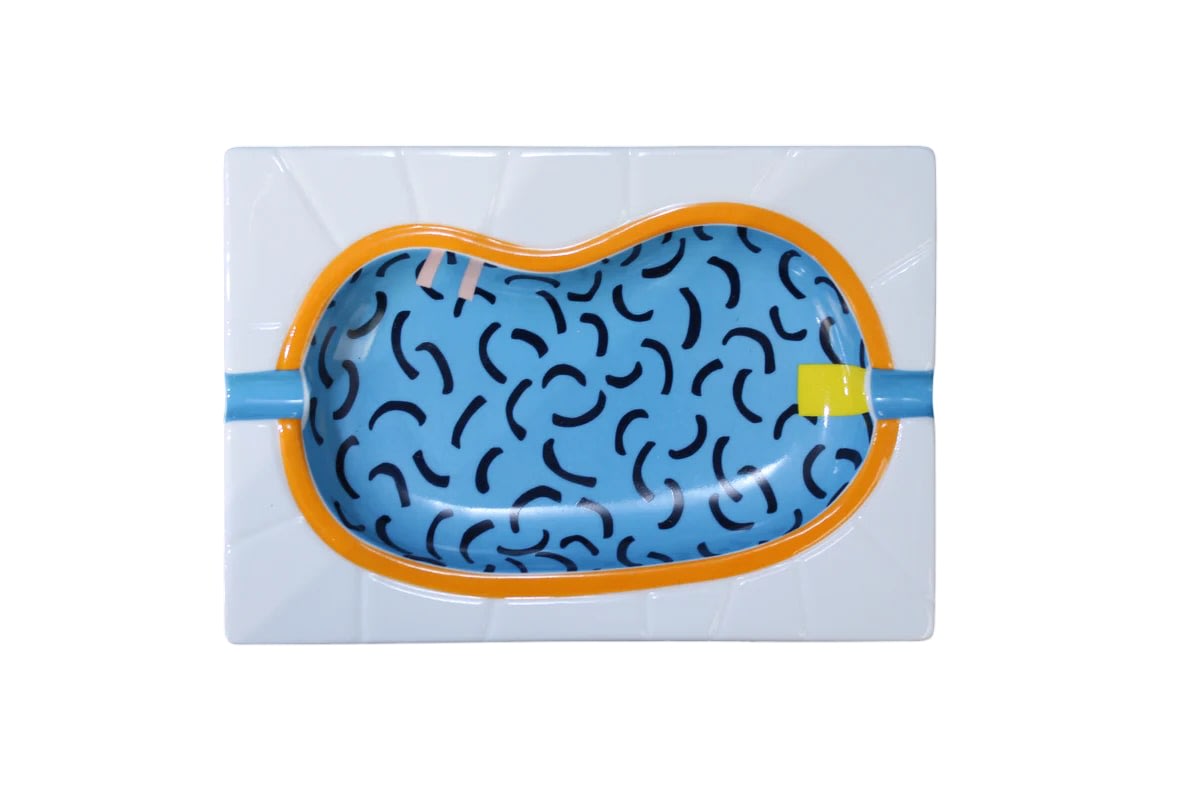
A good example of this broader category is the artist-designed Hockney’s Pool, Hollywood Hills ashtray. It is not an original print and should not be described as one. It is a ceramic multiple that uses pool imagery in a different format. For some collectors that distinction is precisely the appeal: the object sits between art, design and artist merchandise while still carrying a recognisable visual language.
What should collectors check before buying a Hockney pool work?
1. Medium. Establish whether the object is an original print, digital edition, poster, ceramic, book, photographic work or another type of multiple. This determines how it should be compared with other examples.
2. Edition information. If the work is numbered, check the stated edition size and whether artist’s proofs, printer’s proofs or other proofs exist. A proof is not automatically “better” than a numbered impression; it is simply a different position within the edition structure. Our guide to artist’s proofs and printer’s proofs explains the terminology.
3. Signature. Confirm whether the work is hand-signed, signed in the plate, signed on a justification page, or unsigned. These are materially different descriptions. Collectors should avoid vague phrases such as “signed edition” unless the location and nature of the signature are clear.
4. Condition. Works on paper should be checked for fading, foxing, staining, handling marks, creases and evidence of poor framing. Strong colour is especially important in works where blue water and saturated California light are central to the image. Read our guide to condition and framing for a practical checklist.
5. Provenance. Ask where the work came from and whether there is supporting paperwork. A clear ownership trail does not replace expertise, but it helps establish the history of the object and makes future resale or insurance easier.
Why do prices vary so widely?
Collectors sometimes compare two “Hockney pool” works and wonder why one is priced far above another. Usually they are not directly comparable. An original signed print from a small edition is a different object from a later exhibition poster. A large-format digital edition differs from a ceramic multiple. A rare proof differs from an unlimited publication.
Price can also be affected by the strength of the image, edition size, date, physical scale, signature, condition, provenance and current availability. It is therefore more useful to compare like with like than to search for a single generic “Hockney pool price”.
Original prints versus posters and multiples
There is no rule that says a serious collection must contain only original prints. Posters and artist multiples can be excellent entry points, especially when they are visually strong, well documented and connected to an important exhibition or project. The key is clarity. A collector should know what is being bought and the gallery should describe it accurately.
For many buyers, a balanced collection may include a major signed print alongside lower-priced exhibition material and artist-designed objects. That can create a more interesting picture of Hockney’s visual world than focusing on one category alone.
How to build a focused Hockney collection
A useful strategy is to collect by motif rather than by chronology. Pools are an obvious route, but the same approach works with flowers, landscapes, portraits, dogs or domestic interiors. A motif-led collection can combine different techniques while retaining visual coherence.
Another approach is technical: one etching, one lithograph, one digital edition and one multiple. This highlights Hockney’s unusually broad engagement with reproduction and print technology. Our article on Hockney’s landscapes is useful for collectors interested in a parallel theme.
Frequently asked questions
What is David Hockney’s most famous swimming-pool image?
A Bigger Splash from 1967 is the most widely recognised pool image associated with Hockney. Collectors should remember that reproductions of the painting are not the same as an original Hockney print.
Did David Hockney make original prints?
Yes. Printmaking has been a major part of Hockney’s practice for decades, including etchings, lithographs and later digital and inkjet editions.
Are Hockney exhibition posters collectible?
Yes, particularly when they relate to important exhibitions or reproduce sought-after imagery. They should still be described and valued as posters rather than confused with original prints.
Does a Hockney work need to be signed?
No. Some legitimate editions and posters are unsigned. What matters is accurate cataloguing, authenticity, provenance and an appropriate comparison with similar works.
Where can I see David Hockney works currently available at Dovehouse?
Browse the current David Hockney collection at Dovehouse Contemporary. Availability changes regularly, so individual works should always be checked at the time of enquiry.
Collecting takeaway: the most useful question is not simply “Is this a Hockney pool image?” but “What exactly is this object?” Medium, edition, signature, condition and provenance provide the framework for making a sensible comparison. Once those basics are clear, the enduring appeal of the pool motif becomes much easier to appreciate—and much easier to collect with confidence.

Leave a comment
This site is protected by hCaptcha and the hCaptcha Privacy Policy and Terms of Service apply.