
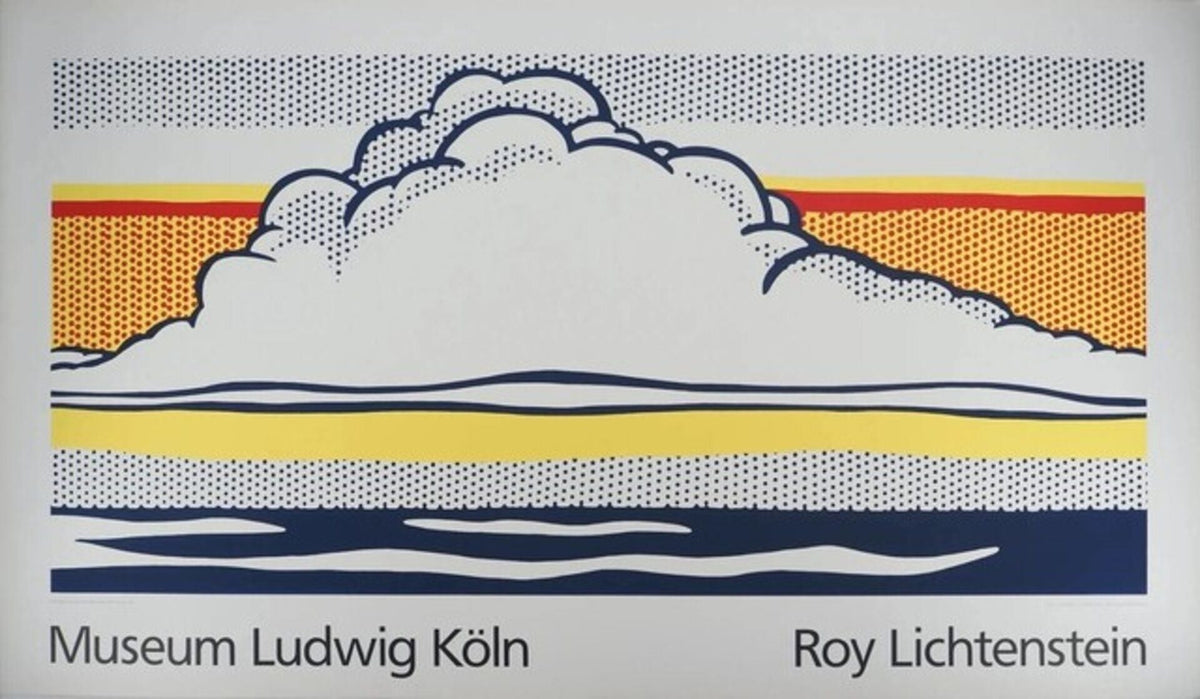
Roy Lichtenstein made the printed dot visible. In a comic strip, the dot helps build an inexpensive image. Enlarged on a canvas or carefully translated into a print, it becomes something we are asked to inspect. The outline, flat colour and cropped composition may look borrowed from mass media, but their scale changes the experience entirely.
That shift is a useful way into Lichtenstein’s work. It invites a close look at how a supposedly mechanical image has been designed, printed and placed in front of us.
The result was a body of work that was direct, witty and visually striking, but also deeply concerned with the way modern images are produced, repeated and consumed.
Who Was Roy Lichtenstein?
Roy Lichtenstein was born in New York in 1923. After studying art, he developed a practice that initially moved through several different styles before arriving, in the early 1960s, at the visual language for which he would become internationally known.
Rather than looking to traditional painting for subject matter, Lichtenstein began drawing from the everyday imagery surrounding him: comic strips, advertisements, product packaging and printed illustrations.
This was a radical move at the time.
By enlarging and isolating these supposedly ordinary images, he forced viewers to reconsider their status. What happened when a tiny comic-book panel was transformed into a large painting? Could a commercial image become high art simply through scale, context and artistic decision?
Those questions sit at the heart of Lichtenstein’s work.
 POW (1982)
The Ben-Day Dot
One of the most distinctive features of Lichtenstein’s work is his use of Ben-Day dots.
Originally developed as a commercial printing technique, Ben-Day dots allowed publishers to create areas of colour and tone economically by printing small, regularly spaced dots.
Lichtenstein deliberately reproduced this mechanical effect by hand and later through printmaking techniques.
The dots became one of his signatures.
They gave the work the look of mass-produced imagery while also emphasising that what the viewer was seeing was carefully constructed. This tension between the handmade and the mechanical was central to Pop Art more broadly.
In Lichtenstein’s hands, the language of cheap commercial reproduction became a sophisticated artistic device.

Comics, Drama and Emotion
Lichtenstein is perhaps best known for works inspired by romance and war comics.
These images often feature glamorous women, heroic men, explosions, speech bubbles and moments of heightened emotion.
At first glance, they can feel melodramatic or even humorous. But the emotional distance created by Lichtenstein’s cool, graphic style makes them more complicated.
A scene that might originally have been designed as disposable entertainment becomes strangely theatrical when enlarged and isolated.
A tearful face, a dramatic kiss or an aircraft explosion can become almost monumental.
Lichtenstein was interested not only in what these images depicted, but in the formulas used by mass media to communicate emotion.
The works ask us to consider whether the feelings we see are genuine, exaggerated or manufactured.
Appropriation and Transformation
Lichtenstein’s use of pre-existing imagery has long been central to discussion around his work.
He often sourced compositions from comic books and commercial illustration, altering them through cropping, simplification, scale and colour.
This process raised important questions about originality and authorship.
For Lichtenstein, the source image was only the beginning.
By removing it from its original context and reconstructing it in a highly controlled visual language, he transformed the image into something new: less narrative, more formal, more ambiguous.
This strategy became enormously influential and helped establish appropriation as a major feature of contemporary art.

Beyond Comic Books
Although comic imagery remains his most famous subject, Lichtenstein’s practice was much broader.
He produced works exploring:
-
still life
-
landscapes
-
interiors
-
mirrors
-
brushstrokes
-
nudes
-
art history
-
architecture
-
sculpture
One of the most interesting aspects of his career was the way he applied the same Pop vocabulary to increasingly diverse subjects.
His Big Painting No.6 and related Brushstroke works are a particularly important example.
The expressive brushstroke had traditionally symbolised artistic individuality and emotion, especially in Abstract Expressionism. Lichtenstein transformed that spontaneous gesture into something hard-edged, mechanical and reproducible.
In doing so, he gently mocked the romantic idea of the artist as an emotional genius while simultaneously paying homage to painting itself.
Lichtenstein and Art History
Lichtenstein frequently revisited the history of modern art.
He reinterpreted works and styles associated with artists including Picasso, Monet, Matisse and Mondrian, translating their visual language into his own graphic vocabulary.
These works are more than simple parodies.
They reveal an artist deeply engaged with the history of painting.
By filtering famous artistic styles through the aesthetic of commercial reproduction, Lichtenstein questioned how masterpieces become cultural images in their own right.
Once an artwork is endlessly reproduced in books, magazines and posters, do we experience the original painting — or an image of the painting?
This question feels particularly relevant today.
Roy Lichtenstein and Printmaking
Printmaking was an important part of Lichtenstein’s career and fits naturally with his interest in mechanical reproduction.
He worked across a wide range of techniques, including:
-
screenprint
-
lithography
-
woodcut
-
etching
-
relief printing
For collectors, Lichtenstein’s prints offer an important route into his work.
Many editions contain the same visual characteristics found in his paintings: strong graphic composition, Ben-Day dots, bold primary colours and carefully controlled lines.
Printmaking was not simply a secondary medium for Lichtenstein. It was central to his exploration of repetition, reproduction and popular imagery.
Collecting Roy Lichtenstein
Lichtenstein remains one of the most important and widely collected artists associated with Pop Art.
His market spans major paintings, works on paper, sculpture and an extensive body of prints and editions.
When considering a Roy Lichtenstein print, collectors should pay close attention to:
-
authenticity
-
provenance
-
edition size
-
signature
-
condition
-
publisher
-
printmaking technique
-
catalogue raisonné reference
Condition can be particularly important with works on paper.
Fading, paper discolouration, handling marks, trimming and restoration can all affect desirability and value.
Works from recognised series or especially recognisable compositions will generally attract the greatest collector attention.
Why Roy Lichtenstein Still Matters
Lichtenstein’s work feels remarkably contemporary.
We now live in a world dominated by screens, advertising, memes, social media and endlessly reproduced images.
Lichtenstein was already exploring many of these ideas more than sixty years ago.
He understood that modern life was increasingly being experienced through images.
By taking the visual language of mass culture and slowing it down, enlarging it and placing it in an art context, he forced us to look again at imagery we might otherwise ignore.
That is one reason his work remains so powerful.
It is immediately accessible, but also intellectually sophisticated.
A Lichtenstein image can be understood in seconds and studied for decades.
Explore Roy Lichtenstein at Dovehouse Contemporary
Explore Roy Lichtenstein prints and editions at Dovehouse Contemporary, alongside works by leading figures in modern and contemporary art.
Compare a reproduction with the original print where possible. The dots may differ in size and regularity, while the paper and registration affect how edges meet. Those physical details are easy to lose on a screen. They also help explain why a Lichtenstein edition is more than a recognisable image: it is a particular printed object with a process, date and publication history that a collector should be able to identify.


Leave a comment
This site is protected by hCaptcha and the hCaptcha Privacy Policy and Terms of Service apply.