
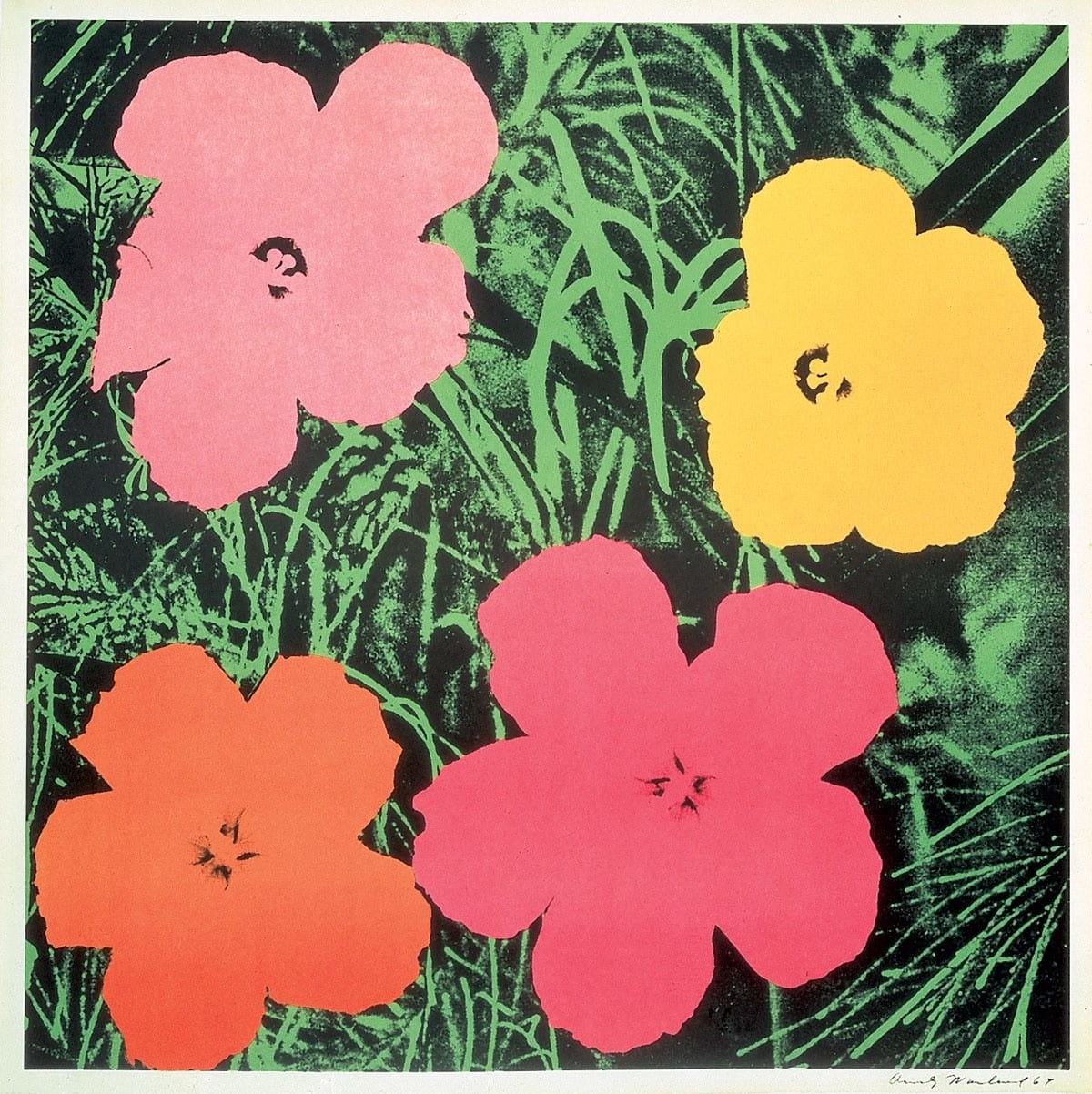
Andy Warhol’s Flowers is one of the defining images of his 1960s practice. The subject looks simple: four flowers compressed into a square field of grass. Yet the series brings together many of the ideas that made Warhol central to Pop Art—appropriation, repetition, photographic transfer, intense colour and the removal of traditional distinctions between a “high” artistic subject and a mass-media image.
For collectors, Flowers is also a useful case study in how to read Warhol properly. The image exists in different formats and at different dates, so two works that look closely related can occupy very different positions in the market. Start with the current Andy Warhol works at Dovehouse Contemporary and our broader guide to collecting Andy Warhol prints.
Where did Warhol’s Flowers image come from?
Warhol developed the Flowers image in 1964 using a photograph of hibiscus blossoms by Patricia Caulfield that had appeared in Modern Photography magazine. He cropped and transformed the photograph, flattening the flowers into a nearly abstract pattern and using colour combinations that moved the image away from naturalistic botanical description.
This origin is important because it shows Warhol’s method clearly. He was not trying to make a traditional flower study from life. Instead, he treated an existing photograph as raw visual material. Through cropping, repetition and screenprinting, the source image became unmistakably his own in appearance and function.
The subject was first shown prominently in 1964 and became part of Warhol’s wider exploration of serial imagery. Unlike the celebrity portraits, car crashes or consumer products for which he was already known, flowers offered a more decorative subject. Yet the repetition and artificial colour kept them firmly within the logic of Pop.
Why is the square format so important?
The square is central to the impact of Flowers. It removes the conventional hierarchy of landscape or portrait orientation and makes the image easy to repeat in a grid. Warhol could hang multiple works together so that the flowers became less like individual pictures and more like units in a visual field.
That modular quality is especially relevant to print collecting. A square composition can work as a single image, as part of a series, or in a group with other colourways. Collectors often respond as strongly to the relationship between colours as to the flower motif itself.
How did screenprinting shape the Flowers series?
Warhol had begun using photographic silkscreen in 1962. The process allowed him to transfer a photographic image repeatedly while changing colour, registration and surface. That tension—mechanical repetition combined with visible variation—is fundamental to his work.
In Flowers, the process separates image and colour. The photographic information can sit over areas of intense, sometimes unnatural colour, making the flowers feel both familiar and artificial. If you are new to the technique, read Why Andy Warhol Chose Screenprinting.
Are all Andy Warhol Flowers works the same kind of object?
No. Collectors need to distinguish between paintings, original prints, offset lithographs, exhibition material and later reproductions. Similar imagery does not mean identical status.
Dovehouse currently catalogues Andy Warhol, Flowers (FS II.6), a 1964 offset lithograph in colours on wove paper. That object should be assessed according to its own medium, date, signature and publication context rather than compared indiscriminately with a screenprint or a painting.
This is one of the recurring lessons in collecting Warhol: catalogue the object first, then compare it. The image may be famous, but the medium and edition structure determine what you actually own.
What does “FS” mean in a Warhol catalogue reference?
Collectors frequently see Warhol prints described with an “FS” reference followed by a number. This refers to the Feldman and Schellmann catalogue raisonné numbering system used to identify Warhol’s prints. A catalogue raisonné reference helps distinguish a specific edition or print from other objects using related imagery.
A reference number is useful, but it should not be treated as a substitute for checking the actual work. The dimensions, paper, signature, edition information and condition should still correspond with the description of the object being offered.
What should collectors check before buying a Warhol Flowers print?
Medium: Determine whether the work is a screenprint, offset lithograph, poster or another type of edition. Do not assume from the image alone.
Date: Warhol’s imagery was reused and republished in different contexts. Date helps establish which project or publication a work belongs to.
Signature: Confirm whether a signature is hand-applied, printed, stamped or absent. The location of a signature can also matter. Our guide to signatures on limited-edition prints explains the basic distinctions.
Edition and proofs: Check the numbered edition and whether proofs exist. Printer’s proofs, artist’s proofs and hors commerce impressions should be described precisely rather than simply marketed as “rare”.
Condition: Warhol works on paper can be sensitive to light, handling and poor framing. Look for fading, staining, paper discolouration, creasing and mounting issues. Strong, balanced colour can be a major part of the visual appeal.
Provenance: A clear chain of ownership and reliable documentation are particularly valuable in a market where Warhol imagery has been reproduced extensively.
Why are colourways important?
Colour is not a secondary element in Warhol—it is often the structure of the picture. Two impressions using the same underlying image can feel completely different because of the colour combination. In a Flowers work, the balance between petals, grass and background can shift from harmonious to acidic, soft to confrontational.
Collectors should therefore resist the idea that there is always one universally “best” colourway. Rarity, condition and market history matter, but so does personal response. A strong collection can be built around colour relationships rather than a simple hierarchy of price.
How does Flowers fit within Warhol’s wider print market?
Flowers sits naturally beside Warhol’s Marilyns, Campbell’s Soup imagery, Ads, Endangered Species and Camouflage works because all demonstrate how he could turn a familiar source into a repeated visual system. You can explore these connections through our articles on Warhol’s Marilyns and Warhol’s Camouflage prints.
For a new collector, Flowers can be particularly useful because the motif is instantly legible while still opening onto the central questions of Warhol’s practice: where does an image come from, what happens when it is repeated, and how does mechanical reproduction become fine art?
Frequently asked questions
When did Andy Warhol make Flowers?
Warhol developed the famous Flowers image in 1964, using a photographic source by Patricia Caulfield and transforming it through cropping, colour and repetition.
Are Warhol Flowers prints screenprints?
Some are, but collectors should not assume every Flowers work uses the same medium. The image appears in multiple formats, including different types of works on paper. Always check the catalogue description.
Does a catalogue raisonné number prove authenticity?
No single reference should be treated as a standalone guarantee. A catalogue number is a useful identification tool, but the physical work, dimensions, paper, signature, edition information, provenance and condition must also make sense.
Should I buy a signed or unsigned Warhol?
Both can be legitimate, depending on the edition. The key is to compare the work with the correct version of the edition and understand how signature status affects comparability.
Where can I see Warhol works available through Dovehouse?
Browse the current Andy Warhol collection. Stock changes regularly and some works may be available on enquiry rather than through immediate checkout.
Collecting takeaway: Warhol’s Flowers rewards close looking precisely because the image appears so simple. The collector’s job is to look beyond the four blossoms: identify the exact medium, date and edition, check condition and provenance, and compare the work with genuinely equivalent examples. That is the difference between buying an image you recognise and understanding the object you are collecting.

Leave a comment
This site is protected by hCaptcha and the hCaptcha Privacy Policy and Terms of Service apply.