
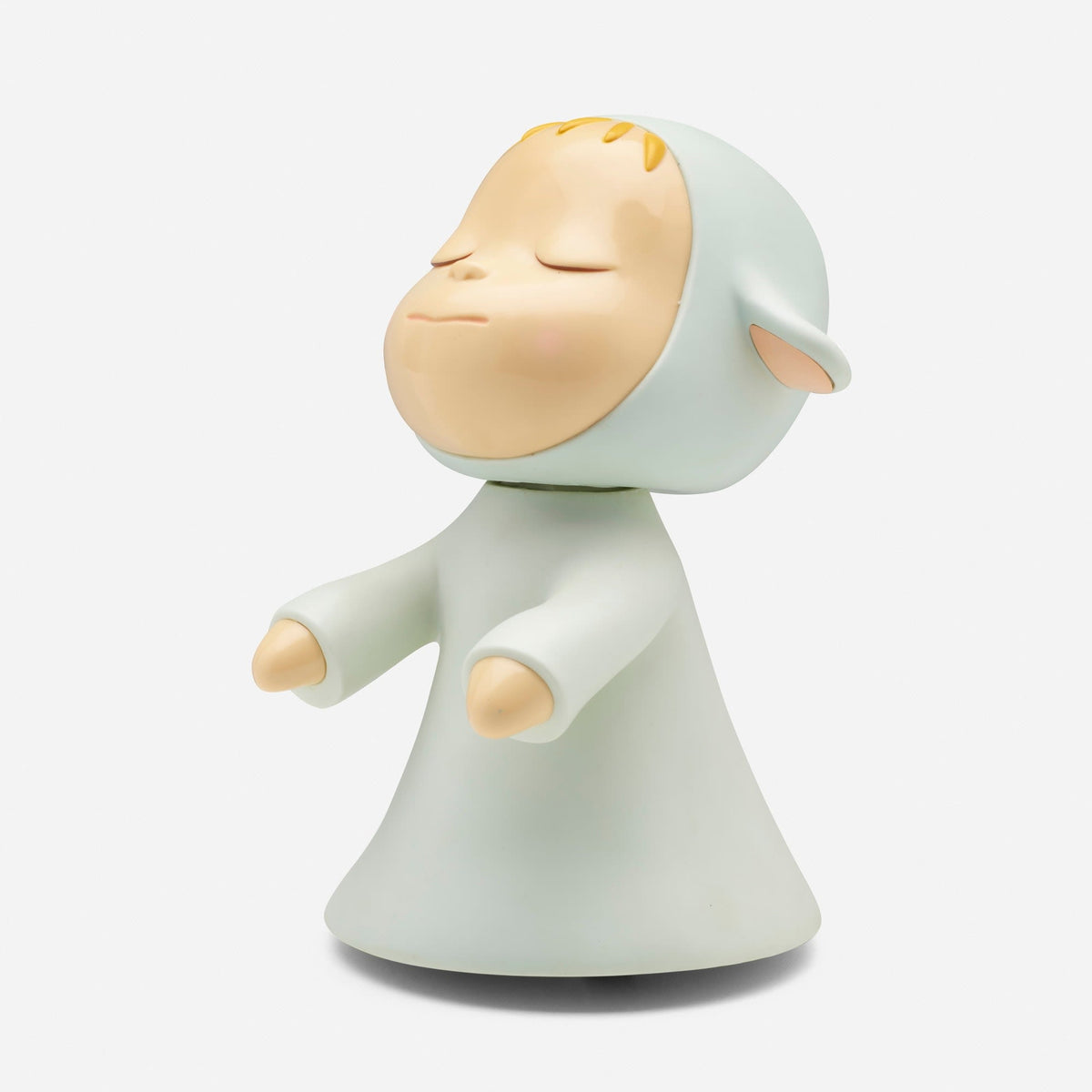
A Yoshitomo Nara figure rarely needs much scenery. A few lines establish the body; a slight tilt creates attitude; one small action supplies the story. In Little Wanderer, the figure walks. In Banging The Drum, she makes her own rhythm. In Marching on a Butterbur Leaf, movement becomes more improbable, with a leaf serving as both platform and vehicle.
Seen together, these works show why Nara’s editions cannot be understood simply as reproductions of a familiar character. Medium changes the encounter. A plastic figure occupies the room and can be viewed from several sides. An offset lithograph keeps the action within the flat, economical language of drawing. Scale, surface and packaging all matter. So does the precise relationship between a particular edition and the broader family of images from which it comes.
Dovehouse Contemporary currently represents all three works. They form a focused route into Nara’s practice for collectors interested in the point where drawing, sculpture, music and movement meet.
Little Wanderer: a figure that enters the room
Little Wanderer dates from 2003. The current Dovehouse example is an injection-moulded and rotomoulded plastic figure, 26.5 cm high, contained in its original plastic presentation package. It is stamp-signed on the underside, from an open edition and was published by Cerealart, Philadelphia.
The shift from image to object is decisive. Nara’s standing and walking figures often appear isolated against an empty ground, but a sculpture has no drawn background. The collector’s shelf, table or plinth becomes the setting. Seen straight on, the figure retains the clarity of Nara’s drawings. Move around it and the silhouette changes: the large head, narrow body and forward step become physical rather than graphic facts.
The title matters too. “Wanderer” suggests movement without a fixed destination. It is less heroic than “traveller” and less purposeful than “marcher”. The figure is simply going somewhere. MoMA Design Store notes that the Little Wanderer character developed from Nara’s 1999 Little Pilgrims (Night Walking) sculptures, which places the edition within a longer sequence rather than treating it as an isolated design.

Why movement changes Nara’s figures
Nara’s best-known figures are often still. They face us, withhold information and let the viewer do the psychological work. A walking or marching figure behaves differently. Direction enters the image. The body implies a moment before and a moment after, even when Nara gives us no destination and no conventional plot.
This is one reason the movement can feel emotionally precise without becoming illustrative. A forward step may suggest resolve, escape, independence or play. None of those readings is guaranteed. Nara leaves the action clear and the motive open. Pace Gallery describes his children as ranging from resistance and rebellion to quietude and contemplation; the walking figures hold those positions together particularly well. They move with purpose, but they remain private.
For collectors, the distinction is useful. A frontal portrait concentrates attention on gaze and expression. A figure in motion introduces gesture, direction and balance. It may also work differently in a room: the eye follows the implied movement rather than stopping at the face.
Banging The Drum: music made visible
Banging The Drum is a 2020 offset lithograph measuring 68.6 × 43.2 cm. The figure does not merely pose with an instrument. The title gives us an action and, by implication, a sound. Yet the print itself remains silent. Nara asks line and stance to carry the rhythm.
Music is not decorative context in his work. LACMA’s major survey of Nara was organised through the lens of his longstanding engagement with music, including folk, rock, blues, soul and punk. Album covers provided an early visual education; songs offered emotional structures that did not require a complete narrative. Banging The Drum makes that relationship unusually direct. The instrument is present, but what matters is the self-contained act of playing.
The print’s vertical format reinforces the upright body. Empty space around the figure keeps the action legible, while the offset process preserves the crispness of Nara’s drawn language. When viewing an impression, that surrounding field deserves attention. Paper tone, handling marks and framing can alter the balance more than a catalogue photograph suggests.

Marching on a Butterbur Leaf: scale and absurdity
Marching on a Butterbur Leaf is a 2019 offset lithograph measuring 61 × 45.7 cm, from an edition of 1,000. The title turns a simple march into something less stable. The leaf changes the figure’s scale and introduces a natural form without creating a fully described landscape.
That mismatch is characteristic of Nara at his sharpest. The action is readable at once, but the situation is not. Is the figure tiny, the leaf enormous, or is the scene closer to a private emblem than a physical world? The print does not settle the question. Its appeal lies in the friction between a determined gesture and a setting that makes ordinary scale unreliable.
Compared with Banging The Drum, the image feels less like a performance and more like a journey. Compared with Little Wanderer, it remains firmly on paper, where the leaf and figure share the same graphic space. The edition size is recorded, which makes it easier to identify the work precisely, but collectors should still compare the individual sheet, not just the title.

Comparing a sculptural edition with a print
The most obvious difference is dimensional. Little Wanderer shares the viewer’s space; the two lithographs organise movement on a sheet. That changes how condition should be assessed.
For the sculpture, ask about the surface, colour, joins, stability, underside stamp and original presentation package. Packaging is not a substitute for the work, but it is part of the object’s history and can be relevant to completeness. Photographs should show more than the front view.
For the prints, request images in neutral light and confirm the sheet dimensions, margins and any framing history. Check for creasing, edge damage, staining, fading or previous mounting. An edition number, when recorded, identifies a place within the edition; it does not describe the condition of the individual impression.
The display decision is equally practical. A small sculpture can be repositioned and seen from changing angles. A framed print has a fixed orientation and depends on the relationship between image, mount and wall. Neither format is automatically more important. The better choice is the work whose medium strengthens the aspect of Nara’s language you want to collect.
What should a collector verify?
Start with the exact catalogue description. Confirm the title, date, medium, dimensions, edition information and signature or stamp details where they are recorded. Similar-looking Nara figures appear across drawings, prints, sculptures, books and authorised objects; familiarity with the character does not identify the particular edition.
Then look at documentation and provenance for the individual object. Ask what accompanies it and whether the information connects to that specific work. Our guide to collecting Yoshitomo Nara prints and sculptural editions explains the broader distinction between formats. For the role of line and reduction, read Yoshitomo Nara and the language of drawing. The guide to why Nara’s figures feel so alive looks more closely at expression and empty space.
Three routes into the same visual world
Little Wanderer, Banging The Drum and Marching on a Butterbur Leaf are not interchangeable versions of one idea. One turns a drawing-like figure into an object. One gives movement a beat. One places a march on an unstable fragment of nature. Their shared economy makes the differences easier to see.
Explore the current Yoshitomo Nara collection at Dovehouse Contemporary. For condition information, documentation, display advice or worldwide delivery details on any of these works, contact the gallery and we will provide the information recorded for the individual example.

Leave a comment
This site is protected by hCaptcha and the hCaptcha Privacy Policy and Terms of Service apply.