
Billy Childish’s portraits can appear to arrive in a single rush: a face, a hat, a dark outline and a pale field of paint. That first impression matters, but it is not the whole picture. For a collector, the useful work begins by separating speed from carelessness, biography from object, and a painted self-image from the editioned prints that circulate more widely.
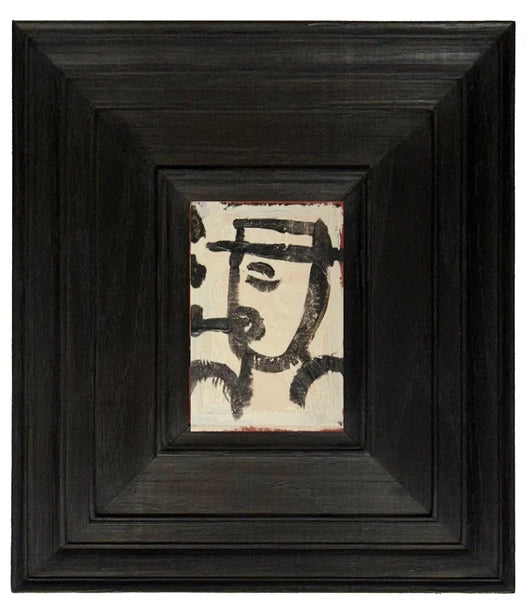
The current Dovehouse catalogue provides an unusually concentrated example. Untitled (self portrait) is recorded as a 1994 oil painting on board measuring just 11 × 7 cm. It is small enough to be read almost at the distance of a photograph, yet the paint refuses photographic smoothness. Dark, broad marks establish a hat-wearing profile against a pale ground. The face is not described into submission. A few decisions carry it.
What makes a Billy Childish self-portrait distinctive?
Childish has worked across painting, printmaking, music and writing since the late 1970s, but painting has remained central to the practice. His official biography at Lehmann Maupin identifies self-portraits alongside landscapes and portraits of people significant to his life. Carl Freedman Gallery has made a related point in its discussion of recent paintings: portraits may begin with Childish himself or people close to him, then move beyond straightforward biography.
That distinction is helpful when looking at the 1994 work. The title tells us it is a self-portrait. The painting does not, however, offer the kind of inventory a conventional likeness might provide. There is no detailed room, costume or narrative episode to decode. Instead, identity is concentrated in contour, posture and the pressure of the marks. The profile is particular, but it also behaves as a type: painter, traveller, solitary figure.
It is tempting to call such an image raw and leave the analysis there. Look again. The dark head is held away from the board’s edges. The pale surrounding area is not empty background; it gives the profile room to register. The compact support makes every interval consequential. Directness is being constructed through proportion and omission.

Why does the small scale matter?
Eleven by seven centimetres is a genuinely intimate format. A large portrait can establish physical authority across a room; this one asks the viewer to come closer. At that distance, the support, edges and thickness of the paint become part of the encounter. The painting feels concentrated rather than reduced.
Scale also changes how the mark is read. A broad stroke on a small board can describe both a feature and a shadow. There is little room for a mark to be merely decorative. This economy is one reason the image retains presence despite its dimensions.
Collectors should plan its presentation around the actual object, not a screen enlargement. Ask for an image with a ruler or a photograph of the painting in its frame. A wide mount or visually heavy moulding can overwhelm a work of this size; a quieter presentation may preserve the close, private character. The appropriate choice depends on the current frame, the board’s edges and any original presentation, all of which should be confirmed before changing anything.
Is the 1994 self-portrait a print or an edition?
No. The current Dovehouse record describes Untitled (self portrait) as oil on board. It should not be catalogued with an edition size or a printed signature borrowed from one of Childish’s woodcuts or pigment prints. Medium is the first boundary.
This sounds elementary, yet Childish’s images travel across paintings, prints, books and exhibition material. A recurring subject does not make every version the same object. When comparing listings, record the support, dimensions, date and signing information of the individual work. If a detail is not stated, ask for evidence rather than filling the gap from another catalogue entry.
Our guide to Billy Childish prints explains the separate language of woodcuts, etchings and pigment editions. The distinction is commercially important, but also visual. A carved line, a digitally printed colour field and a loaded brush each produce a different kind of edge.
How does a self-portrait compare with a portrait of another person?
Robert Walser, dated 2009 in the Dovehouse catalogue, provides a useful comparison. It is a photocopy with paint on paper, approximately 29.5 × 21 cm, and the product record describes the work as unique. The image names another person, but the handling remains recognisably concerned with the pressure of the artist’s intervention.
The photocopied base gives Robert Walser a reproducible starting point. Paint then interrupts that repeatability. Marks, stains and additions belong to this sheet, not to a hypothetical clean copy. That is why material description matters: “photocopy with paint” is more informative than calling it simply a print or drawing.
The work’s subject also fits the wider structure described by Lehmann Maupin. Childish’s portraits include people he knows and figures he admires, as well as himself. Seen beside the 1994 painting, Robert Walser shows that portraiture in this practice is not limited to likeness. It is a way of placing another figure inside Childish’s own visual language.

What should a collector check on an oil painting on board?
Begin with the support. Ask whether the board is flat, whether its edges are stable and whether there are visible knocks, splits or areas of loss. Request photographs in ordinary light and at a slight angle. Raking light can reveal raised paint, dents and surface texture that disappear in a straight-on image.
Next, distinguish the artist’s handling from later condition. A broken outline, exposed ground or abrupt passage of colour may be intentional. Flaking, lifting paint, fresh abrasion or an unstable crack is a different matter. A useful condition report locates an issue precisely and explains whether the work was examined inside or outside its frame.
The reverse should be photographed as well. Labels, inscriptions, old hinges and frame fittings can help describe the object’s history, but they need to be read carefully. A gallery label is not a substitute for provenance, and an inscription should not be attributed to the artist without a supported basis. The invoice should repeat only the facts that have been established.
For the work on paper, the questions change. With Robert Walser, examine the full sheet, painted passages, edges and reverse. The Dovehouse record identifies the paint staining as intended, so a condition report should distinguish those original material features from later handling, creases or surface changes. Our condition and framing guide sets out the broader checks for paper, mounting and glazing.
How much biography should influence the purchase?
Childish’s life across painting, poetry and music is relevant, but it can become an easy substitute for looking. The object still has to work. In Untitled (self portrait), the useful questions are concrete: how does the dark profile sit within the pale board; how does the small scale affect attention; what do the broad marks reveal at close range?
Biography becomes valuable when it sharpens those observations. Knowing that self-portraiture recurs throughout the practice helps place the 1994 painting within a continuing subject. Knowing that his portraits also encompass admired cultural figures helps explain why Robert Walser belongs in the same conversation. Neither fact removes the need to examine medium, date, dimensions and condition.
For a broader account of the artist’s work across media, read Billy Childish: Painting, Printmaking and Creative Practice. That context is most useful when it leads back to the particular work rather than turning every object into an illustration of a life story.
A concise acquisition checklist
- Confirm the exact title, date, medium, support and dimensions.
- Ask whether measurements describe the artwork alone or include the frame.
- Request current front, edge and reverse photographs.
- Establish whether signatures, labels or inscriptions are present and how they are recorded.
- Separate intentional marks and exposed support from later damage.
- Check provenance and condition against documents for the individual work.
- Keep the invoice, condition report and new photographs together after purchase.
Viewing Billy Childish at Dovehouse
A small self-portrait can carry unusual intensity because there is nowhere for the image to hide. Childish’s 1994 painting turns a few dark marks and a narrow board into a self-image that is both specific and open. Robert Walser extends the comparison into a different material language, where a photocopied image is made singular through paint.
Browse the Billy Childish collection for current paintings, works on paper and editions. For Untitled (self portrait) or Robert Walser, contact Dovehouse Contemporary to request current condition photographs, reverse images, framing details and worldwide delivery advice.

Leave a comment
This site is protected by hCaptcha and the hCaptcha Privacy Policy and Terms of Service apply.