
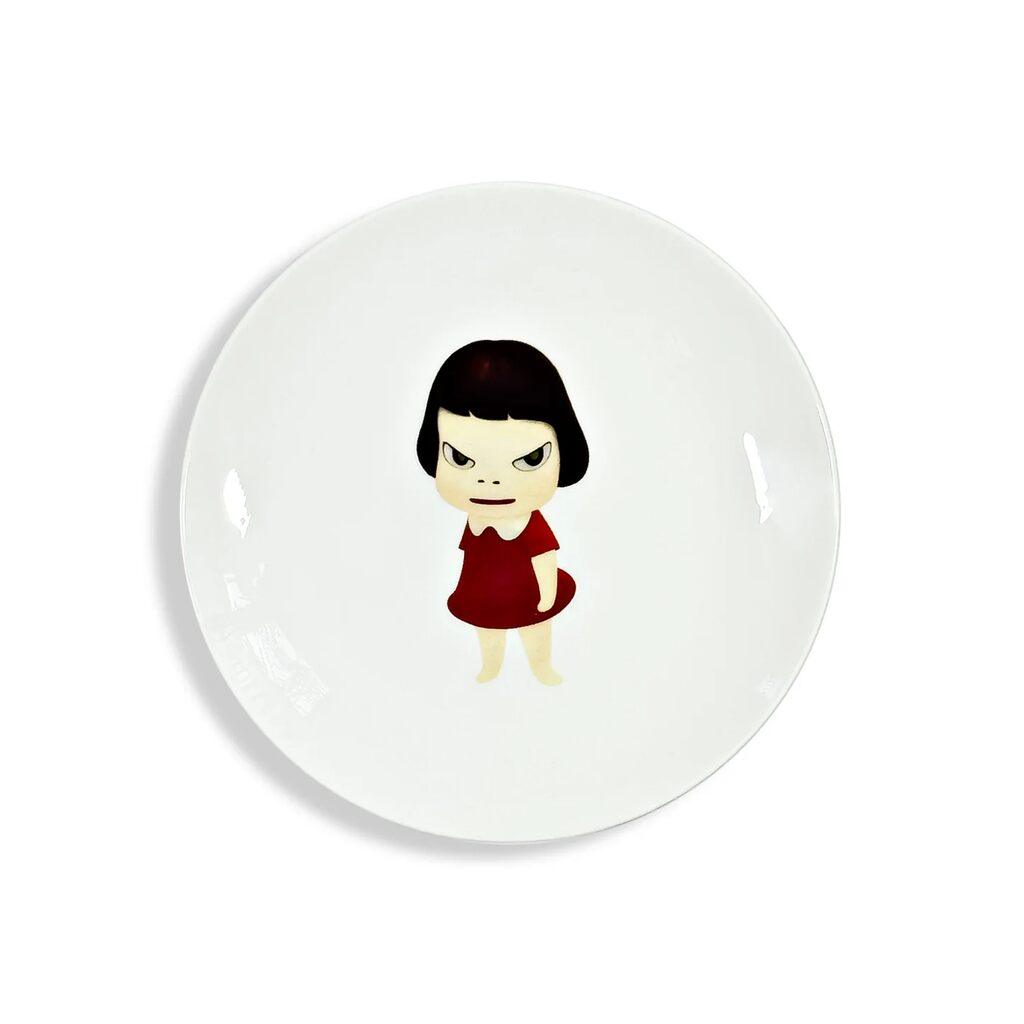
A Yoshitomo Nara plate can look simple online: a familiar face, a circular support and a recognisable name. For a collector, the useful questions begin after that first recognition. Who published it? Was it made for an exhibition, issued in a numbered edition or sold as an authorised object? What material is stated? What should be present on the reverse, and did it originally come with a presentation box?
Those distinctions are not pedantic. Nara’s imagery has appeared across prints, sculpture, ceramics, books and exhibition merchandise. Two plates can both be legitimate publications while differing substantially in date, edition structure, scale and collecting context. The object should be described for what it is, without promoting an unnumbered exhibition plate into a numbered fine-art edition or dismissing it as mere decoration.
What is a Yoshitomo Nara artist plate?
“Artist plate” is a useful visual category, but it is not a complete technical description. It may refer to a numbered fine-bone-china edition, an exhibition publication, a ceramic object carrying an authorised image or a plate produced for a charitable project. The title alone does not establish rarity.
The current Dovehouse catalogue illustrates this clearly. Missing in Action is recorded as a 21 cm bone-china plate, hand decorated in the UK and produced for the Hayward Gallery exhibition in 2025. Yamako (Mountain Sister / elder) is described as a ceramic plate approximately eight inches in diameter, supplied with a NARA / Hayward Gallery presentation box. Neither listing states a numbered edition. We would not infer one.
Other Nara plates have been issued with a defined edition and printed details on the reverse. That is a different publication structure, not an automatic measure of visual quality. A collector should compare the stated facts rather than assume that every circular object bearing the same artist’s imagery belongs to one series.

The Hayward Gallery context
The two recent plates are connected to the Hayward Gallery’s major Yoshitomo Nara retrospective, held from 10 June to 31 August 2025. The Southbank Centre records more than 150 works across drawing, painting, sculpture, installation and ceramics. It was the first UK solo exhibition of Nara’s work at a public art gallery.
That context matters, but it needs precise wording. “Produced for the exhibition” describes the plate’s relationship to a specific institutional event. It does not by itself tell us the production quantity, nor does it make the plate an original painting or unique ceramic. The exhibition connection should sit alongside the material, dimensions, markings and packaging, not replace them.
It also gives the objects a useful documentary role. They belong to the public history of a significant exhibition and show how Nara’s images moved beyond the gallery wall into objects that could be handled, displayed and lived with. Collectors interested in exhibition culture may value that connection independently of numbered-edition status.
How the circular format changes the image
Nara’s faces are often reproduced as though the support were neutral. A plate is not neutral. Its rim curves around the figure and turns the boundary into an active part of the composition. On Missing in Action, the close crop presses the face into the circle. The result is more contained than a rectangular print and more direct than a page in a book.
Yamako offers a different balance. The white surround gives the image room, while the circular edge prevents the space from reading like an ordinary sheet of paper. The figure is both picture and object. That dual character is one reason artist plates work well in a collection of editions: they can hold a wall visually while retaining the scale and intimacy of something made for the hand.
This does not mean every plate should be treated as sculpture. It means that support, image and display method should be considered together. Our essay on why Nara’s figures feel so alive looks more closely at gaze, spacing and the small changes that give apparently simple faces their psychological force.

Numbered edition or unnumbered exhibition object?
An edition number answers one question: how a particular publication was structured. It does not answer every question about authenticity, quality or scarcity. If a plate is described as an edition of 250, the fraction, printed signature and reverse information should agree with the publisher’s documented format. If no edition size is recorded, a seller should not manufacture certainty with phrases such as “rare limited edition”.
For the Hayward plates discussed here, the Dovehouse records do not state edition sizes. The correct approach is to describe each as an exhibition-related plate and record the details that are supported. On Yamako, the presentation box is part of that description. On Missing in Action, the current record specifies bone china, UK decoration, a 21 cm diameter and the 2025 exhibition connection.
This distinction is central to collecting Nara more broadly. The market includes original works, editioned prints, sculptural multiples, books, posters and authorised products. Our guide to collecting Yoshitomo Nara prints and sculptural editions explains how to keep those categories clear without pretending that only one of them is worth owning.
What should appear on the reverse?
The back of a plate can be more informative than the front. Ask for a clear, square photograph of the entire reverse. Look for the artist or image credit, publisher or institutional wording, material information, edition details where applicable, and any labels added later. Compare the typography and layout with another documented example of the same publication.
A printed signature is not a hand signature. It may be entirely correct for the object, but the invoice should say so. Equally, the absence of a handwritten number is not a defect where the publication was not issued as a numbered edition. Good cataloguing separates the plate’s original marks from later gallery labels, auction stickers or ownership notes.
Packaging should be documented separately. A box can support provenance and improve the completeness of an edition, yet it is not proof on its own. Check that the label corresponds to the plate inside, note crushing, tears or staining, and keep the packaging even if the plate will be displayed.
Condition checks for ceramic and bone-china plates
Start with the rim. Small chips are easy to miss in a frontal photograph, particularly against a white background. Ask for angled images around the complete circumference, then examine the face and reverse for scratches, rubbing, hairline cracks and areas of surface wear. Strong reflections can conceal marks as readily as they reveal gloss.
Next, look at the decorated image. Compare colour and registration with a reliable example, while allowing for differences in lighting. Check whether the image crosses a curved area where abrasion is more likely. If the plate has been displayed, ask how it was mounted and whether adhesive pads, wire fittings or plate hangers have left pressure marks or residue.
The current Dovehouse examples are recorded as mint, as new. That description should still be supported by current photographs of the individual objects before purchase. Condition is specific to the plate being offered, not to the title in general.
A collector’s checklist
- Record the exact title and the image shown.
- Confirm the material: ceramic, bone china or another stated body.
- Measure the diameter and note whether the figure includes the rim.
- Identify the publisher, institution or project connected to the release.
- State the edition size only when it is documented.
- Distinguish printed credits and signatures from hand-applied inscriptions.
- Photograph the front, reverse, rim and any box or certificate.
- Check for chips, hairlines, scratches, rubbing, residue and restoration.
A plate can be an intelligent entry point into Nara’s work because it makes the relationship between image and object impossible to ignore. The right purchase is not necessarily the smallest edition or the loudest claim. It is the example whose publication history, condition and presentation are described with enough precision to make comparison possible.
Viewing the current Yoshitomo Nara selection
Explore the Yoshitomo Nara collection for prints, sculptural editions and artist-designed objects. For the 2025 Missing in Action plate or the Hayward Gallery Yamako plate, contact Dovehouse Contemporary for current availability, reverse photographs, box details and worldwide delivery advice. For wider context on the imagery, read Yoshitomo Nara: Art, Rebellion and the Meaning Behind His Work.

Leave a comment
This site is protected by hCaptcha and the hCaptcha Privacy Policy and Terms of Service apply.