
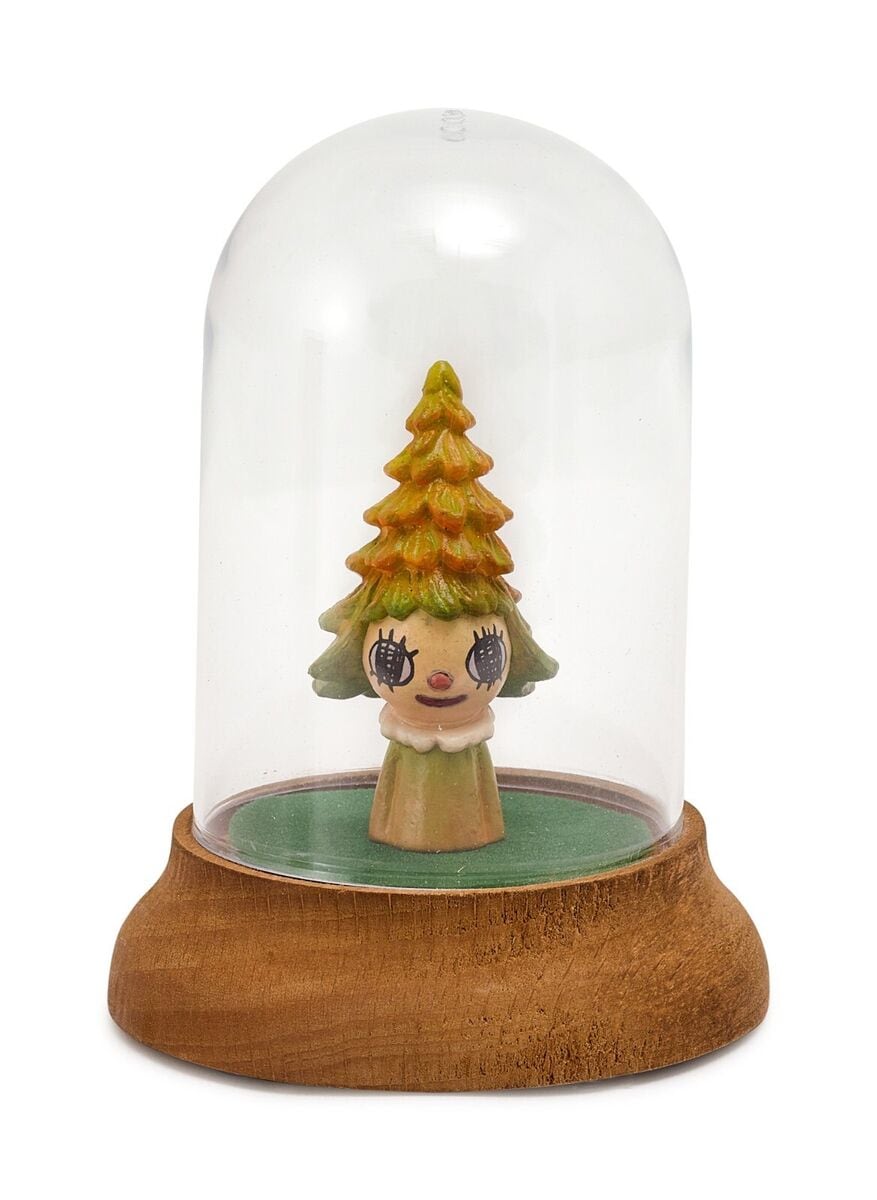
How small shifts in expression create complexity.
Expressions hover between suspicion, boredom, tenderness and resistance, inviting projection without confirming it.

Selected work: Mini Mori Girl.
Current examples include Mini Mori Girl, Real One and Sprout in the hand mirror. View the complete Yoshitomo Nara collection for current availability.
Explore available works by Yoshitomo Nara
Small differences carry the expression
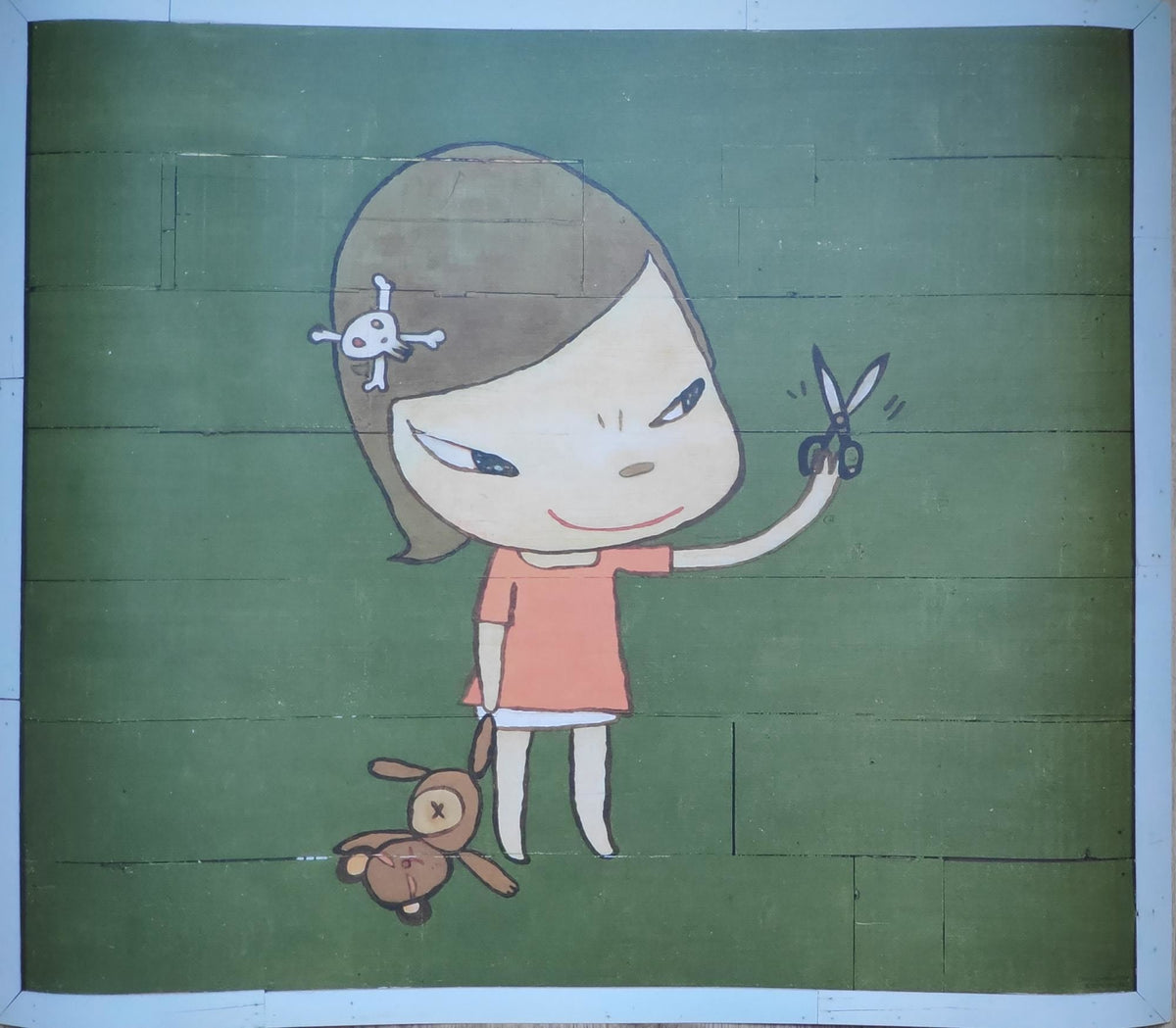
Nara’s figures often appear formally simple, but their expressions depend on minute relationships: the angle of an eyelid, the position of the mouth, the tilt of the head and the amount of space surrounding the body. These details can hold defiance and vulnerability at the same time. The viewer reads a mood quickly, then discovers that the first interpretation is unstable.
The importance of empty space
The apparently blank ground is not neutral. It isolates the figure, removes narrative explanation and gives every glance or gesture greater weight. In an edition or work on paper, the tone and condition of that surrounding field are therefore essential. Fading, staining or intrusive framing can alter the balance between figure and space more than it would in a busier composition.
The gaze does not explain itself
A figure looking directly at us can feel unusually present, but eye contact does not tell us what the figure thinks. Nara makes productive use of that gap. The eyes establish a relationship with the viewer while the simplified setting withholds the circumstances that might explain it. We sense an encounter without receiving a complete story. The image can therefore remain open after its first, apparently immediate emotional impact.
Try describing the eyes without naming a mood. Are they level or tilted? Do they meet the viewer or turn slightly away? Is the upper lid heavy, and how much of the pupil is visible? Such observations are more precise than immediately calling a character angry or sad. They also make it easier to notice when the same arrangement supports more than one interpretation.
The mouth can resist the eyes
Expression becomes especially complex when different features do not point towards a single conclusion. A small mouth may remain almost neutral beneath an emphatic gaze. A slight downturn can suggest displeasure, but it can also look like concentration or an effort to remain composed. Because there are few competing details, the distance between eye and mouth takes on unusual significance.
Covering one feature briefly can help reveal that construction. The eyes alone may seem confrontational; adding the mouth and rounded outline may introduce vulnerability. This is not a game of discovering the correct hidden emotion. It demonstrates how the whole face produces an effect that cannot be assigned to one isolated sign. The figure feels alive partly because its expression resists being reduced to a label.
Posture gives the face a body
Discussion of Nara often concentrates on enlarged heads, but the body establishes how a figure occupies space. Planted feet can make a small character seem stubbornly secure. Arms held close to the torso can suggest guardedness, while a slight lean changes the sense of balance. The scale of the head in relation to the body intensifies these effects without requiring elaborate anatomical description.
Look at the contact between the feet and the ground. Does the character seem firmly located, suspended or almost detached from a setting? An apparently minor gap or shadow can affect whether the figure feels available to us or enclosed in a separate world. This bodily relationship is one reason an image can suggest independence even when its subject appears physically small.
Solitude is different from a supplied narrative
A lone figure may invite associations with loneliness, but solitude is not always presented as helplessness. The character can seem self-contained, watchful or resistant to company. Nara's sparse settings allow those possibilities to coexist. The viewer is not shown enough surrounding action to settle whether the figure has been abandoned, chosen to be alone or is simply pausing between events.
The Guggenheim Bilbao's 2024 retrospective connected Nara's work with memory, music, travel and his lived experience. That context broadens the reading of the figures beyond a simple opposition between cuteness and anger. It does not require each image to illustrate a specific biographical episode. The individual work still needs to be encountered on its own terms.
What changes when the figure becomes an object
The selected Mini Mori Girl is catalogued as a sculpture made from resin, wood and plastic. It therefore occupies actual space rather than only representing a figure within a flat image. The viewer's height and position change the encounter: looking down, meeting it at eye level and seeing its profile can produce noticeably different impressions of the same object.
This offers a useful comparison with works on paper, but the formats should not be confused. A sculpture's base, depth and surface are part of its presence. A print's margins, paper and fixed viewpoint perform other roles. The emotional vocabulary may be related, while the physical means of producing that emotion differ. Paying attention to those differences makes the comparison more rewarding.
The viewer contributes something too
An ambiguous expression can change with the viewer's own state of mind. A guarded face may seem hostile on one occasion and vulnerable on another. That does not make interpretation arbitrary; the visible arrangement still limits and directs the response. It means that the artwork establishes a relationship rather than delivering a message that remains identical for every person and every encounter.
Return to the figure after looking at another work from the Nara collection. Notice which features now seem more pronounced and whether the surrounding space feels different. Comparison can make a small tilt, a compressed mouth or a change in scale newly apparent. The characters' vitality lies in these controlled relationships, where immediate recognition is followed by an experience that remains unresolved.
That is why an apparently simple image can sustain long attention. It gives the viewer enough information to feel addressed, while retaining enough independence to resist possession through a single explanation.
Notice the work at the distance from which you would normally live with it, too. A feature that dominates in a close photograph may become a small part of the whole across a room. That shift can change the balance between confrontation and quiet companionship.

Leave a comment
This site is protected by hCaptcha and the hCaptcha Privacy Policy and Terms of Service apply.