
Yoshitomo Nara: Innocence, Rebellion and the Art of Solitude
At first glance, Yoshitomo Nara’s figures appear deceptively simple. A child stands alone against an empty background. A pair of oversized eyes looks directly at the viewer. A small dog waits quietly, its expression somewhere between devotion, sadness and resignation.
Yet the longer we look, the less straightforward these images become.
Nara’s children are not conventionally sweet or sentimental. They glare, withdraw, dream, resist and occasionally threaten. Their expressions can shift from vulnerable to defiant in an instant, creating a psychological tension that has made Nara one of the most recognisable and emotionally compelling artists of his generation.
Through paintings, drawings, prints, sculptures and installations, Yoshitomo Nara has developed a visual language that crosses geographical and cultural boundaries. His art speaks about childhood without idealising it, rebellion without turning it into spectacle, and loneliness without presenting solitude as weakness.

Who Is Yoshitomo Nara?
Yoshitomo Nara was born in Hirosaki, in Japan’s Aomori Prefecture, in 1959. He studied at Aichi University of the Arts before moving to Germany in 1988, where he continued his education at the Kunstakademie Düsseldorf. Nara remained in Germany for more than a decade, living for a period in Cologne before returning to Japan in 2000. (Yoshitomo Nara)
This extended period outside Japan played an important role in the formation of his artistic identity. Living abroad reinforced the sense of physical and emotional distance that already existed within much of his work. Nara has frequently returned to images of solitary figures occupying sparse, undefined spaces—characters who seem self-contained but intensely alert to the world around them.
Although Nara emerged internationally during the 1990s alongside a generation of Japanese artists associated with popular culture, animation and graphic imagery, his work cannot be adequately understood through those references alone. Its apparent simplicity conceals a wide range of influences, including European modernism, Japanese painting, children’s book illustration, folk culture, literature and music.
The artist’s official archive describes his paintings as the result of repeatedly layering and erasing colour until only the most essential elements remain. His finished images may look immediate, but they are often created through a slow process of refinement and reduction. (Yoshitomo Nara)

The Children Who Look Back
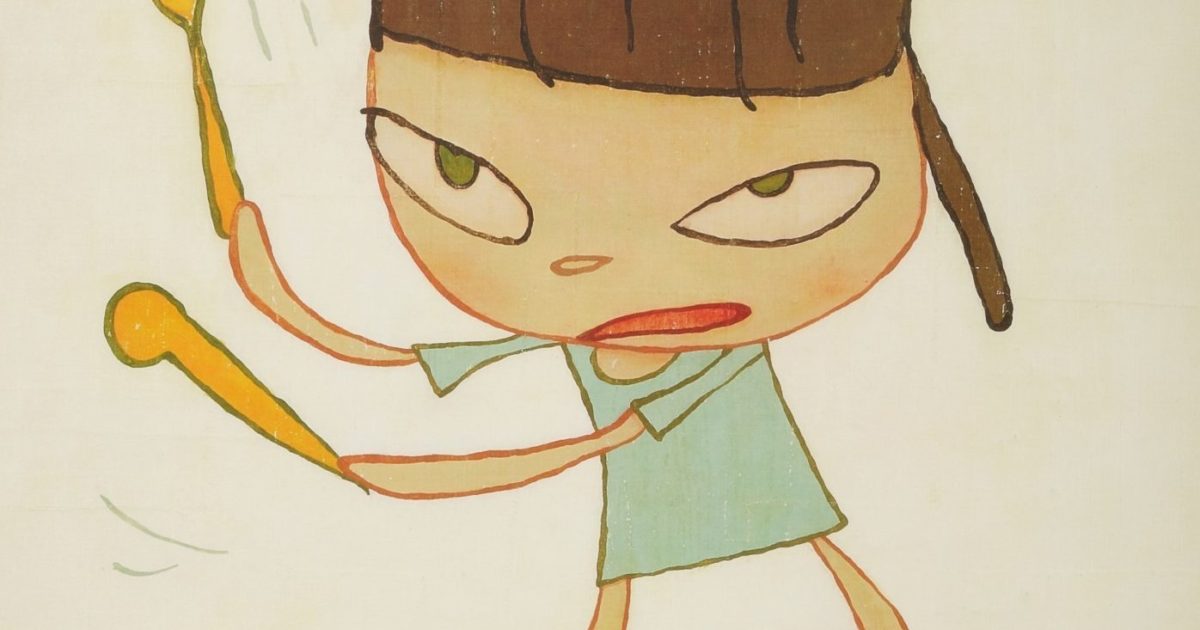
Nara is best known for his portraits of children with large heads, simplified features and disproportionately large eyes. These figures have become instantly recognisable, but their popularity can sometimes obscure their emotional complexity.
The eyes are central to their power.
Rather than passively receiving the viewer’s gaze, Nara’s subjects appear to return it. Some look suspicious. Others seem irritated, melancholy or quietly amused. Even the most vulnerable figures retain a sense of independence, as though they possess private thoughts that remain inaccessible to us.
The visual language may recall childhood, but the emotions are not exclusively childish. Alienation, frustration, anxiety, resistance and longing continue throughout adult life. Nara’s figures are compelling partly because they allow viewers to recognise these emotions without defining them too precisely.

Marching on a Butterburr Leaf (2019)
Their isolation also gives them a particular intensity. Nara frequently removes almost everything that could locate a figure within a conventional narrative. There may be no detailed room, landscape or supporting cast. The child occupies the image alone, leaving the viewer to interpret a gesture, expression or small symbolic object.
This simplicity is not emptiness. It creates concentration.
By removing unnecessary narrative detail, Nara focuses our attention on subtle emotional shifts. A slight change in the eyes or the angle of a mouth can transform the meaning of the entire image.
Innocence and Defiance
One of the defining qualities of Yoshitomo Nara’s art is its ability to hold apparently contradictory ideas together.
His children can be innocent and knowing, fragile and confrontational, lonely and self-sufficient. A young figure may hold a knife, cigarette, burning object or handwritten protest sign, yet the image rarely feels straightforwardly violent. Instead, these objects operate as signs of resistance, fantasy or internal conflict.
The scale of the child relative to the object often makes the implied threat seem deliberately unstable. The figure may be acting out a private rebellion rather than presenting a genuine danger. Nara understands the way children use imagination to create power within a world largely controlled by adults.

His work also captures the intensity with which children experience emotion. Anger, fear, attachment and exclusion can feel absolute before they become moderated by adult behaviour. Nara does not dismiss these feelings as immature. He presents them as psychologically real.
That emotional directness helps explain the broad appeal of his work. Different viewers encounter different versions of themselves within the same figure: the rebellious child, the isolated adolescent, the resistant outsider or the adult who has preserved some private independence.
Music as a Private Language
Music has been central to Nara’s life and creative practice since adolescence. He grew up listening to records and radio broadcasts, developing an attachment to folk, rock, blues, punk and new wave music. Album covers also provided an early visual education, connecting sound, typography, photography and graphic design. LACMA’s major retrospective of Nara’s work was organised through the lens of this lifelong relationship with music. (LACMA)
This influence can be seen in the mood of his work as much as in its explicit references.
Punk music, in particular, offered a language of individuality and resistance that closely parallels Nara’s imagery. His characters often appear uninterested in pleasing the viewer. They occupy their own emotional territory, displaying the same refusal of authority and conventional expectations found within underground music cultures.
Song titles and fragments of lyrics sometimes appear in Nara’s drawings. He has worked on found paper, envelopes, cardboard, notebooks and other everyday materials, creating images that feel closer to private notes, record sleeves or handmade flyers than formal academic studies. Pace Gallery has described these drawings as intimate reflections of the artist’s psychological landscape, populated by youthful figures, animals, lyrics and occasional expletives. (Pace Gallery)
Music also provides a connection between isolation and community. Listening is often a solitary act, yet music allows people to recognise shared emotions across distance, language and time. Nara’s art operates in a similar way. His figures may be alone, but they are rarely emotionally inaccessible.

Beyond Manga and Popular Culture
Nara’s work is frequently compared with manga and anime because of its simplified forms, enlarged eyes and connection to Japanese visual culture. While the comparison is understandable, it can become reductive.
The artist’s figures are shaped by a much wider range of sources. His portraits have been discussed in relation to European artists such as Amedeo Modigliani and Léonard Tsuguharu Foujita, whose elongated forms and distinctive faces helped transform portraiture during the twentieth century. LACMA has also emphasised the importance of modern art from both Europe and Japan within Nara’s practice. (LACMA)
Unlike characters designed to perform within an illustrated storyline, Nara’s subjects often resist narrative resolution. We are not told exactly who they are, where they have come from or what will happen next. They exist in a suspended psychological space.
This ambiguity distinguishes Nara’s work from purely graphic or commercial imagery. The figures are immediately legible but never fully explained. Their familiarity attracts us, while their emotional uncertainty holds our attention.
Drawings, Paintings and the Importance of Process
Although Nara’s imagery is widely reproduced, his paintings possess a physical and tonal subtlety that is difficult to convey through photographs.
Earlier works often feature flatter areas of colour and more visibly graphic outlines. In later paintings, faces may emerge from layers of translucent colour, producing softer transitions and greater emotional complexity. The eyes can appear illuminated from within, while the surrounding surface reveals evidence of revision, repainting and gradual adjustment.
His drawings operate differently.
Nara often draws quickly and directly on readily available materials. These works can feel impulsive and unfiltered, preserving passing thoughts, jokes, anxieties and emotional reactions. The informality of the surface is part of their meaning. A discarded envelope or piece of cardboard becomes the site of an image that feels private yet universal.
Nara has also produced sculptures in materials including wood, ceramic, bronze and fibre-reinforced plastic, as well as installations involving small houses and studio-like environments. (Yoshitomo Nara)
His sculptural figures bring the emotional world of the paintings into physical space. Seen in three dimensions, the oversized heads and small bodies can appear even more vulnerable, but their expressions retain the independence associated with his paintings and drawings.
The recurring dog is another important presence within Nara’s work. Often shown with a large head and lowered body, the animal can suggest loyalty, loneliness, patience or emotional retreat. Like the children, the dog is accessible without being simplistic. It appears familiar enough to invite affection but ambiguous enough to support multiple interpretations.

Yoshitomo Nara Prints and Editions
Alongside unique paintings and drawings, Yoshitomo Nara has produced prints, posters, multiples, sculptures, books and artist-designed objects.
These works have helped introduce his imagery to a wider international audience. They also demonstrate how effectively Nara’s visual language can move between different formats. A screenprint, lithograph or offset work can preserve the directness of his line and the intensity of his characters while introducing differences in scale, colour, paper and production.
For collectors, it is important to distinguish between signed limited editions, official multiples, exhibition posters, licensed products and authorised reproductions. These categories can vary significantly in rarity, value and collectability.
Why Yoshitomo Nara’s Work Resonates
Nara’s international popularity is sometimes attributed to the immediate recognisability of his characters. Yet recognisability alone does not explain the durability of his work.
His images endure because they remain emotionally open.
A Nara child can appear angry to one viewer and frightened to another. A figure that initially seems hostile may gradually appear guarded or vulnerable. The work changes according to the emotional experience brought to it.
This openness allows Nara’s art to travel across cultural boundaries without becoming emotionally neutral. The characters are distinctive, but they are not tied to a single nationality, story or identity. They represent states of feeling rather than fixed personalities.
Nara’s art also reflects a particularly modern tension between connection and isolation. His subjects often appear alone, yet they have reached millions of viewers. Their solitude has become collective. In a culture saturated with communication, performance and constant visibility, their refusal to explain themselves feels increasingly powerful.
They remind us that being alone is not the same as being passive, and vulnerability is not the opposite of strength.
A World of Quiet Resistance
Yoshitomo Nara has created one of the most distinctive visual languages in contemporary art. His children, animals and solitary figures are immediately accessible, but their emotional depth prevents them from becoming merely decorative or nostalgic.
Behind the enlarged eyes and simplified forms lies a sustained exploration of memory, identity, alienation, music, independence and the private emotional life of the individual.
Nara’s figures do not ask for our approval. They look back at us with suspicion, curiosity, sadness or defiance. They may be small, but they refuse to be powerless.
It is this combination of intimacy and resistance that gives Yoshitomo Nara’s work its enduring force—and continues to attract museums, institutions and collectors around the world.

Leave a comment
This site is protected by hCaptcha and the hCaptcha Privacy Policy and Terms of Service apply.