
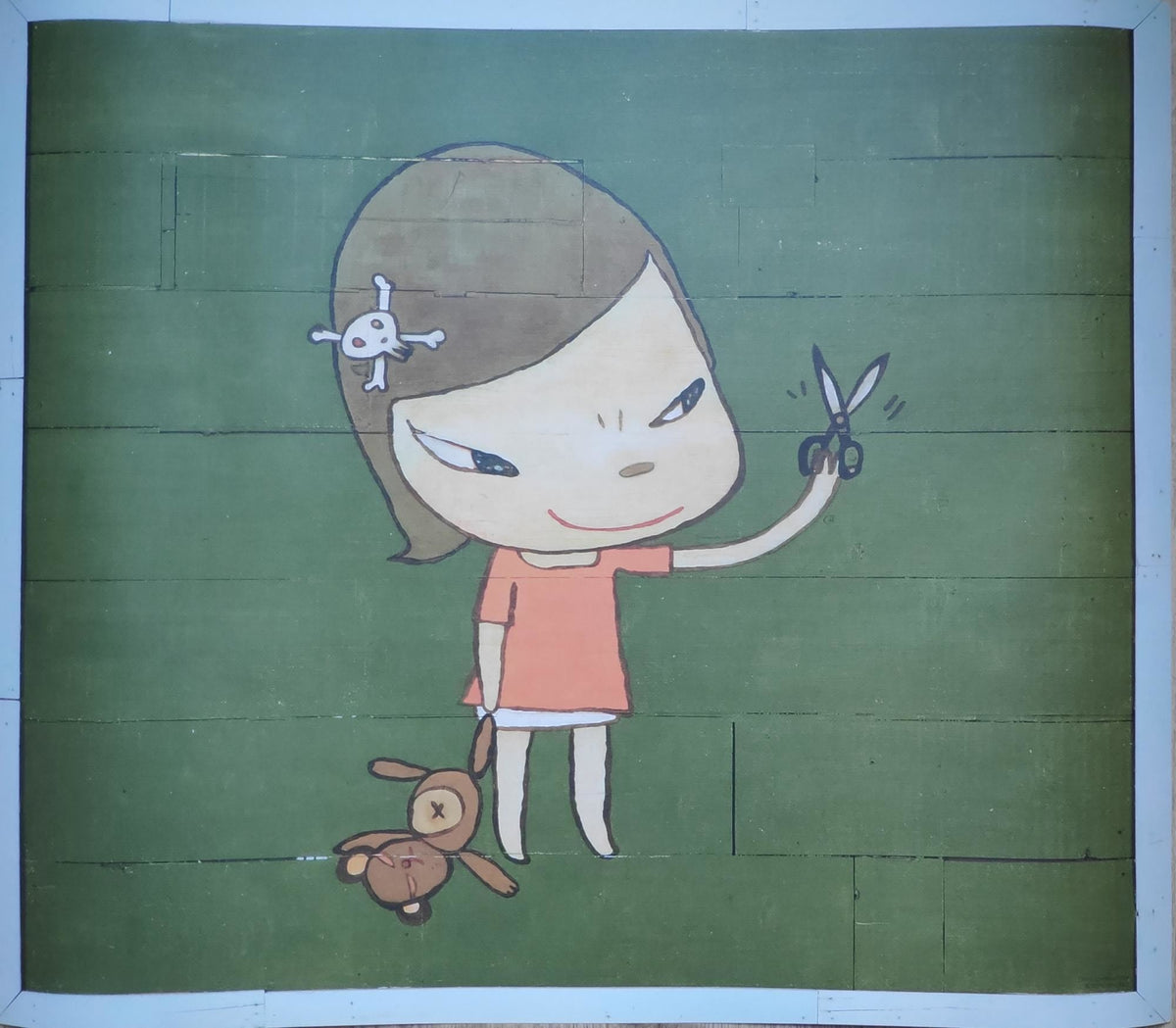
Yoshitomo Nara’s images are often remembered as faces, but they begin with line. A tilt of the head, the angle of an eyelid or the compressed shape of a mouth can change a figure from guarded to defiant, lonely to self-possessed. Nara’s drawing is economical without being simple: it removes distraction so that very small decisions carry unusual emotional weight.
This is why his figures resist a single reading. They may resemble children, yet they are not conventional portraits of childhood. Their scale, stillness and direct gaze give them an independence that feels closer to an inner state than a narrative scene. Drawing is the structure that makes that ambiguity possible.

Yoshitomo Nara, Real One, 2020.
Line as expression
Nara’s line rarely behaves like a neutral outline. It describes a body, but it also establishes temperament. A sharply raised brow can imply suspicion; a soft, rounded contour can make the same figure appear vulnerable. Because the compositions are usually stripped back, these changes are not secondary details. They are the event of the image.
The apparent directness is carefully controlled. Nara often sets a concentrated figure against open space, allowing posture and expression to dominate. The space is not empty in a decorative sense. It isolates the subject and slows the viewer down. We look more closely because there is nowhere else for the eye to go.
Why the figures remain ambiguous
Many of Nara’s subjects seem immediately legible: a solitary girl, a small animal, a figure holding an object or meeting the viewer’s gaze. Yet their emotional meaning remains unstable. A smile can appear knowing rather than cheerful. A frown may suggest resistance, concentration or self-protection. The same image can feel tender at one distance and confrontational at another.
That instability is central to Nara’s visual language. The figures do not illustrate a complete story for us. Instead, they hold back information. Their simplified settings and tightly edited gestures leave room for the viewer’s own memories and associations. This helps explain why the work can feel intimate without being sentimental.
From drawing to print
When Nara’s imagery moves into an edition, the character of the line remains decisive. Different printing methods create different surfaces, but the success of the image still depends on the balance between contour, colour and unprinted space. In a work such as Cosmic Girl, the figure’s presence is established through a combination of graphic clarity and controlled restraint. The image does not need a crowded setting to feel psychologically charged.
Print also changes how the viewer encounters scale. An image seen repeatedly online can become detached from its physical dimensions, margins and paper. In person, those elements affect the apparent intensity of the figure. A broad field around a small subject can make it feel more isolated; a closely cropped composition can make the same gaze feel immediate and insistent.
Faces, bodies and posture
Discussion of Nara often concentrates on the eyes, but the body matters just as much. A lowered arm, planted feet or a slight lean can suggest stubbornness, uncertainty or readiness. In Little Wanderer, the relation between the compact figure and the surrounding field contributes to the sense of independence implied by the title. The emotional effect comes from the whole construction, not from one facial feature.
The same is true of Nara’s animal figures. Dogs and other companions can appear loyal, displaced, watchful or quietly comic. Their outlines may be spare, but their posture gives them personality. This continuity between human and animal subjects is explored further in Yoshitomo Nara’s Dogs, Pups and Wanderers.
What to look for in an edition
When viewing a Nara print or edition in person, begin with the line itself. Look at its density, consistency and relationship to the paper or printed ground. Then consider the margins, colour balance and overall scale. These physical qualities determine whether the image feels delicate, graphic, intimate or monumental.
Exact identification is also important. Works that appear similar may differ in date, medium, dimensions, editioning or publication history. Collectors should establish the title, year, technique, size, edition details, signature or other markings, provenance and condition of the particular example being considered. The purpose is not to reduce the work to a checklist, but to understand the object accurately.
Drawing as a continuing language
Nara’s figures endure because their visual economy is matched by emotional complexity. The line looks immediate, but it is capable of withholding as much as it reveals. Repeated motifs do not simply reproduce a fixed character; changes in expression, scale, medium and spacing create new psychological conditions.
That is the real force of drawing within Nara’s practice. It is not merely a preparatory stage before painting, print or sculpture. It is a language through which attitude, solitude and resistance become visible. The fewer elements the image contains, the more intensely each one has to work.
Explore current Yoshitomo Nara prints, editions and objects available through Dovehouse Contemporary, including Real One, Cosmic Girl and Little Wanderer. For a broader introduction to editioned works, continue with Yoshitomo Nara in Print and our guide to collecting Nara prints and sculptural editions.
Read the pauses as carefully as the marks
A drawn line is only one part of a composition. The point at which it stops, the gap before another mark begins and the unoccupied area beside a figure all contribute to rhythm. In Nara's imagery, these pauses can make an expression feel held back rather than fully declared. The viewer senses that very little has been added unnecessarily, so a small interval acquires unusual weight.
One useful exercise is to follow the outer contour before looking inside the face. Notice where the outline becomes more angular, where it rounds out and how it returns towards the ground. Then bring the eyes and mouth back into the reading. The emotional effect may become more complex because the body and silhouette have already established a particular kind of presence.
Keep drawing and published objects distinct
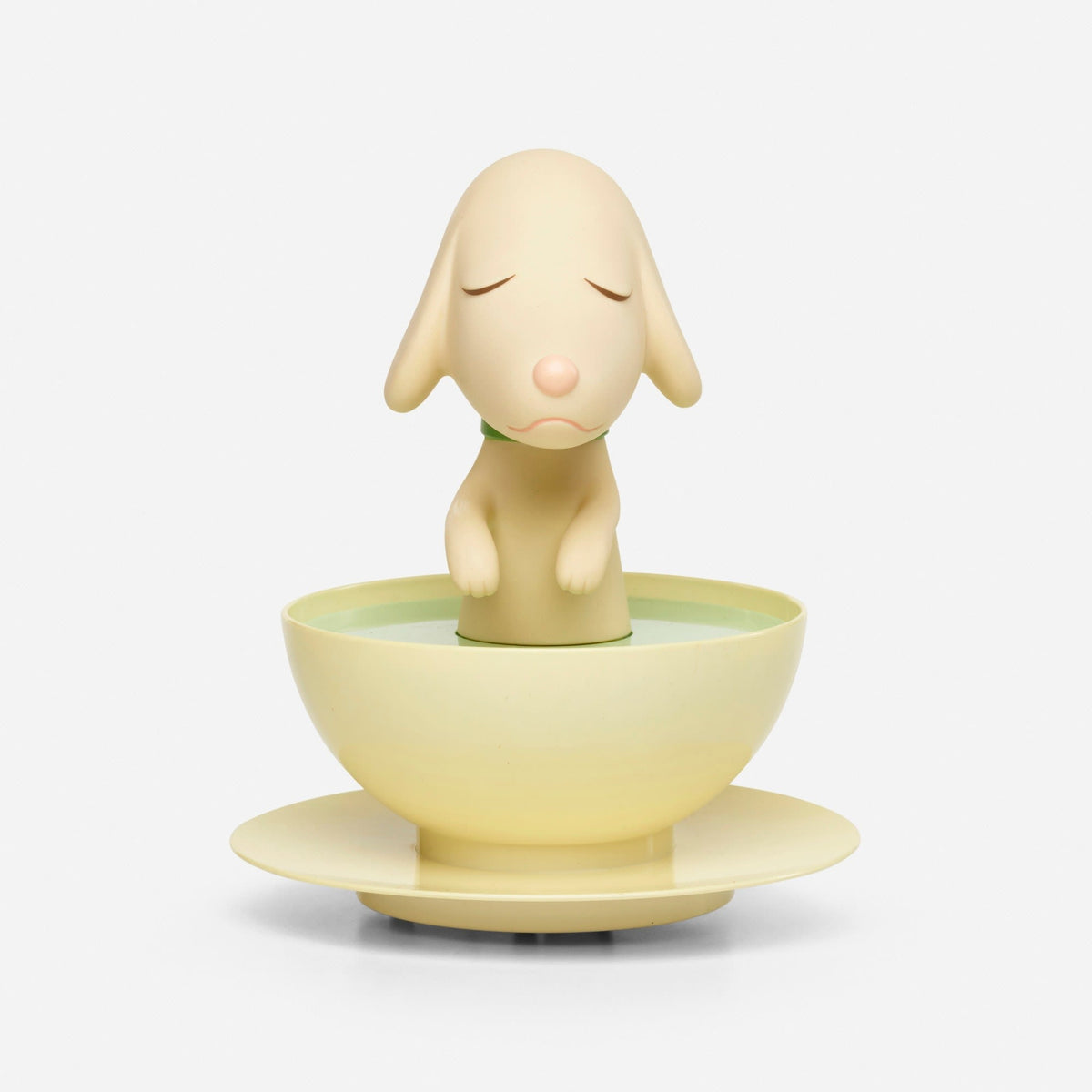
A drawing-like image does not make every object an original drawing. The gallery's Little Wanderer is a plastic multiple, while Cosmic Girl is catalogued as a pair of offset posters. These works help demonstrate how Nara's visual language moves across formats, but their physical categories remain different. Read the medium alongside the image so that an observation about line does not become an inaccurate statement about how the object was made.
This distinction strengthens the comparison. We can follow a recognisable contour through paper and three-dimensional form while asking what each medium changes: the role of empty space, the viewer's position and the relationship between a figure's surface and its apparent inner life.

Leave a comment
This site is protected by hCaptcha and the hCaptcha Privacy Policy and Terms of Service apply.