
What distinguishes an art multiple from a decorative object.
Publisher, material, date, edition status, markings, packaging and provenance establish the object’s category.

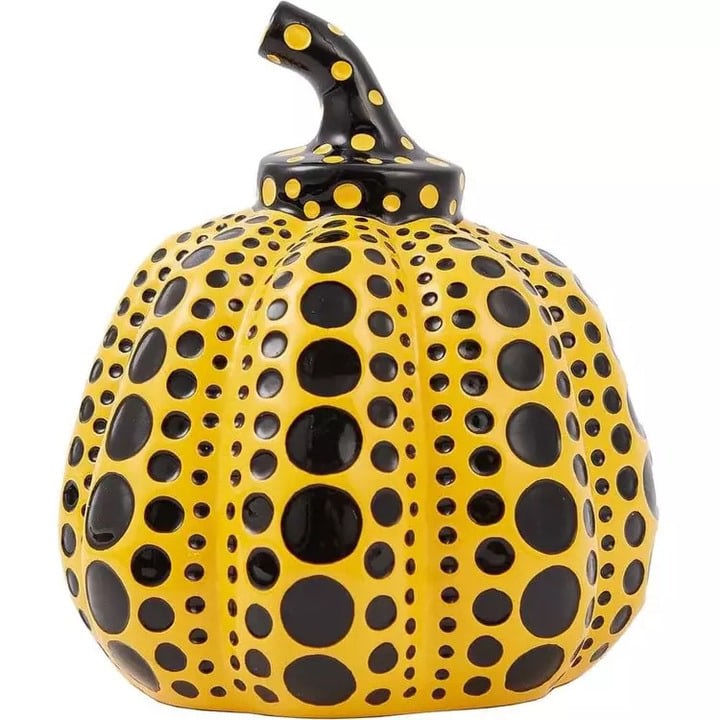
Selected work: Pumpkin Cast Resin Figure - Yellow.
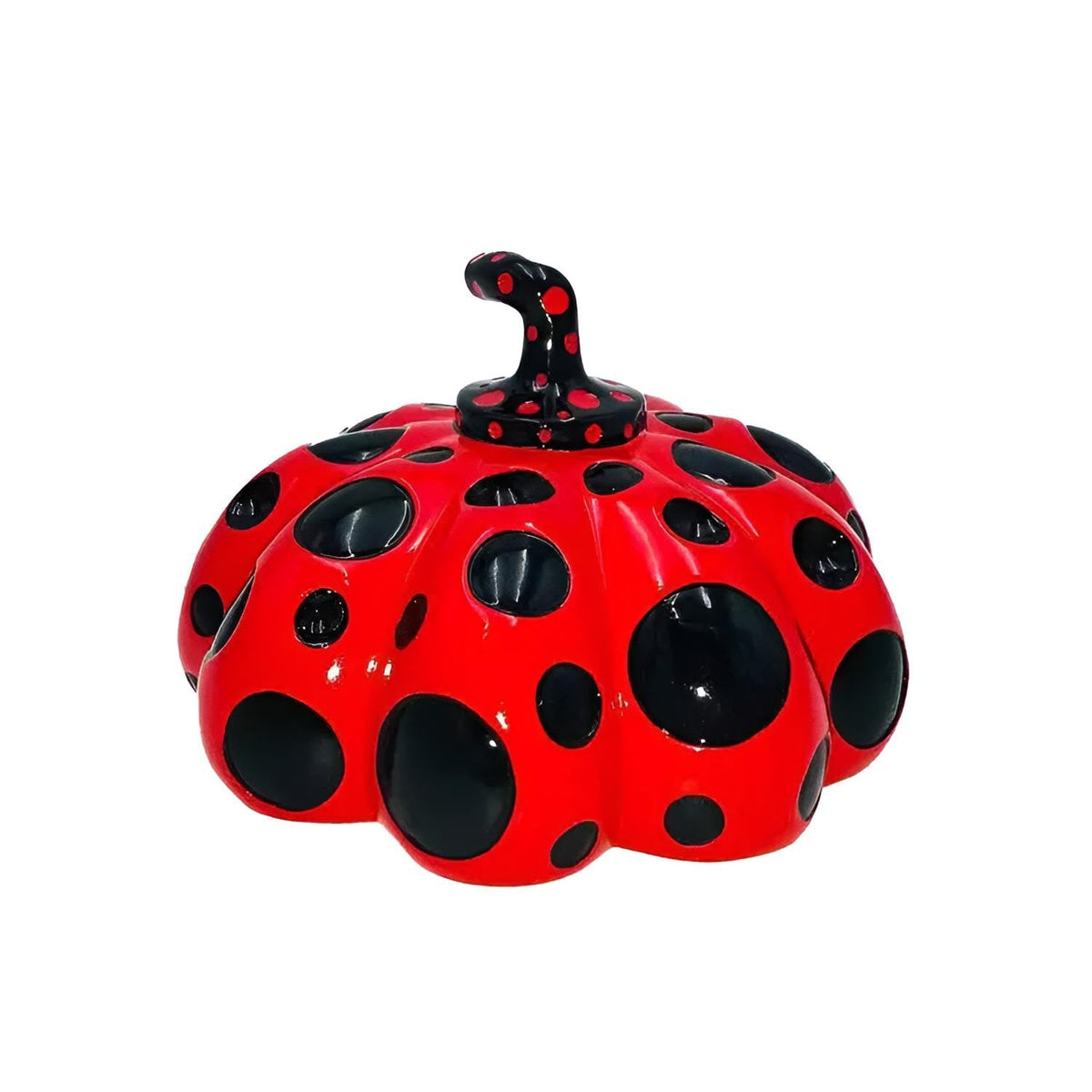
Current examples include Pumpkin Cast Resin Figure - Yellow, Pumpkin Cast Resin Figure - Red and I Want To Sing My Heart Out In Praise of Life. View the complete Yayoi Kusama collection for current availability.
Explore available works by Yayoi Kusama
From symbol to object
Kusama’s pumpkin combines an ordinary cultivated form with a highly controlled pattern. In three dimensions, dots wrap around ridges and disappear from view, so the motif changes as the object is turned. Humour and familiarity coexist with a more complex interest in repetition, bodily scale and the unstable boundary between object and surrounding space.
What to inspect
For sculptural multiples, establish material, dimensions, edition or production information, markings and provenance. Examine the surface for scratches, chips, fading, crazing, repairs or losses, and check joins and bases for stability. Original packaging can help with storage and transport but should not be treated as proof of authenticity or as a substitute for a condition report.
The object changes as you move
A pumpkin on paper presents a chosen view. A three-dimensional pumpkin allows the viewer to move around it, discovering how the pattern continues across ribs and around the stem. Some dots disappear behind the swelling form while others come into view. This ordinary act of walking or turning the object makes repetition temporal: the whole cannot be seen from a single position.
Light introduces another changing element. A glossy surface may reflect the room and create highlights that partly obscure the pattern. A softer finish may hold colour more evenly. These effects belong to the physical object, so the most useful photographs include several angles under consistent light. A dramatic studio image can show visual impact without explaining every part of the surface.
Read the actual material description
The gallery's red and yellow pumpkin figures are catalogued as lacquer-painted cast resin. This is a specific material and finish, not a generic synonym for bronze, ceramic or a unique sculpture. The yellow figure is recorded at 10.2 by 7.6 by 7.6 centimetres. The 2019 Naoshima red figure has different recorded dimensions. Their shared motif should not hide those physical distinctions.
The word multiple describes an object produced in more than one example, but it does not by itself establish the size or limits of production. Some objects are issued in a numbered edition; others are open editions or publications for which a total is not stated. If the catalogue does not document a finite number, a buyer should ask for clarification rather than infer rarity from an attractive presentation box.
Distinguish the artist's image from the object's status
An authorised product can offer a legitimate and enjoyable encounter with an artist's work. It should still be described according to the circumstances of its manufacture and release. A numbered sculptural edition, a museum-related object and a decorative product can share a design while having different collecting contexts. Accurate language helps buyers choose knowingly; it does not require dismissing one category because another is more expensive.
Ask who produced or published the object, when it was released, how it was marked and what documentation survives. If a signature appears, establish whether it is hand-applied, moulded, printed or otherwise reproduced. A reproduced signature may be entirely normal for that product. The issue is whether the description makes the distinction clear and whether the object agrees with the documented format.
Condition has more than one surface
The visible front is only part of a sculptural multiple. Inspect the base, underside, stem and recessed areas between ribs. Chips, abrasions and retouching may be easiest to see where light changes direction. Ask whether the object sits securely and whether any joins or repaired areas require special handling. If a report is based only on photographs, that limitation should be stated.
Original packaging can help identify a release and protect the object during storage, but the box has a separate condition history. A clean box does not prove an undamaged sculpture, and a worn box does not necessarily mean the object inside has suffered. Record both. Keep inserts, labels and accompanying paperwork together, particularly where they contain the publisher's information or handling instructions.
Display at the right viewing height
Small sculpture is easy to place where it becomes visually lost among unrelated objects. Consider whether the pumpkin is being viewed from above, at eye level or from across the room. Each position changes the visibility of the stem and the proportion of the body. Give it enough surrounding space for the silhouette to remain legible and for the pattern to be read without competing reflections.
A stable surface matters more than elaborate display furniture. Avoid positions where the object can be knocked by a door, sleeve or passing hand. Follow any supplied handling guidance and ask for advice before using cleaning products on a painted finish. Do not assume that a durable-looking material is resistant to abrasion, heat or prolonged strong light. Preventive care should suit the specific material and coating.
Compare sculpture with a print thoughtfully
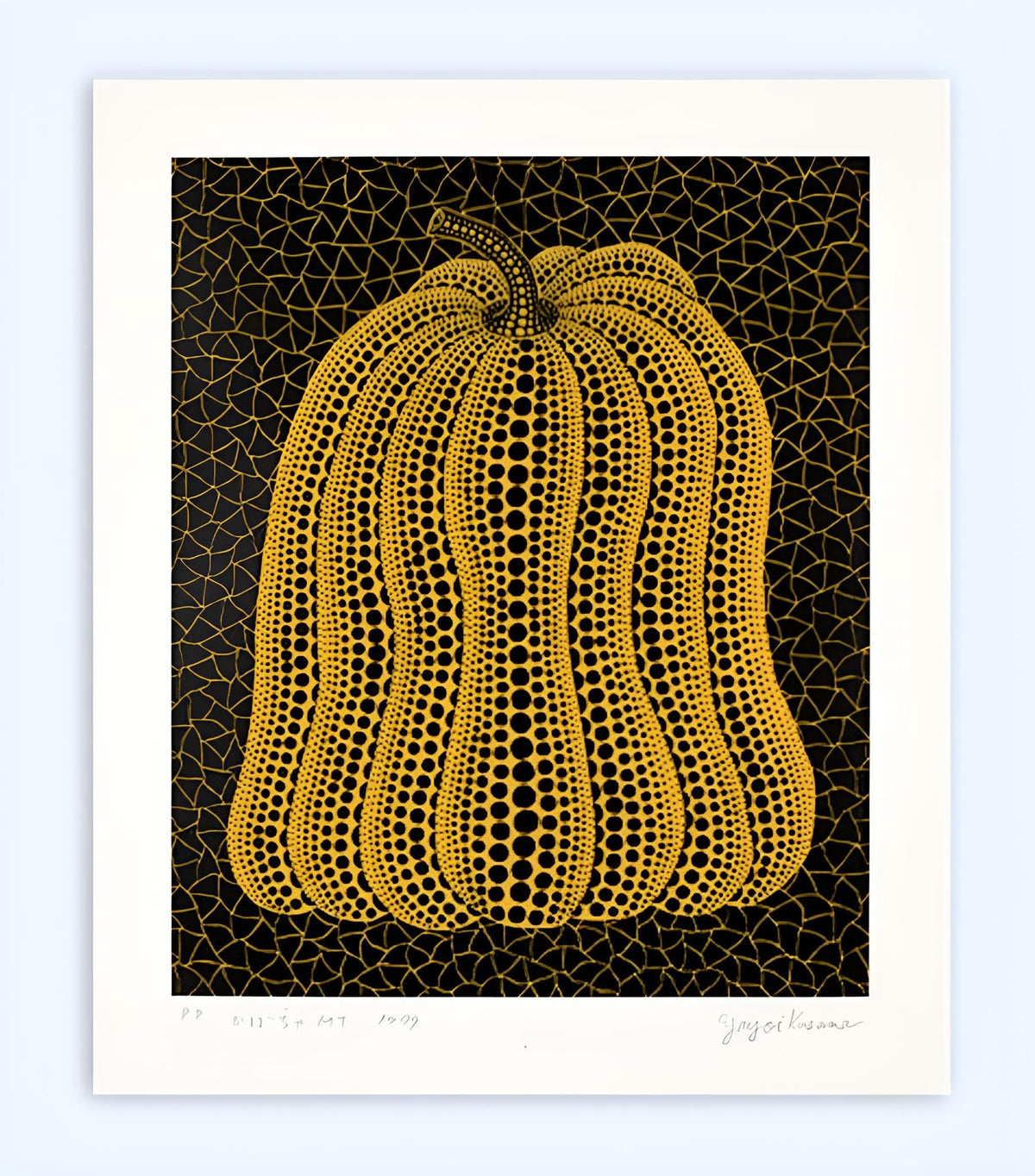
The Pumpkin MT screenprint provides a useful comparison because the same broad subject behaves differently on paper. A printed pumpkin organises pattern within a fixed view; the resin figure distributes it around a body. The comparison can sharpen attention to both works, but it should not turn one into a substitute for the other or imply that they share an edition history.
A collection may benefit from that difference. Works on paper and objects can establish a conversation about contour, repetition and scale while remaining distinct in their documentation and care requirements. Begin with the experience each one offers, then verify the catalogue information. This approach makes the familiar pumpkin a starting point for sustained looking rather than the end of the enquiry.
For a pair or set, confirm that the quoted price and dimensions refer to the complete group and that both objects are included in the condition assessment. Photograph them separately as well as together. Small differences in surface wear or packaging can matter even when the two colours form a visually unified display. Keep any identifying labels with the correct component during storage or transport.

Leave a comment
This site is protected by hCaptcha and the hCaptcha Privacy Policy and Terms of Service apply.