
What animal figures reveal about companionship and solitude.
These figures suggest loyalty, waiting, vulnerability and independence without resolving into simple narratives.

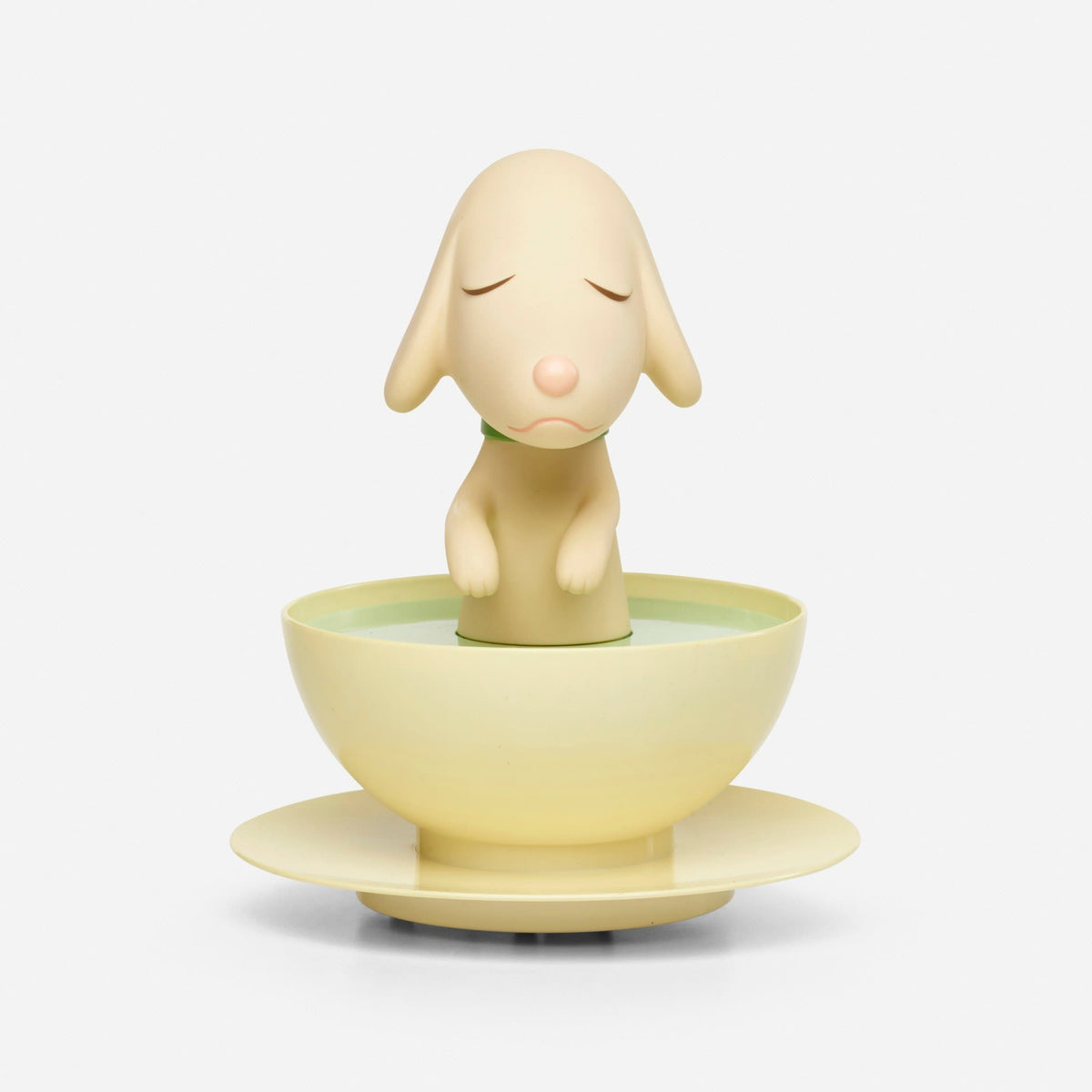
Selected work: Pup Cup.
Current examples include Real One, Sprout in the hand mirror and Untitled (Schrödinger). View the complete Yoshitomo Nara collection for current availability.
Explore available works by Yoshitomo Nara
Companions and alter egos
Nara’s dogs can appear loyal, melancholy, comic or solitary. Their low bodies and oversized heads invite affection, yet their independence resists a purely sentimental reading. Like the children in his work, they often seem to inhabit a private world. The animal becomes a companion figure and, at times, an alter ego through which ideas of belonging, travel and emotional distance can be explored.
Scale changes the encounter
A small printed dog may feel intimate, like an image kept close; a sculptural version occupies the viewer’s space and asks to be walked around. When collecting, consider how medium and size affect the character rather than treating every appearance of the motif as equivalent. For objects, examine stability, surface and fabrication; for works on paper, check colour, margins, edition and condition.
An animal can hold a feeling without explaining it
Nara's animal figures offer a different kind of encounter from a directly confrontational human face. Their posture may suggest waiting, affection or quiet independence, but the surrounding story is often withheld. We are not necessarily shown an owner, a home or a destination. The animal becomes a concentrated presence around which the viewer supplies associations without being able to settle them completely.
This is one reason it is useful to resist immediately calling every dog sad or loyal. Those are possible responses, but the visible evidence is more specific: the angle of the head, the placement of the feet, the direction of the gaze and the relation between body and ground. Describing those features leaves room for the image's ambiguity rather than replacing it with a familiar story about pets.
The body establishes a pace
A compact body and an enlarged head can make a figure feel grounded and top-heavy at once. A low stance may suggest patience, while the direction of the neck creates a sense of attention extending beyond the body. The animal can seem still without becoming inert. Its pose implies the possibility of movement or response, even when nothing in the image actually changes.
Compare the silhouette before looking at the eyes. Is the body compressed into a single mass, or do legs and neck open spaces around it? Does the outline lead smoothly from one part to another, or pause at an abrupt change of direction? These formal differences help explain why two apparently similar figures can have different temperaments. The character is built through the whole body, not attached afterwards by a facial expression.
Companionship can include distance
A companion is someone or something with whom we share space, but sharing space does not guarantee complete understanding. Nara's figures can feel close while retaining a private world. That combination gives them an emotional complexity beyond straightforward cuteness. The viewer may feel invited to care for the figure without being granted the authority to explain everything about it.
This relationship also connects the animals with the solitary human characters. Both can seem vulnerable and self-possessed. Both may occupy a sparse setting that leaves their circumstances unresolved. The resemblance is not necessarily a literal narrative in which a particular child owns a particular dog. It is a shared way of organising presence, attention and emotional distance.
Pup Cup as a physical object
The selected Pup Cup is catalogued as a 2003 plastic multiple, 22.4 centimetres high, with an edition size recorded as unknown. That final detail should remain explicit: an unknown total is not the same as a documented limited edition. The work can be appreciated for its form and character without inventing a numerical scarcity that the catalogue does not establish.
As an object, it asks to be viewed from more than one angle. Photographs should show its profile, rear and underside as well as the most expressive front view. The relation between the figure's upper and lower parts, the stability of the base and the condition of the surface all contribute to the encounter. A familiar online image cannot communicate all those qualities by itself.
Wandering as a different kind of independence
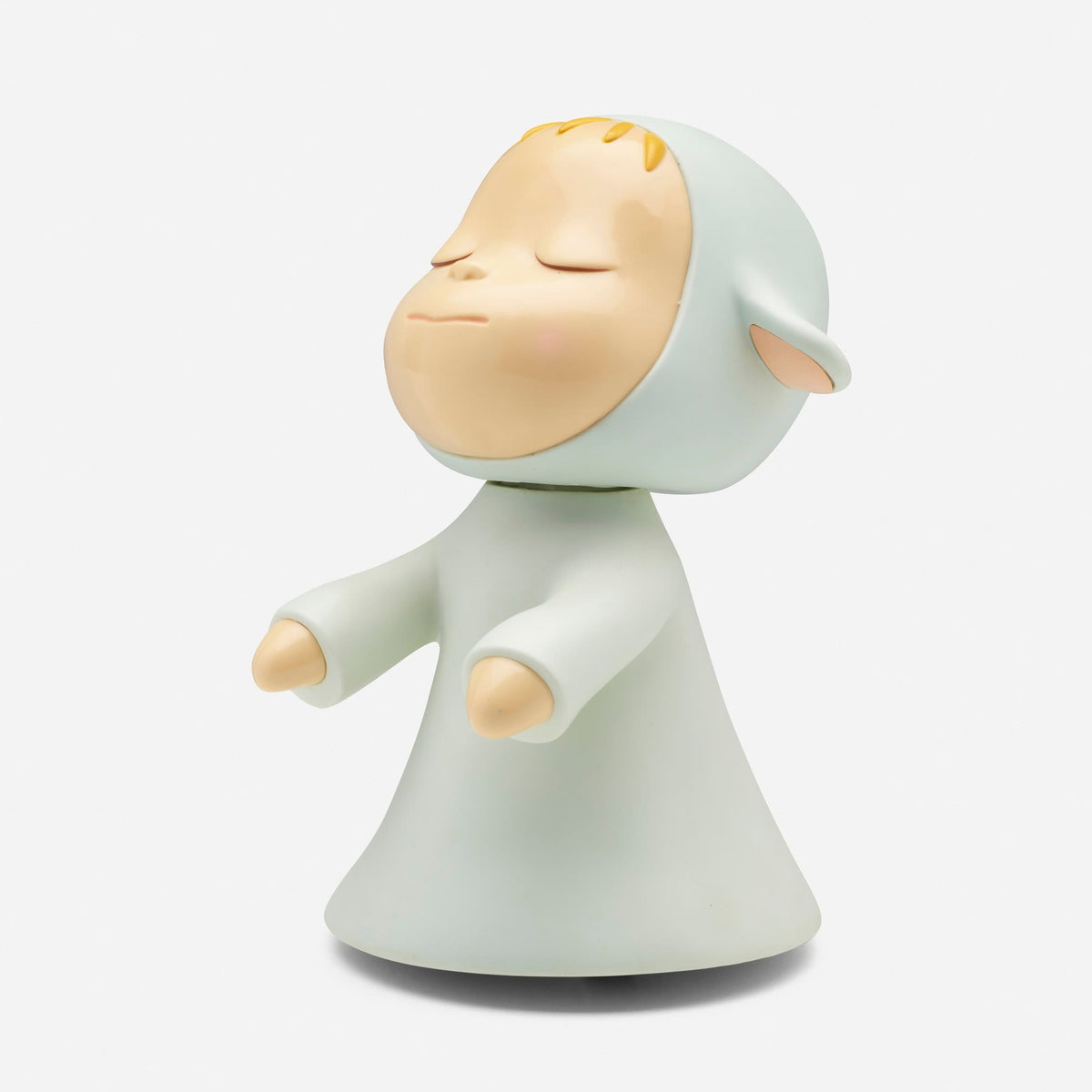
Little Wanderer belongs to the wider conversation about compact figures moving through or occupying space. Dovehouse records it as a 2003 plastic object from an open edition, with a stamped signature underneath and original presentation packaging. These details distinguish its publication from a signed work on paper or a numbered sculptural edition. The shared artist does not erase those differences.
The idea of wandering suggests movement without a fully supplied destination. A figure can seem self-directed even when its form is small and vulnerable. Placing that idea beside the patient presence of a dog creates a useful comparison: waiting and travelling can both express a relationship to belonging. The viewer does not have to decide that one is secure and the other lost.
Scale changes the terms of affection
A small object invites proximity. We can imagine holding it or placing it within a domestic setting, and that bodily relation may intensify affection. A larger sculpture can reverse the relationship, making the viewer feel small beside a familiar-looking figure. In works on paper, the surrounding field and the scale of the image establish another balance between intimacy and distance.
When choosing an object, consider how it will be seen rather than only whether it fits a shelf. Eye level, nearby objects and the amount of empty space around it affect its presence. Give the silhouette room to register. The figure's quietness may be lost if it is crowded into a group where colour and detail compete for every glance.
Nara's animals and wanderers reward attention because they remain independent of the feelings we project onto them. They can invite tenderness without becoming merely comforting, and suggest solitude without supplying a tragedy. That emotional openness is sustained by precise decisions about contour, posture and scale. Looking closely at those decisions makes the work more particular than a recognisable mascot or a general symbol of childhood.

Leave a comment
This site is protected by hCaptcha and the hCaptcha Privacy Policy and Terms of Service apply.